
Disclaimer: This has been reported after the availability of the order of the Court and not on media reports so as to give an accurate report to our readers.
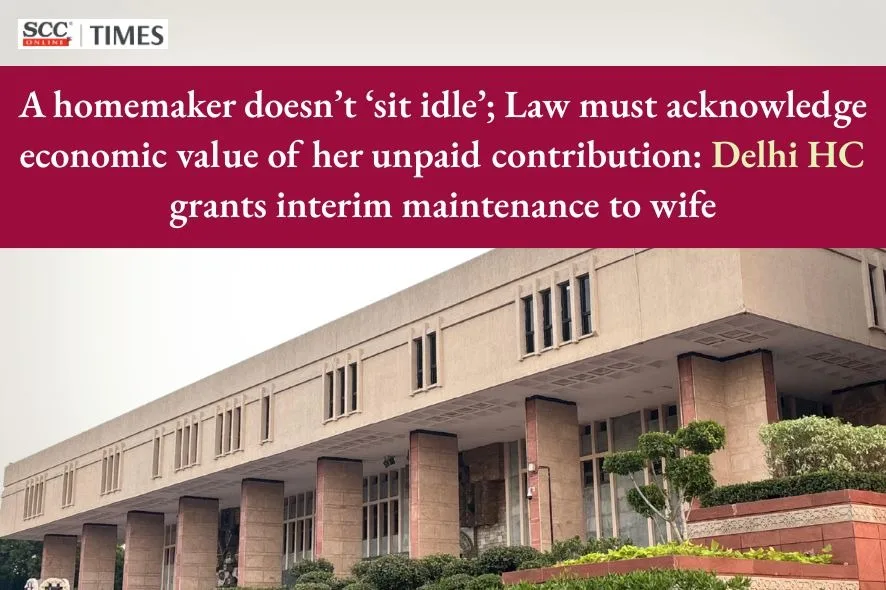
Delhi High Court: In revision petitions arising out of matrimonial discord between the parties and relating to the grant, denial and quantum of interim maintenance to the wife and the minor child under the Protection of Women from Domestic Violence Act, 2005 (DV Act) and Section 125, Criminal Procedure Code, 1973 (CrPC), the Single Judge Bench of Swarana Kanta Sharma, J.*, set aside the Magistrate’s and appellate court’s orders denying interim maintenance to the wife and upheld the Family Court’s order granting ₹50,000/- per month to the wife, and ₹40,000/- per month to the child as balanced and reasonable.
“The law… has to step in to ensure that the spouse who invested in the family is not pushed into financial hardship merely because the marriage has come to an end.”
Factual Matrix
In the instant matter, the parties were married in June 2012 and solemnised their marriage again according to Hindu rites in February 2013. They lived together at Durgapur, later shifted to Kuwait upon the husband securing employment with Kuwait Oil Company, and adopted a male child in 2015. The parties returned to India in February 2020, but the husband left for Kuwait in August 2020, allegedly deserting the wife and the child.
The wife initiated proceedings under Section 125 CrPC claiming ₹2.5 lakhs per month and under Section 12, DV Act seeking various reliefs including maintenance.
-
Proceedings under DV Act
The Metropolitan Magistrate awarded ₹10,000/- per month for the child (apart from school expenses) but declined maintenance to the wife, holding that the wife was well-educated, able-bodied and had concealed material facts regarding income and assets.
The appellate court enhanced the child’s maintenance to ₹50,000/- (later ₹60,000) but again denied maintenance to the wife on the ground of incomplete bank statements and alleged income from Lakme.
The Family Court observed that “merely on the basis of the photograph as makeup artist it cannot be said that she is able to maintain herself.” It further held that even if she had pursued the make-up artist course, she was “at very initial stage of her profession” and her assessed income, if any, would be between ₹20,000—₹30,000 per month—far less than that of the husband. The Family Court granted ₹50,000/- per month to the wife, and ₹40,000 per month to the child.
The husband challenged the impugned order of family court in revision.
Moot Points
-
Whether the wife had any independent source of income and, if so, whether she was entitled to the grant of maintenance?
-
Whether the income of the husband had been correctly assessed and appropriately apportioned between the wife and the minor child for the purpose of maintenance?
Court’s Analysis
Wife’s Independent Income
The Court noted that the Magistrate had denied interim maintenance to the wife on multiple grounds, including bank account statements reflecting frequent transactions involving large sums of money. The Court found that the Magistrate had treated transfers made by the husband for monthly expenses as the wife’s income, which was “wholly misplaced”. The Court held that both the Magistrate and the appellate court misdirected themselves.
On the alleged loans of ₹19—20 lakhs, the Court stated that in Indian social context, a daughter who has been deserted by her husband returns to her parental home and financial assistance is extended to her, such support is often extended “out of familial responsibility and support, and not after assessing the daughter’s capacity to repay.” Thus, the Court held that the mere fact that the wife claimed to financial assistance/loan from parents or relatives during distress cannot be construed as evidence of her financial independence or earning capacity nor can it be treated as a false or misleading disclosure.
The Court reiterated the settled distinction between “capacity to earn” and “actual earning” and asserted that mere educational qualification or theoretical employability cannot disentitle a wife from maintenance absent proof of actual income sufficient to sustain her.
The Court held that there was no material showing any present or past income of the wife and that the husband’s own earlier monthly transfers established her dependence. Thus, she was entitled to interim maintenance.
Marital Expectations and Social Context in Indian Households
The Court further discussed in detail about the “Marital Expectations and Social Context in Indian Households” and noted that women often discontinue employment due to marital expectations, relocation, or childcare responsibilities. It was emphasised that re-entry into the workforce after a long break is “not effortless” due to technological change, age barriers and loss of professional continuity. It was held that a husband who expected or permitted his wife to give up employment cannot later shift the burden by arguing that she should now independently sustain herself.
“A woman who has stepped away from her profession due to marriage or family responsibilities cannot be expected to resume employment at the same level, salary, or professional standing merely because the marriage has broken down between the parties after several years.”
The Myth of the “Idle” Wife
The Court stated that the description of a non-earning wife as “idle” reflects a misunderstanding of domestic contribution, which forms the “invisible structure on which many families function.” It was stated that describing non-employment as idleness is easy but recognising the labour involved in sustaining a household is far more difficult. These responsibilities do not appear in bank statements or generate taxable income, yet they form the invisible structure on which many families function.
“A homemaker does not ‘sit idle’; she performs labour that enables the earning spouse to function effectively… The law must recognise not only financial earnings but also the economic value of the contribution of the wife within the home.”
Assessment of Husband’s Income
The Court noted that the husband, a drilling engineer in Kuwait, was earning between ₹4—5.29 lakhs per month and had substantial savings, fixed deposits exceeding ₹1 crore and other financial investments.
The Court rejected the argument that voluntary EMIs and personal financial commitments could reduce maintenance liability. Relying on X14 v. Y2, 2025 SCC OnLine Del 4088, it was observed that only statutory deductions can be excluded while computing income and EMIs, personal loans and voluntary financial commitments cannot dilute the obligation to maintain wife and child. Moreover, the cost of living in the foreign country can be a factor while deciding maintenance, but it cannot be used to defeat the maintenance claim.
“Voluntary financial commitments, including repayment of housing loans or personal loans undertaken by the earning spouse at his own discretion, cannot be permitted to dilute or defeat the statutory obligation to maintain a dependent spouse and minor child.”
The Court described maintenance not merely as a measure against destitution but as a device to ensure economic parity and dignity between spouses after marital breakdown. The Court found that the Family Court’s grant of ₹50,000 to the wife and ₹40,000 to the child reflected a “balanced approach.”
“When a marital relationship breaks down, the law must ensure that the spouse who invested time, effort, and years into building the family is not left economically stranded… Award of maintenance to the spouse seeks to correct that imbalance by recognising the contribution made within the family, even though it may not have been in the form of a salary”.
Mediation, not Litigation
The Court noted that maintenance litigation often becomes excessively adversarial, with wives overstating expenses and husbands understating income, and emphasised that mediation offers a more constructive path for resolving such disputes, particularly where minor children are involved.
“Mediation, rather than continued litigation, offers a more constructive path forward in matrimonial disputes. Mediation, undoubtedly, provides a better space for meaningful dialogue, realistic assessment of needs and capacities of both the husband and the wife, and mutually acceptable solutions.”
Court’s Decision
The Court set aside the findings of the Magistrate and appellate court denying maintenance to the wife and upheld the Family Court’s order granting ₹50,000/- per month to the wife, and ₹40,000/- per month to the child as balanced and reasonable.
To ensure uniformity, avoid overlapping of maintenance orders, and to harmonise the relief granted under the DV Act and Section 125 CrPC, the Court held that interim maintenance of ₹50,000/- per month to the wife and ₹40,000/- per month to the minor child shall be payable under both proceedings. The enhancement of child maintenance to ₹60,000 by the appellate court was reduced to ₹40,000.
The Court directed the maintenance was to be paid from the date of the respective applications, with adjustment/set-off for amounts paid in parallel proceedings as per Rajnesh v. Neha, (2021) 2 SCC 324. Further, arrears were directed to be cleared within six months.
[Rakesh Ray v. Priti Ray, 2026 SCC OnLine Del 757, decided on 16-2-2026]
*Judgment by Justice Swarana Kanta Sharma
Advocates who appeared in this case:
Mr. Deepak Tyagi and Mr. Ishaan Seth, Counsel for the Petitioner
Mr. Atul Chaubey and Mr. Chandan Sharma, Counsel for the Respondent
Buy Code of Criminal Procedure, 1973 HERE