
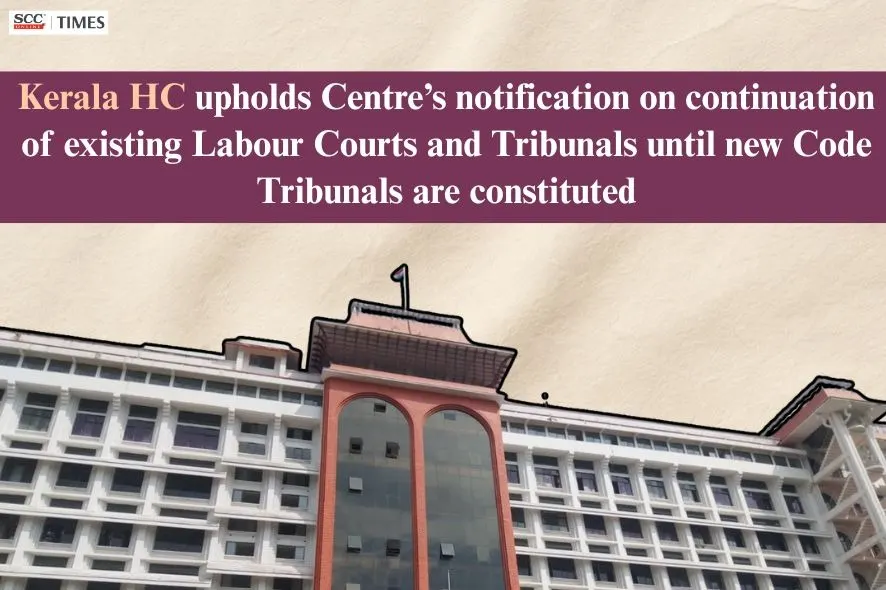
Kerala High Court: In a writ petition challenging Centre’s notifications directing that the existing Labour Courts, Industrial Tribunals and National Tribunals under the Industrial Disputes Act, 1947 (ID Act) will continue adjudicating existing as well as new matters till Tribunals under the Industrial Relations Code, 2020 (IR Code) are constituted, a Single Judge Bench of Gopinath P., J., held that no ground for interference with the notification was made out and dismissed the writ petition. The Court upheld the continuation of existing Labour Courts and Tribunals, concluding that the notifications operated within the scope of Section 103 of the IR Code, and thus, were not ultra vires.
Background:
The petitioners filed a writ petition seeking a writ of certiorari to quash a Notification dated 8-12-2025 issued by the Ministry of Labour and Employment under Section 103 of the IR Code, providing that the existing Labour Courts, Industrial Tribunal and National Tribunals constituted under the ID Act shall continue to adjudicate existing as well as new cases arising under the Trade Unions Act, 1926 (1926 Act), the Industrial Employment (Standing Orders) Act, 1946 (1946 Act), the ID Act, and the IR Code, till the constitution of Tribunals under the new Code. The petitioners alleged that the notification was ultra vires the IR Code.
The petitioners contended that Section 103(1) of the IR Code permitted only orders not inconsistent with the IR Code and the notification ran counter to Section 44(7) of the IR Code, which specified that a certain category of disputes shall be adjudicated by a Bench consisting of a Judicial Member and an Administrative Member, whereas existing forums under the ID Act consisted of only one Presiding Officer. It was submitted that Section 51(1) of the IR Code mandated transfer of all pending cases to the newly formed Tribunals, and that permitting adjudication by existing Courts or Tribunals was against the scheme of the IR Code. It was further argued that permitting adjudication of disputes by the existing Labour Courts or Tribunals would amount to sidestepping the provisions of the IR Code and would defeat the purposes of the legislation.
On the other hand, the respondents submitted that the writ petition was not maintainable and questioned the locus standi of the petitioners. Referring to Sections 47, 51, 103, and 104 of the IR Code, it was contended that the failure to notify continuation of jurisdiction of the existing Courts or Tribunals would result in a stalemate, and that transfer of cases under Section 51 of the IR Code could only be made after the new forums were constituted consistent with the IR Code and the directions of the Supreme Court regarding appointment of Tribunal members. It was alleged that abruptly stopping presently functioning adjudicatory Forums would not be in public interest.
Analysis and Decision
The Court noted that while, on 21 November 2025, the Central Government notified the commencement of the IR Code without specifying the repeal dates for the 1926 Act, the 1946 Act, and the ID Act, a subsequent Notification dated 2 February 2026, specified that the provisions of the said enactments stood repealed with effect from 21 November 2025, i.e., the date on which the IR Code came into force.
The Court referred to Section 103 of the IR Code which empowered the Central Government to issue orders or make provisions not inconsistent with the provisions of the Code for removing any difficulties in giving effect to the provisions of the IR Code. The Court observed that the Notifications dated 8 December 2025 and 2 February 2026, which enabled all statutory authorities under the aforesaid enactments to function, were not ultra vires the IR Code.
The Court relied on State of W.B. v. Anindya Sundar Das, (2022) 16 SCC 318, wherein it was held that under the guise of exercising the power to remove difficulties, the Government cannot sidestep statutory provisions or remove all obstacles arising from statutory restrictions. However, the Court opined that permitting existing adjudicatory mechanisms and statutory authorities to continue till new mechanisms are put in place cannot be said to be sidestepping the provisions of the IR Code or removing obstacles to get over statutory restrictions. The Court observed that holding that adjudicatory bodies under repealed enactments continue to have jurisdiction in respect of pending proceedings presents no difficulty.
The Court referred to Gammon India Ltd. v. Union of India, (1974) 1 SCC 596, and Bengal Iron Corpn. v. CTO, 1994 Supp (1) SCC 310, which elaborate on the scope of a “removal of difficulties clause” and reiterate the necessity of such a clause when a new law is enacted. The Court additionally noted that Division Benches of the Madras High Court and Delhi High Court have taken cognizance of the subsequent notifications and determined that there was no ground for interference.
The Court acknowledged that Section 103 of the IR Code incorporates inherent safeguards. The authority is subject to a three-year limitation to issue an order under this provision and every order “made under this section shall be laid before each House of Parliament”. The Court referred to G.P. Singh, Principles of Statutory Interpretation (13th Ed., 2012, p. 1053) where it was observed that:
“The object of any requirement of laying provided in enabling Acts is to subject the subordinate law-making authority to the vigilance and control of the Legislature.”
Consequently, the Court dismissed the writ petition observing that no ground for interference with the notification was made out.
[M.K. Suresh Kumar v. Union of India, 2026 SCC OnLine Ker 2389, decided on 17-2-2026]
Advocates who appeared in this case :
For the Petitioners: Anand B. Menon, Vijayakumar K., A. Abdul Nabeel, Advocates.
For the Respondents: Vishnu J., CGC, Liju. V. Stephen, Indu Susan Jacob, Jiji Joy, Sanjay Johnson Mathew, Preethi Ramakrishnan (P-212), Pratap Abraham Varghese, Manojkumar G., Ashok Menon, Advocates.