
Disclaimer: This has been reported after the availability of the order of the Court and not on media reports, so as to give an accurate report to our readers.
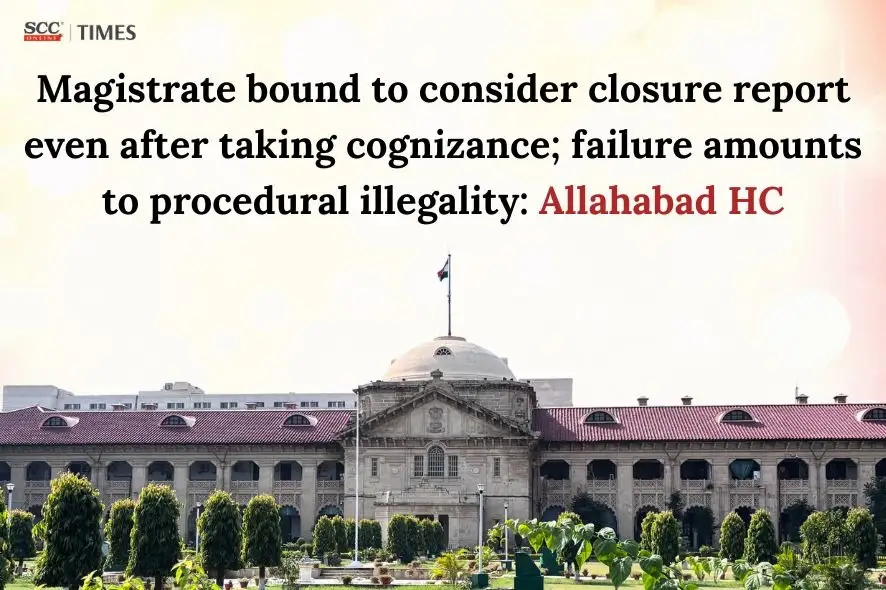
Allahabad High Court: The issue that arose for consideration in the present case was, what should a Magistrate do when, after taking cognizance on the basis of an initial charge sheet, the police later submit a “Final Report” (negative report) following further investigation under Section 173(8) of the Criminal Procedure Code, 1973 (‘CrPC’). The Single Judge Bench of Anil Kumar, J., stated that if a Magistrate has taken cognizance of an offence and, thereafter, the Investigating Officer submits a Final Report/Closure report stating that no case is made out, the Magistrate cannot ignore that report. The Magistrate is legally bound to consider the Final Report and accordingly, may accept it, reject it, or take cognizance despite it but, he must apply his judicial mind to the report. If the Magistrate proceeds without considering the Final Report at all, such inaction amounts to a procedural illegality.
Background
An FIR was lodged against the appellants under Sections 147, 452, 323, 504, 506 Penal Code, 1860 and Section 3(1)(d) of the Scheduled Castes & Scheduled Tribes (Prevention of Atrocities) Act, 1989. After investigation, the Investigating Officer submitted a charge sheet on 15-09-2023, upon which cognizance was taken by the trial court on 21-12-2023. Subsequently, during further investigation under Section 173(8) of CrPC, the Investigating Officer submitted a supplementary report on 31-03-2024, concluding that the allegations against the appellants were false. Despite this, the trial court proceeded to frame charges on 07-08-2025 without passing any order on the final report.
Aggrieved by this order, the appellants challenged the legality of framing charges without consideration of the supplementary closure report.
Analysis
At the outset, the Court examined Section 173 of CrPC (now Section 193 BNSS). Section 173(8) of CrPC permits further investigation even after submission of a police report. The initial report is called ‘primary report’, and the latter report is classified as ‘supplementary report’. The Court relied on Vinay Tyagi v. Irshad Ali, (2013) 5 SCC 762 (“Vinay Tyagi case”) and reiterated that a supplementary report is a continuation of the primary report.
The Court analyses that it is likely that a dilemma arises in situations where a Magistrate has already taken cognizance based on an earlier “primary report” disclosing the commission of an offence, but the investigating officer thereafter submits a supplementary report in the form of a closure report, commonly termed a “Type B report”. This dilemma arises for two reasons. First, once a court has passed an order, it cannot review its own order. Second, there is a perception that once a magistrate has passed an order, then he is not required to pass any order upon any further supplementary report.
The Court stated that both logics are against the canon of law. The act of taking cognizance of an offense is not finalised by the submission of an initial report and the investigating officer’s duty continues beyond the primary report. In such a situation, the obligation of the Magistrate persists until the police submits their final and conclusive report. Therefore, the Magistrate is duty-bound to exercise “judicial mind” and consider all police reports submitted during the investigation of a case.
Addressing the dilemmas arising from the situation concerned, the Court clarified that Section 362 of CrPC, which prohibits review of a signed judgment or final order, and that an order taking cognizance does not amount to disposal of the case. Therefore, passing a fresh order upon consideration of subsequent material does not amount to review. The Court reasoned that said Section restricts the power of review in criminal matters as per the principles of Functus Officio, that is, once a court signs its judgment, its authority over that specific matter ends. However, the role of a Magistrate is different. Since different facts may arise at different stages, and naturally, he will have to pass orders independently applying his judicial mind, Section 362 of CrPC does not restrain the magistrate from passing fresh orders on emergent facts under Section 173(8) of CrPC.
Thus, the Court stated that content of the report submitted under Section 173 of CrPC will not change the nature of the report and Magistrate is bound to pass order upon it.
The Court further relied on Vinay Tyagi case (supra) and held that:
“A supplementary report under Section 173 CrPC must be treated as an integral part of the primary (initial) report. Before reaching any conclusion, the court must evaluate the cumulative effect of all reports submitted under this section, reading them conjointly (together as a whole) and will apply its mind to the reports to determine if there are sufficient grounds to presume that the accused has committed the offence. The proposition laid down by the Supreme Court will apply equally at the time when a Magistrate is confronted with more than one police reports and has to pass an order.”
The Court also relied on Ram Lal Narang v. State, (1979) 2 SCC 322, wherein the Supreme Court held that further investigation may result in new material either implicating or exonerating persons, and it is for the Magistrate to decide the future course depending upon the stage of proceedings. Further, in Dharmatma Singh v. Harminder Singh, (2011) 6 SCC 102, the Supreme Court held that where conflicting police reports are submitted, it is for the Magistrate to form an independent opinion based on the material contained in both reports.
Therefore, the Court stated that if a Magistrate has taken cognizance of an offence and, thereafter, the Investigating Officer submits a Final Report (closure report) stating that no case is made out, the Magistrate cannot ignore that report. The Magistrate is legally bound to consider the Final Report and accordingly, may accept it, reject it, or take cognizance despite it but, he must apply his judicial mind to the report. If the Magistrate proceeds without considering the Final Report at all, such inaction amounts to a procedural illegality.
Accordingly, the Court concluded that a supplementary report under Section 173(2) CrPC is not different from the initial report (primary report). When supplementary police reports are filed, a Magistrate must treat such supplementary reports as an integral part of the primary report and read them conjointly before reaching any conclusion. A Magistrate/Court is bound to apply their mind independently, without being influenced by their earlier order. Lastly, if upon such application of mind, the Magistrate concludes contrary to their previous order, such a decision would not amount to a review or recall of their earlier order.
Applying these principles to the facts of the case, the Court directed the trial court to consider the final report and initial report conjointly and decide if a prima facie case is made out against the appellants. Therefore, the appeal was allowed.
[Sonu v. State of U.P., 2026 SCC OnLine All 318, decided on 13-02-2026]
Advocates who appeared in this case :
For the petitioner: D.K. Tripathi, Advocate
For the respondents: Amrit Raj, AGA for the State; Manoj Kumar Srivastava, Advocate