
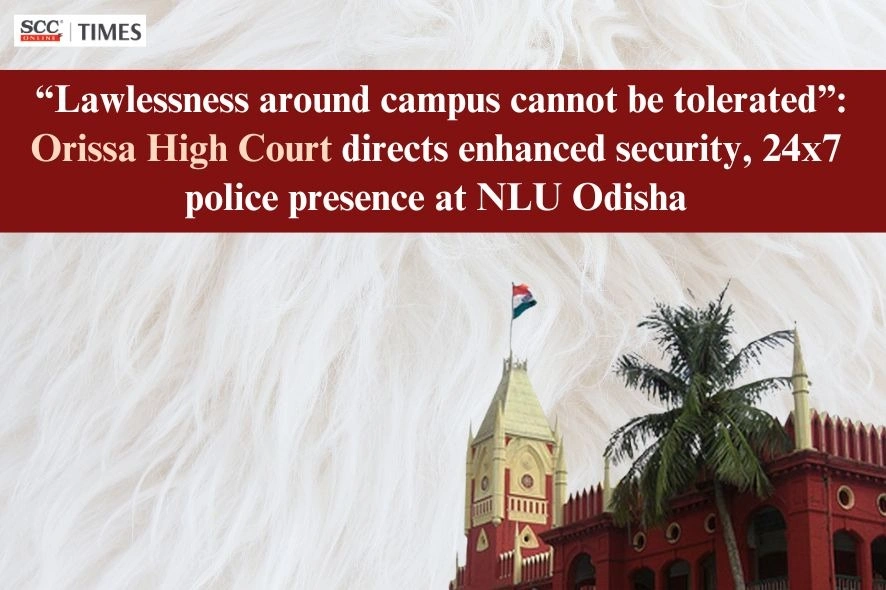
Orissa High Court: While allowing a petition under 482 of the Criminal Procedure Code, 1973 (‘CrPC’), a Single Judge Bench of Sanjeeb K Panigrahi, J., observed that continuation of criminal proceedings, arising from a complaint by a student of National Law University Odisha (‘NLU Odisha’), would amount to an abuse of process after the parties reached an amicable settlement.
In the case where the NLU Odisha student had alleged intimidation, abuse, and an attempt to abduct him while returning from Naraj Dam to the campus, the Court held that since the complainant had unequivocally expressed unwillingness to prosecute further, the proceedings deserved to be quashed, while also issuing directions to ensure safety, discipline, and maintenance of a secure academic atmosphere in and around the NLU Odisha campus.
Background:
The matter arose from a petition under Section 482 CrPC seeking quashment of criminal proceedings initiated on the basis of a complaint lodged by a student.
The complainant alleged that while returning from Naraj Dam to the NLU Odisha campus, he and his friend were forcibly compelled to sit inside a vehicle, where the accused persons interrogated them about consumption of alcohol and psychotropic substances, detained the complainant, directed his friend to call a female acquaintance, abused them in obscene language, made sexually offensive remarks, and attempted to abduct the complainant. Acting on these allegations, the police registered a case and prosecution followed.
During the pendency of the proceedings, however, the matter was amicably settled with the intervention of well-wishers. Considering the complainant’s academic career, both sides executed a joint affidavit affirming the settlement. In the affidavit, the complainant categorically stated that he did not wish to pursue the matter further, subject to assurance that no harm would be caused to him in the future.
The petitioners therefore sought quashment of the proceedings on the ground of compromise.
Analysis and Decision:
The Court considered the joint affidavit filed by the petitioners and the complainant, and having regard to the principles enunciated by the Supreme Court in Gian Singh v. State of Punjab, (2012) 10 SCC 303, as well as the decisions of this Court in Lokanath v. State of Orissa and Sansuri v. State of Orissa, the Court was of the considered opinion that continuation of the criminal proceeding would serve no fruitful purpose.
The Court observed that the dispute in question having been amicably settled between the parties, and the de facto complainant having unequivocally expressed his unwillingness to prosecute the matter any further, the likelihood of securing a conviction is rendered remote and bleak. In such circumstances, the Court held that continuation of the criminal proceeding would not subserve the ends of justice but would instead amount to an abuse of the process of Court.
In view of the aforesaid discussion and guided by the principles governing the exercise of inherent jurisdiction under Section 482 CrPC to secure the ends of justice and prevent abuse of process, the Court deemed it appropriate to interdict the prosecution. Consequently, the application stood allowed and the criminal proceedings were quashed.
Before parting, the Court observed with concern that recurring incidents, particularly involving allegations of intimidation, misconduct, or unlawful interference with students, cast an unwarranted shadow over an institution of national importance entrusted with imparting legal education and upholding constitutional values. The Court highlighted that institutions of higher learning must remain spaces of safety, dignity, and intellectual freedom, and any trend of lawlessness, vigilantism, or disorder in and around the campus environment not only jeopardises students’ welfare but also undermines the institutional ethos.
The Court expected the NLU Odisha administration and local law enforcement agencies to remain vigilant and adopt preventive measures to ensure that incidents of intimidation or misconduct do not recur, and that the campus atmosphere remains secure and conducive to academic pursuits. To this end, the Court directed the NLU Odisha to strengthen security through deployment of personnel, installation of CCTV cameras, illumination of vulnerable areas, and regular liaison with police authorities. It was further ordered the establishment of a Police Outpost at Naraj and a Beat House within the campus with 24×7 police presence, along with strict enforcement against the supply of alcohol, narcotics, and other intoxicants to students.
The Court also emphasised the need for regulatory measures such as entry-point checks, hostel inspections, disciplinary action against students found consuming prohibited substances, and informing parents or guardians in such cases. Additional directions included arranging safe transportation, conducting awareness programmes, and maintaining a grievance redressal mechanism to address harassment or misconduct. Stressing that these directions must be implemented in letter and spirit, the Court underscored their importance in preserving safety, discipline, and academic decorum within the campus.
Accordingly, the interim order, if any, passed earlier stood vacated.
[Roshan Kumar Pradhan v. State of Orissa, 2026 SCC OnLine Ori 613, decided on 12-02-2026]
Advocates who appeared in this case:
For the Petitioner: Soubhagya Swain, Adv.
For the Opposite Party: Sonak Mishra, ASC, Sarita Moharana, ASC