Disclaimer: This has been reported after the availability of the order of the Court and not on media reports so as to give an accurate report to our readers.
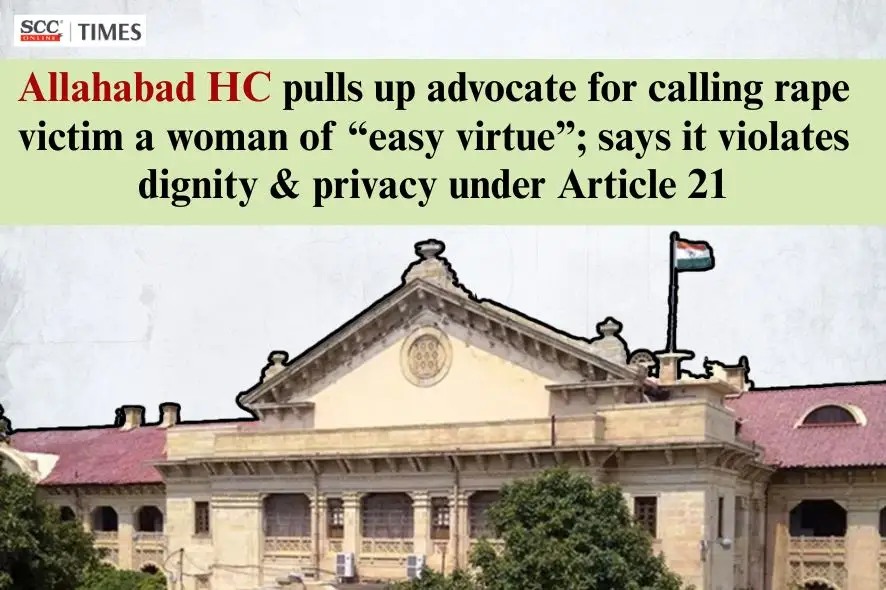
Allahabad High Court: In a significant ruling condemning rape victim character assassination in court proceedings, the Single Judge Bench of Anil Kumar-X, J., held that labelling a survivor as a woman of “easy virtue” amounts to a direct attack on her dignity and privacy under Article 21 of the Constitution. The Court came down heavily on the defence counsel for relying on scandalous and extraneous material to malign the prosecutrix’s moral character, stressing that such attempts are expressly barred under Section 53A and the proviso to Section 146 of the Evidence Act and are wholly inconsistent with standards of ethical advocacy.
The Court noted that evidently, the victim’s statements were consistent from the very inception and her allegations stood duly corroborated by her statements recorded under Sections 161 and 164 of the Criminal Procedure Code, 1973 (“CrPC”).
Background of the case
The victim, a married woman with two children, lodged an FIR against the accused, alleging that she had gone to his clinic for treatment. On the pretext of administering treatment, the accused made her consume a sedative pill, as a result of which she became unconscious, and he raped her. Upon regaining consciousness, she found her clothes to be unsettled and later became pregnant due to the alleged rape.
After investigation, a charge-sheet was submitted against the accused for the offences under Section 376 of the Penal Code, 1860 (“IPC”) and Section 3(2)(v) of the Scheduled Castes and Scheduled Tribes (Prevention of Atrocities) Act, 1989 (“SC ST Act”). Thereafter, the Trial Court issued the impugned order taking cognizance of the case.
Aggrieved, the accused filed the present appeal against the order and the charge sheet.
The accused’s counsel contended that the victim was a “woman of easy virtue” who would blackmail people to extort money. The accused also placed reliance on an affidavit dated 22-04-2022 filed by the victim, wherein she stated that she exaggerated the incident in the FIR due to being upset with the accused for refusing her treatment. She also allegedly stated that she may be prosecuted if she were to make such complaints in the future.
Analysis
At the outset, the Court remarked that during the course of arguments, the Court repeatedly requested the accused’s counsel to confine his submissions to the material available in the case diary, as affidavits relied upon by him were admittedly not part of the investigation record. Despite repeated attempts to restrain him from indulging in unnecessarily lengthy arguments, he insisted on advancing submissions based on extraneous material, stating that he would argue the matter at length and, if necessary, challenge the order before the Supreme Court.
The Court added that the jurisdiction of the Court at this stage was limited to examining whether the charge-sheet and cognizance order suffer from legal infirmity, and not to undertake a roving enquiry based on unverified affidavits or disputed questions of fact. However, the accused’s counsel persisted in advancing arguments dehors the settled legal position. Considering the repeated insistence of the counsel, the Court remarked that it was compelled to address the submissions raised, though such an exercise is ordinarily unnecessary and legally unwarranted at this stage.
“Such conduct is clearly improper and contrary to established norms of advocacy.”
On the merits, the Court stated that the affidavits relied upon by the accused’s counsel could not be considered, as they did not form part of the case diary. Additionally, the affidavit allegedly filed by the victim, prima facie, appeared to be prepared under the influence and could not be relied upon at this stage. The Court remarked that it was unusual that a person would voluntarily make a declaration in an affidavit that he should be prosecuted for filing false complaints.
The Court further stated that the language used therein, attacking the character and dignity of the victim, was wholly unacceptable. “It is not expected from a member of the Bar to place reliance on such material.”
The Court added that any attempt to portray a woman as being of “easy virtue” or to cast aspersions on her moral character was wholly irrelevant and is expressly barred under Section 53A and the proviso to Section 146 of the Evidence Act, 1872.
“These allegations amount to character assassination. Such allegations violate the woman’s right to dignity and privacy under Article 21 of the Constitution of India, and constitute an abuse of the process of law.”
The Court further reiterated that a woman’s past conduct or character cannot be used to discredit her or defeat her legal rights. Thus, the Court held that the impugned statements deserved to be expunged and ignored for all purposes.
On the plea of alibi, the Court noted that though the accused submitted his attendance sheet to establish his presence at his job, he also argued that the victim was motivated to lodge this FIR because the accused refused to deliver her abortion pills. Thus, the Court held that the plea was unsupported by any evidence collected during the investigation and, therefore, could not be considered. Additionally, the Court noted that the victim’s statements under Sections 161 and 164 of the CrPC consistently supported the prosecution’s case.
Regarding the contention that the Court had relied upon the contended affidavits in earlier proceedings, the Court held that such contention was factually incorrect, as the perusal of the orders passed in Criminal Misc. Writ Petition No. 7787 of 2022 and Criminal Appeal No. 7295 of 2023 demonstrated that no reliance was placed on the affidavits and no findings were recorded therein. The affidavits were merely referred to for the limited purpose of verification.
Thus, the Court held that evidently, the victim’s statements were consistent from the very inception, and her allegations stood duly corroborated by her statements recorded under Sections 161 and 164 of the CrPC. There was nothing on record at this stage to discredit or disbelieve her version.
As regards the delay in lodging the FIR, the Court reiterated that, particularly in cases of sexual offences, such delay cannot be evaluated at the stage of taking cognisance and is a matter to be examined during trial.
Before parting with the matter, the Court deprecated the conduct of the accused’s counsel, who adopted an improper and impermissible practice of annexing and relying upon affidavits containing scandalous allegations questioning the character and dignity of a woman.
“Such pleadings are wholly unbecoming of an advocate and strike at the very foundation of ethical advocacy.”
Furthermore, the Court remarked that the counsel’s attempt to browbeat the Court by openly stating that its order would be challenged before the Supreme Court, as well as making incorrect and misleading statements regarding earlier orders passed by the Court, reflected a serious lapse in professional conduct. Thus, the Court warned the counsel to exercise due care and restraint in the manner of making submissions before the Court.
Accordingly, the appeal was dismissed.
[Bechan Prasad v. State of U.P., 2026 SCC OnLine All 238, decided on 29-01-2026]
Advocates who appeared in this case:
For the appellant: Avinash Chandra Srivastava, Sanjay Kumar Mishra
For the respondent: Government Advocate and State Law Officer Subham Tandon
Buy Code of Criminal Procedure, 1973 HERE

Buy Penal Code, 1860 HERE
Buy Constitution of India HERE