
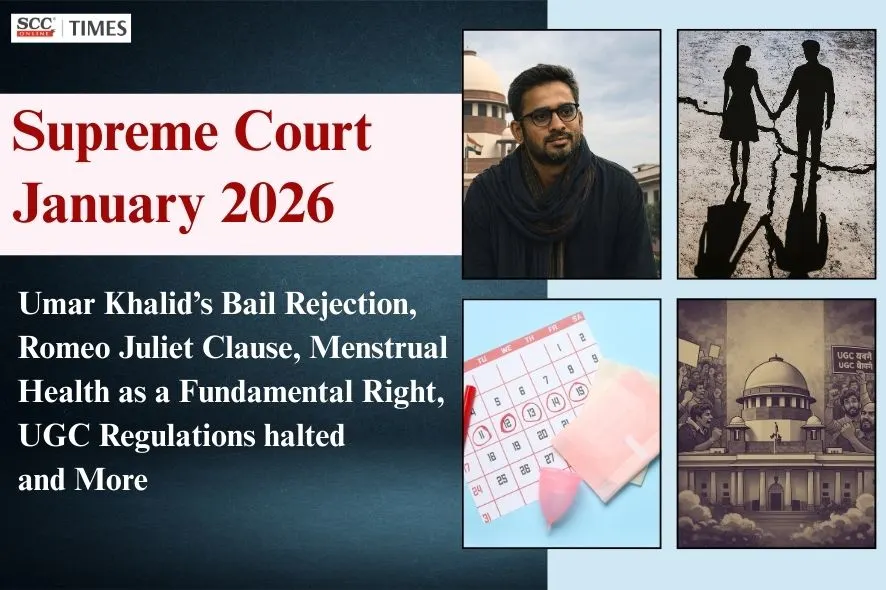
Supreme Court in January 2026 took a proactive approach around several issues-whether holding Menstrual Health a part of Article 21 of the Constitution or putting a stay on much talked about UGC Regulations. The Court also used its judicial wisdom to balance the right to personal liberty with security and integrity of the nation in its verdict on Umar Khalid’s bail. Furthermore, the Court displayed sensitivity to the existence of young adolescent love and flagged oft misuse of POCSO Act.
Besides providing an overview of the important cases, and key updates that made headlines this month, this Round-up also highlights a “Know Thy Judge” feature, as well as appointments and transfers by the Supreme Court.
Do not miss out on the latest Supreme Court Judgments published in SCC Weekly!
Supreme Court in January 2026
Top Stories of January 2026
2020 Delhi Riots | No Bail for Umar Khalid and Sharjeel Imam; 5 Accused get bail
While considering the bail pleas of Sharjeel Imam, Umar Khalid, Shifa Ur Rehman, Mohd. Saleem Khan, Meeran Haider, Shadab Ahmed and Gulfisha Fatima who were booked under several provisions of Penal Code, 1860, Unlawful Activities (Prevention) Act, 1967 (UAPA), Arms Act and Prevention of Damage to Public Property Act, 1984, for their alleged involvement in 2020 Delhi NCR communal riots and larger conspiracy; the Division Bench of Aravind Kumar* and N.V. Anjaria, JJ., refused to grant bail to Sharjeel Imam and Umar Khalid, expressing satisfaction that the prosecution material prima facie discloses attribution of a central and formative role by the 2 accused persons. Vis-a-vis Shifa Ur Rehman, Mohd. Saleem Khan, Meeran Haider, Shadab Ahmed and Gulfisha Fatima, the Court decided to grant them conditional bail having regard to the role attributed, the nature of the material relied upon, and the present stage of the proceedings. [Gulfisha Fatima v. State (NCT of Delhi), 2026 SCC OnLine SC 10]
While considering this appeal concerning nature of the legal duty cast on the police to draw up a medical report determining the age of a victim while investigating POCSO Act offences, the Division Bench of Sanjay Karol* and N. Kotiswar Singh, JJ., held that determination of age of the victim is a matter of trial and not at the stage of bail. Furthermore, taking note that repeated judicial notice has been taken of the misuse of POCSO Act the Court directed that a copy of the judgment be circulated to the Secretary, Law, Government of India, to consider initiation of steps as may be possible to curb this menace inter alia, the introduction of a Romeo — Juliet clause exempting genuine adolescent relationships from the stronghold of this law; enacting a mechanism enabling the prosecution of those persons who, by the use of these laws seeks to settle scores etc. [State of U.P. v. Anurudh, 2026 SCC OnLine SC 40]
While considering this writ petition seeking appropriate directions for providing free sanitary pads to every schoolgirl and separate toilets for females in all government aided and residential schools and other consequential reliefs, the Division Bench of J.B. Pardiwala and R. Mahadevan, JJ.*, held that the right to education is a ‘multiplier right’ as it enables exercise of other human rights. Right to education forms part of the broader framework of the right to life and human dignity, which cannot be realized without access to education. The Court further concluded that inaccessibility of menstrual hygiene management measures undermine the dignity of a girl child and that the right to life under Article 21 of the Constitution includes the right to menstrual health. [Dr. Jaya Thakur v. Government of India1]
Supreme Court Halts UGC 2026 Regulations; Revives 2012 Regulation pending Judicial Review
In a writ petition challenging the constitutional validity of the University Grants Commission (Promotion of Equity in Higher Education Institutions) Regulations, 2026 (“2026 UGC Regulations”) a Division Bench of Surya Kant, CJ., and Joymalya Bagchi, J., expressed the prima facie concern regarding the definitional scope of “caste-based discrimination” and the possibility of their misuse cannot and referred the matter to 3-Judges Bench with direction to keep the 2026 UGC Regulations in abeyance. The principal challenge was directed against Clause 3(c) defining “caste-based discrimination”. The petitioners contended that the definition is “restrictive and exclusionary in its formulation” as it renders persons belonging to non-reserved or general categories “completely remediless under the statutory framework”, even if subjected to caste-based discrimination or institutional bias. The petitioners further argued that the Regulations proceed on an “unfounded presumption that caste-based discrimination is necessarily unidirectional”. [Mritunjay Tiwari v. Union of India2]
Article 142- Complete Justice
Article 142 to the Rescue: SC allows Widow to Settle Loan & Secure Release of Mortgaged Property
In an appeal arising out from the orders of the Madras High Court rejecting the appellant’s request to avail the benefit of an expired One Time Settlement (OTS) scheme and for release of the title deeds of her residential property mortgaged with the respondent Bank, a Division Bench of Surya Kant, CJI. and Joymalya Bagchi, J., granted equitable relief under Article 142 of the Constitution and permitted the appellant widow to settle the loan by payment of ₹33 lakhs and directing release of the mortgaged property upon compliance. In the instant matter, the appellant’s husband was the proprietor of a concern known as FILSA Leathers and had availed credit facilities to the tune of ₹50 lakhs from the respondent Bank. A residential house measuring 3240 sq. ft. was mortgaged as security. [Sumaiya Parveen v. Central Bank of India, 2026 SCC OnLine SC 118]
Arbitration
The present appeal questioned the correctness of the Kerala High Court’s judgment dated 7-1-2025, which upheld the District Judge’s order setting aside the arbitral award and restoring the Adjudicator’s decision. The High Court held that the arbitrator had jurisdiction only over dispute 1 and not disputes 2 to 4 owing to the absence of a separate notice under Section 21 of the Arbitration and Conciliation Act, 1996 (‘A&C Act’). The Division Bench of J.B. Pardiwala and K.V. Viswanathan*, JJ., stated that the High Court erred in aside the arbitral award on the basis that the appointment of the Tribunal was only to adjudicate dispute 1 and in holding that the non-issuance of notice under Section 21 of the A&C Act by the appellant with regard to dispute 2 to 4 was fatal for it to pursue its claim before the arbitrator. The Court stated that the object of Section 21 of A&C Act, is only for the purpose of commencement of arbitral proceedings failure to issue notice under the said provision, would not be fatal to a party in arbitration, if the claim is otherwise valid and the disputes arbitrable. Thus, the Court set aside the impugned order and accordingly, upheld the award passed by the arbitrator. [Bhagheeratha Engineering Ltd. v. State of Kerala, 2026 SCC OnLine SC 5]
Bar Council Elections
In a writ petition instituted under Article 32 of the Constitution of India raising issues concerning the functioning of the Bar Councils, transparency in electoral processes, and representation of women advocates in elected bodies, a Division Bench of Surya Kant, CJ., and Joymalya Bagchi, J., issued directed regarding implementation of the Court’s order in Meena A Jagtap v. Bar Council of India, 2025 SCC OnLine SC 2749, dated 08-12-2025. The instant matter concerned with implementation of the directions issued by the Supreme Court in Meena A Jagtap (Supra), particularly relating to 30% reservation for women members and reforms in Bar Council elections. Several interlocutory applications were filed seeking clarification, modification, implementation of directions and intervention by various stakeholders, including State Bar Councils and the Bar Council of India. [Yogamaya M.G. v. Union of India, 2026 SCC OnLine SC 102]
Constitutionality Issues
Supreme Court’s split opinion of constitutionality of S. 17A of the Prevention of Corruption Act
While considering a writ petition challenging the constitutional validity of Section 17A of the Prevention of Corruption Act, 1988 (PC Act), the Division Bench of B.V. Nagarathna** and K.V. Viswanathan*, JJ., delivered split opinions.
Viswanathan, J., held Section 17A PC Act inserted by virtue of Section 12 of the Prevention of Corruption (Amendment) Act, 2018 to be constitutionally valid, subject to the condition that grant or refusal of the approval by the competent authority mentioned therein will depend on the recommendation of the Lokpal/Lokayukta (in case of States) respectively.
Whereas, Nagarathna, J., struck down Section 17A PC Act as it is in violation of Article 14 of the Constitution inasmuch as it seeks to protect only those public servants who have the responsibility of making a recommendation or taking a decision in the discharge of their official duties which are limited to the officers above a particular level whether in the Union or State Governments or any other Authority. Hence, it protects only a class of public servants inasmuch prior approval is mandated under the said provision for the aforesaid class of public servants, whereas for all other public servants, it does not do so. [Centre for Public Interest Litigation v. Union of India, 2026 SCC OnLine SC 57]
*Did you Know? As per National Judicial Data Grid, the total number of pending cases is 926873
Criminal Law
In an appeal while deciding whether, after suspension of sentence and grant of bail in a criminal appeal, the appellate/revisional court is justified in insisting upon the personal appearance of accused on every date of hearing and in cancelling bail with issuance of Non-Bailable Warrant (NBW), a Division Bench of Aravind Kumar and Prasanna B. Varale, JJ., held that directing personal appearance of accused before appellate/revisional court on every date after suspension of sentence & grant of bail is not warranted. In the instant matter, the appellant, accused in a case under Section 138 of the Negotiable Instruments Act, 1881 (NI Act), was initially granted suspension of sentence and released on bail, which was extended from time to time. Subsequently, the appellate court cancelled the bail, issued a Non-Bailable Warrant (NBW), and took the appellant into custody. [Meenakshi v. State of Haryana, 2026 SCC OnLine SC 94]
In a Special Leave Petition (SLP) examining whether offences under the Prevention of Corruption Act, 1988 (PC Act), allegedly committed by a Central Government employee within a State, can be investigated by the State Anti-Corruption Bureau, or whether jurisdiction to investigate Prevention of Corruption offences vests exclusively with the Central Bureau of Investigation (CBI), a Division Bench of J.B. Pardiwala and Satish Chandra Sharma, JJ., affirmed the view of the Rajasthan High Court and held that — The Anti-Corruption Bureau (ACB) of the State of Rajasthan has jurisdiction to register and investigate offences under the PC Act even where the accused is a Central Government employee. There is no requirement in law that prior approval or consent of the CBI must be obtained before such investigation. A charge-sheet filed by the State ACB in such cases is valid in law. [Nawal Kishore Meena v. State of Rajasthan, 2026 SCC OnLine SC 103]
While considering this appeal which involved interpretation of certain provisions of Nagarik Suraksha Sanhita, 2023 (BNSS), especially Section 175(4), the Division Bench of Dipankar Datta* and Manmohan, JJ., held that Section 175(3) and Section 175(4) are not isolated silos but must be read in harmony, with sub-section (4) forming an extension of sub-section (3). In the case of public servants, where the allegation is that an offence was committed in course of the discharge of official duties, the law (BNSS) now provides a two-tier protection. The first operates at the threshold stage, in the form of additional safeguards under sub-section (4) of Section 175 (when a prayer is made seeking an order for investigation against a public servant), and next under sub-section (1) of Section 218 (before cognizance is taken of the offence alleged). The second tier operates at the stage of taking cognizance when the “previous sanction” of the concerned Government is required. The Court further laid down several principles in order to guide Judicial Magistrates on invoking Section 175(4) BNSS. [X2 v. State of Kerala, 2026 SCC OnLine SC 114]
In a writ petition, challenging Madras High Court’s directions issued for completion of investigation, filing of charge-sheets within a fixed period, and expeditious disposal of pending trials, a Division Bench of Dipankar Datta and Satish Chandra Sharma, JJ., deemd the paragraphs 8 and 9 of the High Court’s order as “unwarranted and uncalled for” and directed for their deletion. The Court held that a writ court cannot direct the investigating agency to file a charge-sheet or compel completion of investigation within a fixed time-frame irrespective of the material collected, as this forecloses the statutory discretion of the investigating officer. Directions to conclude criminal trials within a stipulated period, without regard to the stage of proceedings, amount to improper exercise of writ jurisdiction and may undermine the fairness of trial. [A. Shankar v. State, 2026 SCC OnLine SC 120]
Consumer Protection
In an appeal challenging order of National Consumer Disputes Redressal Commission (NCDRC) dismissing appellant’s consumer complaint on the grounds of limitation and lack of consumer status, a Division Bench of Dipankar Datta and Satish Chandra Sharma, JJ., declined to interfere with the findings of the NCDRC and held that Landowners in Joint Development Agreement are not “Consumers” and that there was “no reason to entertain this civil appeal” , while granting liberty to the appellants to pursue their remedies before the civil court. [Habib Alladin v. Mahmood Builders (P) Ltd., 2026 SCC OnLine SC 54]
Impeachment of Judges
The present writ petition raised, for the first time, an important question concerning the proper interpretation of Section 3 of the Judges (Inquiry) Act, 1968 (Inquiry Act), particularly the scope and operation of the first proviso to Section 3(2) in a situation where notices of motion for removal of a Judge was given in both Houses of Parliament on the same day but the notice was not admitted in the Rajya Sabha. A Division Bench of Dipankar Datta* and Satish Chandra Sharma, JJ., dismissed the writ petition challenging the impeachment proceeding against High Court Judge in Parliament and held that — The first proviso to Section 3(2) of the Inquiry Act applies only where notices given on the same day are admitted in both Houses. The Deputy Chairman is constitutionally competent under Article 91 to exercise the powers of the Chairman when the office is vacant. The Speaker’s power to constitute a Committee is not dependent upon the fate of a notice in the other House unless both notices are admitted. Secretariat of Parliament has only an administrative role and cannot assume a quasi-adjudicatory function. Article 32 cannot be invoked to interfere with parliamentary procedure absent infringement of Fundamental Rights. [X1 v. O/O Speaker of the House of People, 2026 SCC OnLine SC 91]
Judicial Administration and Discipline
While considering this petition challenging administrative notification issued by Bombay High Court appointing Kolhapur as a place at which the Judges and Division Courts of the said High Court may sit; the Division Bench of Aravind Kumar and N.V. Anjaria, JJ., upheld that validity of the impugned notification designating Kolhapur as additional Bench of Bombay High Court. The Court reiterated that the power under Section 51(3) of the States Reorganisation Act, 1956 is an independent and continuing power vested in the Chief Justice of a High Court to appoint additional places of sitting for the more convenient transaction of judicial business, subject to the approval of the Governor. The exercise of this power is not dependent upon the establishment of a permanent Bench under Section 51(2), nor is it constrained by administrative decisions taken in the past under different circumstances. Judicial review of such decisions is correspondingly limited and extends only to examining whether the action is within jurisdiction, bona fide, and consistent with constitutional requirements. [Ranjeet Baburao Nimbalkar v. State of Maharashtra, 2025 SCC OnLine SC 2855]
Finally putting rest to the controversy arose from the levy of customs duty on Adani Power Limited for generating electrical energy within a Special Economic Zone (SEZ) and suppling to the Domestic Tariff Area (DTA), a levy of Customs Duty on Electricity which had earlier been declared to be without authority of law by the Gujarat High Court in Adani Power Ltd. v. Union of India, 2015 SCC OnLine Guj 6720, however, the Union continued to sought recovery of duty for subsequent periods under later notifications, a Division Bench of Aravind Kumar* and N.V. Anjaria, JJ., held that once the very authority to levy customs duty on electricity had been negated, the State could not reassert the same impost in altered form, nor could a Co-ordinate Bench dilute the binding effect of an earlier declaration of law. The Court directed for the refund of such collected custom duty on electricity to Adani Power. [Adani Power Ltd. v. Union of India, 2026 SCC OnLine SC 11]
While considering this appeal filed by a judicial officer challenging his removal after 27 years of unblemished service on account of 4 judicial orders that did not expressly refer to Section 59-A of the MP Excise Act and by which he enlarged certain parties on bail, the Division Bench of J.B. Pardiwala** and K.V. Viswanathan*, JJ., allowed the appeal reasoning that it will be a dangerous proposition to hold that judgments and orders which do not refer expressly to statutory provisions are per se dishonest judgments. In his supplementary opinion, Pardiwala, J., added that a mere wrong order or wrong exercise of discretion in grant of bail by itself without anything more, cannot be a ground to initiate departmental proceedings. To dunk an officer into the puddle of “doubtful integrity” it is not enough that the doubt fringes on a mere hunch. That doubt should be of such a nature as would reasonably and consciously be entertainable by a reasonable man on the given material. Mere possibility is hardly sufficient to assume that it would have happened. There must be preponderance of probability for the reasonable man to entertain doubt regarding that possibility. Only then there is justification to ram an officer with the label ‘doubtful integrity’. [Nirbhay Singh Suliya v. State of M.P., 2026 SCC OnLine SC 8]
Environment Law
In a case relating to the grant of lease of the forest land for agricultural purpose in Dharwad district, the Division Bench of Vikram Nath and Sandeep Mehta* JJ., stated that as per the extant statutes, forest lands could not be used for non-forestry purposes which would include agriculture. The Court stated that the respondent, having enjoyed cultivatory possession over the forest area for a period of more than 10 years, was not entitled for any further extension of the lease, which was illegally granted in the first place. Thus, the Court directed the Forest Department, Karnataka to restore the forest on the 134 acres of released land by planting indigenous plants and trees in due consultation with the experts. [State of Karnataka v. Gandhi Jeevan Collective Farming Coop. Society Ltd., 2025 SCC OnLine SC 2862]
Medical Ethics
In a Public Interest Litigation (PIL) raising serious concerns regarding the rampant promotion, prescription and administration of stem cell “therapy” for Autism Spectrum Disorder (ASD) by clinics across the country, the Division Bench of J.B. Pardiwala* and R. Mahadevan,* JJ., held that Stem cell therapy for treatment of Autism cannot be demanded by a patient as a matter of right. The Court further held that — Stem cells administered for ASD, though falling within the definition of “drugs”, cannot be offered as a clinical service merely on that basis. Administration of an intervention, lacking credible scientific evidence or not recommended by authoritative bodies, violates the standard of care owed by medical practitioners. Stem cell therapy for Autism cannot be offered as a routine or commercial clinical treatment. Patient consent does not legitimise an unproven treatment in the absence of adequate information. Therapeutic use of stem cells in ASD is permissible only within approved and monitored clinical trials. The Court directed the Secretary, Ministry of Health and Family Welfare, in consultation with AIIMS and the National Medical Commission, to evolve a mechanism so that patients already undergoing therapy could be re-routed to approved clinical trial institutions, while discontinuation should not be abrupt. [Yash Charitable Trust v. Union of India4]
*Did you Know? Total number of Pending Cases before 3-Judge Bench is 1228 cases; Pending Cases before 5-Judge Bench is 186 cases; Pending Cases before 7-judge Bench is 35 cases and Cases Pending before 11-Judge Bench in 4 cases.5
Negotiable Instruments
The bench of Sanjay Karol and Prashant Kumar Mishra, JJ has held that multiple complaints under S. 138 NI Act, arising from dishonour of multiple cheques issued pursuant to the same transaction, do not per se amount to abuse of process. Each dishonoured cheque constitutes a distinct and independent cause of action, subject to fulfilment of statutory requirements including presentation, dishonour, notice, and failure to pay. [Sumit Bansal v. MGI Developers & Promoters, 2026 SCC OnLine SC 49]
Right to Education
Neighbourhood schools must ensure admission of children belonging to disadvantaged sections to the extent of 25%
The Division Bench of P.S. Narasimha and Atul S. Chandurkar, JJ., stated that The obligation of a “neighbourhood school” to admit children belonging to weaker and disadvantaged sections of our society, to the extent of 25% of the class strength, under Section 12 of the Right of Children to Free and Compulsory Education Act, 2009 has the extraordinary capacity to transform the social structure of our society. Earnest implementation can truly be transformative. It is not only a step towards educating young India, but also a substantive measure in securing the preambular objective of ‘equality of status’. The constitutional declaration of the right under Article 21A, followed by the statutory mandate under Section 3 of the RTE Act for free and compulsory elementary education can be realised only with effective implementation of the provisions of the Act. The Court held that ensuring admission of such students must be a national mission and an obligation of the appropriate government and the local authority. [Dinesh Biwaji Ashtikar v. State of Maharashtra, 2026 SCC OnLine SC 56]
Women’s Property Rights
While considering this case concerning heirs/family members over issues surrounding the registered will of deceased M who died in December 2021, the Division Bench of Pankaj Mithal* and S.V.N. Bhatti, JJ., held that “any widow of the son” of a deceased Hindu is a dependant within the meaning of Section 21(vii) of the Hindu Adoptions and Maintenance Act, 1956 (the Act) and is entitled to claim maintenance under Section 22 of the Act. The Court pointed out that Section 22 contemplates “maintenance of dependants” including “widowed daughter-in- law” from the estate of her father-in-law meaning thereby that a claim under Section 22 can be raised only after the death of the father-in-law. The Court emphasised that a son or the legal heirs are bound to maintain all the dependant persons out of estate inherited i.e. all persons whom the deceased was legally and morally bound to maintain. Therefore, on the death of son, it is the pious obligation of the father-in-law to maintain widowed daughter-in-law, if she is unable to maintain herself either on her own or through the property left behind by the deceased son. The Hindu Adoptions and Maintenance Act does not envisage to rule out the above obligation of the father-in-law to maintain his widowed daughter-in-law, irrespective of the fact when she became a widow whether prior or after his death. [Kanchana Rai v. Geeta Sharma, 2026 SCC OnLine SC 59]
Special Intensive Revision
Supreme Court issues directions for voters flagged in West Bengal Special Intensive Revision (SIR)
In the bunch of writ petitions raising issues concerning the ongoing West Bengal Special Intensive Revision (SIR) of electoral rolls being undertaken by the Election Commission of India (ECI), a 3-Judges Bench of Surya Kant, CJ., Dipankar Datta and Joymalya Bagchi, JJ., issued directions, thereby, protecting the rights of voters falling within the logical discrepancy category. During the course of the SIR, approximately 1.40 crore individuals were issued notices for document verification. These noticees were classified into three broad categories, Mapped Voters — voters linked with the 2002 SIR; Unmapped Voters — voters not linked with the 2002 SIR and Logical Discrepancy Category — constituting approximately 1.36 crore voters. [Mostari Banu v. Election Commission of India, 2026 SCC OnLine SC 104]
Student Mental Health
In a significant order addressing the alarming rise in student suicides in Higher Educational Institutions (HEIs), the bench of J.B. Pardiwala & R. Mahadevan, JJ invoked Supreme Court’s plenary powers under Article 142 of the Constitution and issued a series of binding directions aimed at strengthening mental health infrastructure, institutional responsibility of HEIs, and preventive mechanisms within the higher education ecosystem. While considering the interim report submitted by the National Task Force on student suicides (NTF) constituted pursuant to its earlier judgment dated 24-03-2025, the Court observed that student suicides represent only the “visible tip of a much larger ice-berg of student distress and well-being” and that HEIs cannot be permitted to absolve themselves of responsibility by individualising such tragedies. [Amit Kumar v. Union of India, 2026 SCC OnLine SC 81]
Labour and Service Law
In an appeal challenging the denial of appointment to the appellant, a visually impaired woman suffering from multiple disabilities to the post of Management Trainee in Coal India Limited, despite having qualified in the selection process, a Divion Bench of J.B. Pardiwala and K.V. Viswanathan, JJ., held that the appellant was eligible and qualified for appointment as Management Trainee therefore, should have been selected. The Court issued direction for the creation of a supernumerary post for the appellant. [Sujata Bora v. Coal India Ltd., 2026 SCC OnLine SC 58]
The instant batch of civil appeals raised an important question concerning the nature, scope and legal enforceability of a waiting/reserve list prepared in public recruitment. In the appeals filed by the Rajasthan Public Service challenging the judgments of the Division Bench of the Rajasthan High Court affirming the orders of the Single Judges directing the appointment or consideration of wait-listed candidates against vacancies arising on account of non-joining of selected candidates, a Division Bench of Dipankar Datta* and Augustine George Masih, JJ., allowed all three appeals and set aside the impugned judgments of the Division Bench and the Single Judges. The Court held that — The RPSC had locus standi to maintain the writ appeals. A Wait-listed candidate has no vested right or indefeasible right of appointment. The six-month statutory validity period cannot be computed from the date of non-joining or cancellation of appointment beyond the prescribed period. In absence of requisition, no mandamus could be issued to recommend candidates from the reserve list. [Rajasthan Public Service Commission v. Yati Jain, 2026 SCC OnLine SC 80]
Apprehended Industrial Dispute justifies Reference; Prior Demand Not Mandatory: Supreme Court
In an appeal, arising from a challenge to the order of reference dated 28-01-2020 made by the appropriate Government under Sections 10(1) and 12(5) of the Industrial Disputes Act, 1947 (ID Act) thereby referring an industrial dispute for adjudication to the Industrial Court, where the principal question was whether the reference was vitiated on the ground that no prior written demand had been raised with the Management before approaching the Conciliation Officer, and whether, in such circumstances, a valid industrial dispute or apprehended industrial dispute existed within the meaning of the Act, a Division Bench of Pankaj Mithal and S.V.N. Bhatti,* JJ., affirmed the High Court’s judgment, holding that the reference made by the appropriate Government was legal and valid, and that a prior demand is not mandatory for an industrial dispute reference under the Act. The Court further held that — A prior written demand on the employer is not a sine qua non for the existence of an industrial dispute. The appropriate Government may refer even an apprehended dispute under Section 10(1) of the ID Act. Disputes as to whether a contract labour arrangement is sham must be adjudicated by the Industrial Court. [Premium Transmission (P) Ltd. v. State of Maharashtra, 2026 SCC OnLine SC 113]
Taxation
In a batch of civil appeals arising from a common judgment dated 28-08-2024 passed by the Delhi High Court, whereby the High Court set aside a common order dated 26-03-2020 passed by the Authority for Advance Rulings (Income Tax) (“AAR”) and held that the respondents were entitled to the benefits of the India—Mauritius Double Taxation Avoidance Agreement (“DTAA”) in Tiger Global in Flipkart Share Sale case, a Division Bench of R. Mahadevan* and J.B. Pardiwala,** JJ., upheld the AAR’s order and set aside Delhi High Court’s judgment. The Court held that capital gains arising from the sale of shares of Flipkart Singapore are taxable in India under the Income Tax Act read with the applicable provisions of the DTAA. [Authority for Advance Rulings (Income Tax) v. Tiger Global International II Holdings, 2026 SCC OnLine SC 86]
In the present case, an appeal was filed against the judgment and order dated 19-4-2024 passed by the Customs, Excise and Service Tax Appellate Tribunal, Principal Bench, New Delhi (‘CESTAT’), wherein the appeal was allowed and it was held that the aluminium shelves (‘the subject goods’) imported by the respondent, Welkin Foods for mushroom growing, should be classified under Customs Tariff Item (‘CTI’) 84369900 as ‘parts’ of agricultural machinery, as opposed to ‘aluminium structures’ under CTI 76109010. The Division Bench of J.B. Pardiwala* and R. Mahadevan, JJ., held that the subject goods did not qualify as a composite machine or a functional unit, thus could not be classified as an ‘agricultural machinery’. Further, they failed to qualify as ‘parts’ of the machines as they merely served as a surface for the devices to perform their functions, and a surface supports an object but does not become a part of it. Thus, the subject goods were liable to be classified as ‘aluminium structures’. Thus, the impugned judgment and order was set aside. Further, the Supreme Court summarized principles regarding the application of common or trade parlance test while dealing with classification disputes under taxation laws. [Commr. of Customs v. Welkin Foods, 2026 SCC OnLine SC 27]
The substantial issue in the present appeal is whether, upon amalgamation, the substitution of shares held as stock-in-trade with shares of the amalgamated company constitutes a taxable event under Section 28 of the Income Tax Act, 1961 (‘Income Tax Act’) or whether tax liability arises only when the new shares are actually sold. The Division Bench of J.B. Pardiwala and R. Mahadevan*, JJ., stated that the statutory substitution of shares of the amalgamating company is not a mere neutral replacement. Where the new shares are freely marketable and possess a definite commercial value, the event constitutes a commercial realisation giving rise to taxable business income. Thus, the Court held that substitution of stock-in-trade shares with shares of the amalgamated company gives rise to taxable business income under Section 28 of the Income Tax Act, but only upon allotment of new shares, not at the appointed date or court sanction. However, with respect to the present case, whether such shares are freely realisable, restricted, or held as investment requires factual determination, so the matter was remitted to the Tribunal. [Jindal Equipment Leasing Consultancy Services Ltd. v. CIT, 2026 SCC OnLine SC 41]
*Did you Know? Case disposal percentage for the current year is 90.64%. Cases disposed in last month is 5843 cases6.
SCC Weekly
Appointments and Transfers
President appoints Chief Justices of 3 High Courts
President appoints 2 Judicial Officers as Additional Judges of Punjab and Haryana High Court
President appoints Justice Manoj Kumar Gupta as Chief Justice of Uttaranchal High Court
Know Thy Judge
Padma Vibhushan for Justice K.T. Thomas: Here’s His Extraordinary Story
Frequently Asked Questions (FAQs)
What were the key Supreme Court judgments in January 2026?
The month saw major rulings on menstrual health under Article 21, UGC Regulations, POCSO misuse, bail cases, and more.
Did the Supreme Court recognise menstrual health as a fundamental right?
Yes, the Court held that menstrual health is part of the right to life under Article 21.
What did the Court say about the Romeo-Juliet clause?
The Court flagged misuse of the POCSO Act and suggested considering protections for consensual adolescent relationships.
1. WRIT PETITION (C) NO. 1000 of 2022
2. W.P.(C) Nos. 101/2026, 108/2026 and 109/2026
3. https://scdg.sci.gov.in/scnjdg/
4. Writ Petition (Civil) No. 369 of 2022