
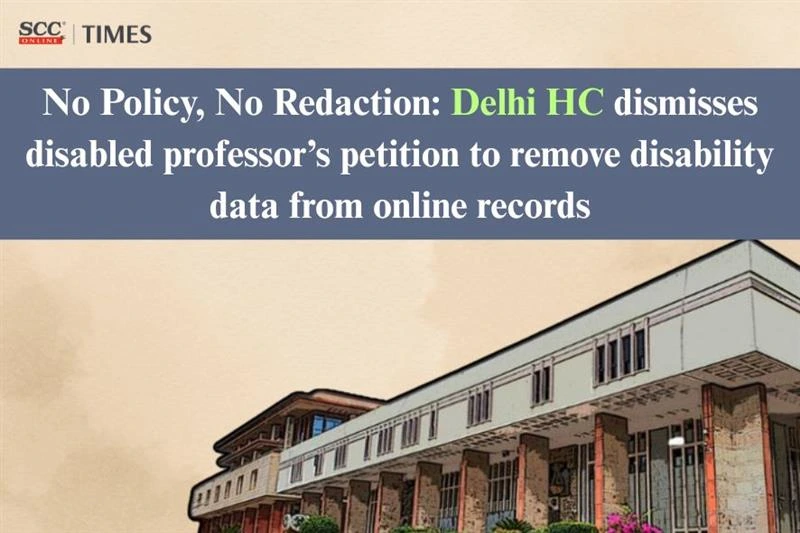
Delhi High Court: While hearing a writ petition filed by a person with 79 per cent disability seeking redaction and de-indexing of sensitive disability information from search engines, on the grounds that such publicity of information has been causing immense mental anguish, social stigma, and professional harm and is in violation of his fundamental rights to privacy, dignity, and equality guaranteed under Articles 14 and 21 of the Constitution, the Single Judge Bench of Purushaindra Kumar Kaurav, J, held that since there was no binding policy allowing redaction of the petitioner’s information on record, the Court cannot create any additional right under Article 226 to the effect. Accordingly, the Court disposed of the petition.
The writ petition was instituted under Article 226 of the Constitution by the petitioner, who was a person with 79% permanent disability in his right upper limb. The petitioner had been employed as an Assistant Professor (Computer Science & Engineering) at G.D. Goenka University, Gurugram.
The petitioner’s disability details had been recorded in a Division Bench judgment dated 18-10-2024 passed by the Court. The judgment specifically mentioned that “the appellant is suffering from 79% disability in the right upper limb.” Although the judgment was not marked as reportable, it was uploaded on the official website of the Court. As a result, it was republished by Respondent 3, Indian Kanoon, and indexed by Respondent 4, Google, making the petitioner’s disability information easily accessible through name-based online searches.
The Petitioner had made repeated efforts to seek redaction and de-indexing of the sensitive disability information. The petitioner had submitted detailed representations to Indian Kanoon and Google seeking redaction and de-indexing. He had also filed a grievance before the Ministry of Electronics and Information Technology (MeitY), alleging violations of the Digital Personal Data Protection Act, 2023 and the
Subsequently, the Petitioner had filed a writ petition seeking redaction and de-indexing of his disability details. By order dated 13-10-2025, the Court had granted liberty to approach the Division Bench that had passed the judgment dated 18-10-2024. Pursuant to this liberty, the petitioner had filed applications for impleadment and for directions seeking anonymisation and redaction before the Division Bench on 24-10-2025. The Division Bench, by orders dated 14-11-2025 and 19-11-2025, had ultimately permitted withdrawal of the applications with express liberty to pursue remedies before this Hon’ble Court.
The continued online availability of this information led to the Petitioner being subjected to social stigma, ridicule, harassment, and discrimination by students, colleagues, and peers. This caused serious harm to his dignity, professional reputation, and mental health.
The petitioner had contended that the continued disclosure and digital indexing of his exact disability percentage constituted a gross violation of his fundamental rights under Articles 14 and 21 of the Constitution of India. It was submitted that such disclosure infringed his right to privacy, dignity, and equality, and exposed him to discrimination solely on account of his disability.
The petitioner had also argued that the disclosure violated Section 3 of the Rights of Persons with Disabilities Act, 2016, which mandates equality, non-discrimination, and respect for dignity of persons with disabilities. It was further contended that the disclosure contravened the Digital Personal Data Protection Act, 2023 and the Information Technology (Reasonable Security Practices and Procedures and Sensitive Personal Data or Information) Rules, 2011, as disability information constituted sensitive personal data.
The petitioner had also submitted that there was no compelling public interest or legal necessity for the continued online availability of the petitioner’s exact disability percentage. The petitioner had relied on the doctrine of constitutional convergence to demonstrate that a single act of digital disclosure simultaneously violated multiple fundamental rights.
The petitioner had further contended that the case illustrated systemic digital discrimination and algorithmic disablement, where neutral digital platforms and search algorithms amplified structural disadvantages faced by persons with disabilities. Reliance was placed on the judgments of the Supreme Court in Justice K.S. Puttaswamy v. Union of India, (2017) 10 SCC 1 on the right to privacy, and Ravinder Kumar Dhariwal v. Union of India, (2023) 2 SCC 209 on substantive equality.
The petitioner had also submitted that Indian constitutional jurisprudence recognised the right to be forgotten and required protection of sensitive medical and disability-related information from unrestricted digital dissemination. It was argued that failure to grant redaction and de-indexing would result in permanent constitutional injury, not only to the petitioner but also to the larger disabled community, by discouraging persons with disabilities from accessing judicial remedies due to fear of public stigma.
The Court held that since there did not exist any binding policy to enable or direct redaction or masking of the petitioner’s information, the Court could not exercise its discretionary power under Article 226 to create any additional right. Accordingly, the Court disposed of the petition.
[ABC v. Union of India, 2026 SCC OnLine Del 143, decided on 12-1-2026]
Advocates who appeared in this case:
For the Petitioner: Manu Beri, Kudrat Mann, Raunek Raheja, Advocates
For the Respondent: Saurabh Seth, SC, Neelampreet Kaur, Abhiroop Rathore, Kabir Dev, Sukhvir Singh, Mamta Rani Jha, Shruttima Ehersa, Rohan Ahuja, Aiswarya Debardarshini, Jahanvi Agarwal, Advocates
Buy Constitution of India HERE