
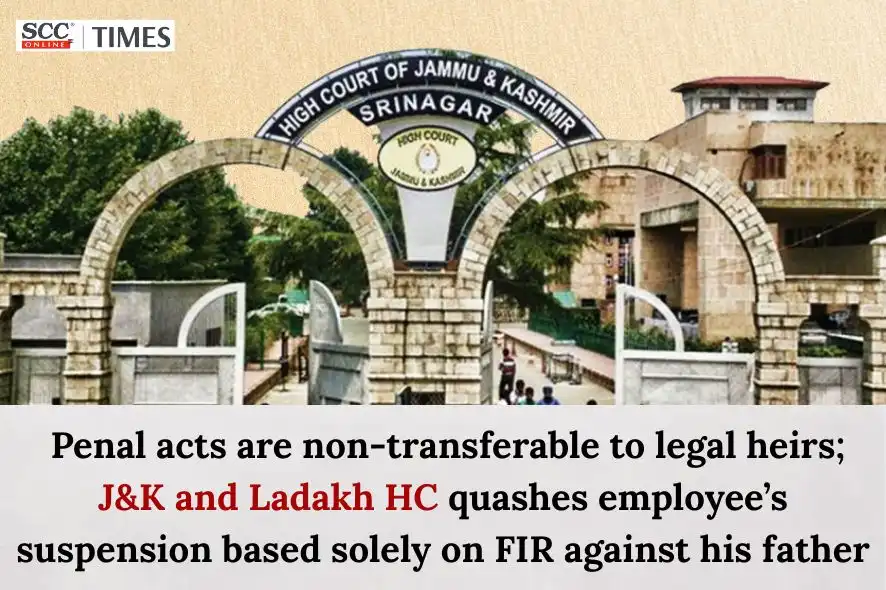
Jammu & Kashmir and Ladakh High Court: In a case revolving around whether a government employee’s suspension, ordered six years after an unrelated FIR against his father, could stand, a Single Judge Bench of Rahul Bharti, J., observed that penal acts are non-transferable to legal heirs and held that the impugned suspension order was utterly misconceived and vitiated with malice in law and accordingly quashed it while directing that the employee to be restored to his service at the post.
Background:
The petitioner (‘employee’) challenged his suspension order dated 11-5-2021 passed by the Additional Secretary, Jammu and Kashmir Legislative Assembly Secretariat. He was suspended relying on the accusation against his father, who as a forest guard and then as PRO with the Deputy Chief Minister allegedly indulged in corrupt and illegal practices.
The employee submitted that ever since his appointment as a Class-IV employee in 2014, he discharged his duties to the best of his abilities and without any adverse attribute in performance. He asserted that the FIR concerned was against his father for an offence under Section 5 of the J&K Prevention of Corruption Act, 2006 (‘2006 Act’), following which his father was arrested in 2017 and then released on bail, and a final police report was pending before the Special Judge, Anti-Corruption Court, Jammu. While challenging the suspension, the employee urged that the Jammu and Kashmir Civil Services (Classification, Control & Appeal) Rules, 1956 (‘Rules’), governed the matter of suspension, which provided the contingencies when a government employee could be put to suspension, and in employee’s case, no such contingency ever accrued for Respondent 3 to order the suspension.
The employee further argued that an FIR registered against his father could not be related with his own conduct as a government employee and no culpability could be shifted unto him by reference to his father’s implication. He submitted that if the FIR was to form the basis for suspension, then the same should have happened coinciding or immediately following the registration of the FIR and not after six years, which reflected the sheer non-application of mind on the part of Respondent 3 acting on the dictation of Respondent 2.
The respondents replied to the writ petition and stated that a regular departmental enquiry has been initiated against the petitioner in terms of the provisions contained under the Rules.
Analysis and Decision:
The Court noted that there was no order of setting up of a departmental inquiry against the employee, as mentioned by the respondents. The respondents’ reply was not accompanied with any annexure indicating that the suspension was continuing without reconsideration as to what purpose the said continuing suspension was serving.
The Court noted that the suspension order contained no reason why the employee was being subjected to such suspension and that too after six years of registration of FIR, and observed that since the suspension order was unrelated to the discharge of the employee’s duty, it was rendered bad per-se.
The Court opined that the basis of criminal jurisprudence is that the penal acts do not pass on to the legal heirs of an accused person. If the employee’s father was allegedly found to be involved in acts of omission or commission amounting to offence under Section 5 of the 2006 Act, the same did not mean that the employee was to be perceived, projected, painted and put to bad treatment by passing the impugned suspension order.
Accordingly, the Court, while allowing the petition, concluded that the impugned suspension order was utterly misconceived vitiated with malice in law, and quashed it, directing restoration of the employee to the post from where he was suspended.
[Ishant Sharma v. State (UT of J&K), 2026 SCC OnLine J&K 31, decided on 16-1-2026]
Advocates who appeared in this case:
For the Petitioner: Vikram Sharma, Sr. Advocate with Sachin Dev Singh, Advocate.
For the Respondents: Monika Kohli, Sr. AAG.