
Supreme Court: The present appeal questioned the correctness of the Kerala High Court’s judgment dated 7-1-2025, which upheld the District Judge’s order setting aside the arbitral award and restoring the Adjudicator’s decision. The High Court held that the arbitrator had jurisdiction only over dispute 1 and not disputes 2 to 4 owing to the absence of a separate notice under Section 21 of the Arbitration and Conciliation Act, 1996 (‘A&C Act’).
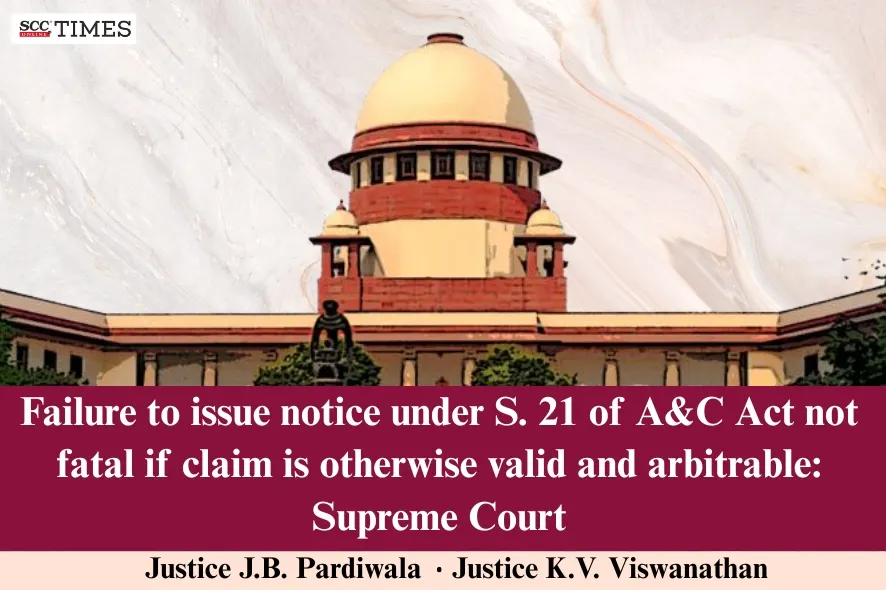
The Division Bench of J.B. Pardiwala and K.V. Viswanathan*, JJ., stated that the High Court erred in aside the arbitral award on the basis that the appointment of the Tribunal was only to adjudicate dispute 1 and in holding that the non-issuance of notice under Section 21 of the A&C Act by the appellant with regard to dispute 2 to 4 was fatal for it to pursue its claim before the arbitrator. The Court stated that the object of Section 21 of A&C Act, is only for the purpose of commencement of arbitral proceedings failure to issue notice under the said provision, would not be fatal to a party in arbitration, if the claim is otherwise valid and the disputes arbitrable. Thus, the Court set aside the impugned order and accordingly, upheld the award passed by the arbitrator.
Background
In the present case, for development of roads in Kerala, four packages of Road Maintenance Contract were awarded to the appellant, as part of the Kerala State Transport Project (KSTP).
Under the General Conditions of the Contract, following mechanisms were provided for the dispute:
-
Clause 24.1 stated that if the contractor believes that a decision taken by the Engineer was either outside the authority or was wrongly taken, the decision shall be referred to Adjudicator within 14 days of the notification of the Engineer’s decision.
-
Clause 25.1 stated that the Adjudicator was to give a decision within 28 days of the receipt of the notification of a dispute and;
-
Clause 25.2 stated that either party may refer the Adjudicator’s decision to an arbitrator within 28 days and if neither party refers the dispute to the arbitration within 28 days, the Adjudicator’s decision will be final and binding.
The appellant quantified the amounts due and submitted the same for decision by the Executive Engineer. According to the appellant, since the Executive Engineer/Superintending Engineer failed to take any decision, the appellant, approached the Adjudicator for decision on pending payments classifying the disputes as disputes 1-4. With reference to disputes 1 and 3, the Adjudicator ruled in the appellant’s favour and against the appellant on dispute 2 and 4. However, the respondent did not settle the bill and stated that the finding of the Adjudicator with respect to dispute 1 was unacceptable and they intend to refer the matter for an arbitration.
After several disagreements, on 11-1-2005, the Arbitral Tribunal was constituted. The Tribunal held that the arbitration clause was comprehensive enough to include any matter arising out of or connected with the agreement. Further, the respondent’s prayer to declare the Adjudicator’s decision as null and void indicated their intention to reopen the four disputes originally brought for consideration before the Adjudicator. Subsequently, vide award dated 29-6-2006, the Arbitral Tribunal answered all four issues in the appellant’s favour and the appellant was awarded a total sum of Rs. 1,99,90,777 along with post award interest at the rate of 18% p.a.
Further, an appeal was filed and the High Court, vide impugned order upheld the District Judge’s order setting aside the arbitral award and stated that the imposition of 28 days’ time-limit to refer the matter to arbitration, in Clause 25.2 was contrary to Section 28(b) of the Contract Act, 1872. However, on the ground that the appellant never sought reference of the dispute by issuing any notice under Section 21 of the A&C Act and only the respondent had issued such a notice on one issue, it found the award to be invalid. However, the order restoring the decision of the Adjudicator was not disturbed.
The following issues arose for consideration:
-
Whether the High Court was justified in holding that the Arbitral Tribunal was appointed at the request of the State to adjudicate dispute 1 only;
-
Was the non-issuance of a notice under Section 21 of the A&C Act by the appellant fatal for it to pursue its claim before the Arbitrator?
Analysis, Law, and Decision
The Court stated that the High Court erred in aside the award on the basis that the appointment of the Tribunal was only to adjudicate dispute 1 and also in holding that the non-issuance of notice under Section 21 of the A&C Act by the appellant with regard to dispute 2 to 4 was fatal for it to pursue its claim before the arbitrator. Further, the High Court also erred in holding that the Arbitral Tribunal exceeded its jurisdiction in deciding the entire dispute.
The Court stated that the object of Section 21 of A&C Act, is only for the purpose of commencement of arbitral proceedings and there is no mandatory prerequisite for issuance of a Section 21 notice prior to the commencement of arbitration. The Court stated that failure to issue such notice would not be fatal to a party in arbitration, if the claim is otherwise valid and the disputes arbitrable.
The Court stated that when the arbitral tribunal is constituted, the claimant is required to file the statement and the respondent to file his defence statement with counter claim, if any, before the arbitrator. The claimant is not bound to restrict his statement of claim to the claims raised by him in the notice issued, if any, before. However, the Court stated that in the present case, it has been held that the rigors of clause 24, 24.1 and 25 have not been followed by the parties and by their conduct the entire dispute have been thrown at large before the Arbitral Tribunal.
Regarding the appellant’s contention that the appellant cannot be referred to as a claimant because no notice under Section 21 has been issued was completely untenable. The Court referred to Section 23 of the A&C Act and stated that once the arbitral tribunal is constituted claims, defence and counter claims are filed. Party which normally files the claim first is, for convenience, referred to as the ‘claimant’ and the party which responds is called the ‘respondent’. The said respondent is also along with the defence statement entitled to file its counter claim.
Thus, the Court set aside the impugned order and accordingly, upheld the award passed by the arbitrator.
[Bhagheeratha Engineering Ltd. v. State of Kerala, 2026 SCC OnLine SC 5, decided on 5-1-2026]
*Judgment authored by- Justice K.V. Viswanathan
Advocates who appeared in this case:
For the Appellant: Rajiv Shakdher, Sr. Adv.; George Thomas, Adv.; Dhiraj Abraham Philip, AOR; Febin Mathew Varghese, Adv.; Sunny George, Adv.; Lija Merin John, Adv.; Soyarchon Khangrah, Adv.
For the Respondent: Naveen R Nath, Sr. Adv.; Nishe Rajen Shonker, AOR Mrs. Anu K Joy, Adv.; Alim Anvar, Adv. Mrs. Devika A.l., Adv.; Santhosh K, Adv.; Disha Gupta, Adv.; Aditya Nath, Adv.; Sai Vaishnav, Adv.
Buy Arbitration and Conciliation Act, 1996 HERE