
Disclaimer: This has been reported after the availability of the order of the Court and not on media reports so as to give an accurate report to our readers.
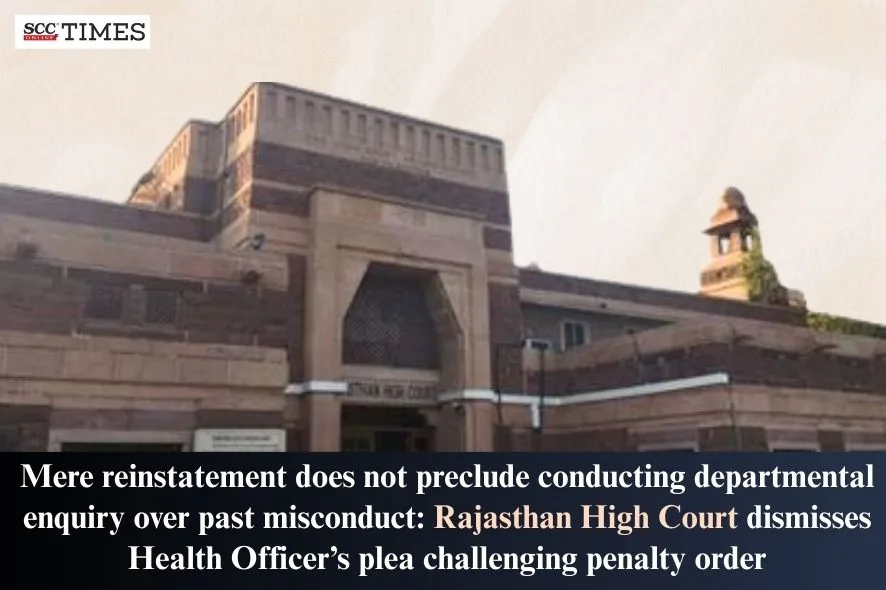
Rajasthan High Court: In a petition filed under Article 226 of the Constitution challenging the penalty order of withholding three annual grade increments with cumulative effect imposed upon the petitioner, a Health Officer, pursuant to a departmental enquiry, a Single Judge Bench of Anand Sharma, J., held that petitioner’s mere reinstatement did not preclude the respondent from conducting any enquiry over past misconduct.
Accordingly, the Court dismissed the petition at hand.
Background
The petitioner was initially appointed on probation, in June 1992, on the post of Health Officer pursuant to which he joined in July 1992. Due to her willful absence during the probation period, her services were terminated by December 1994’s order with effect from July 1992. Aggrieved by it, he reached out to the High Court which directed the respondents to consider the representation of the petitioner.
In compliance with the said order, representation was submitted by the petitioner whereupon she was reinstated back in service. Thereafter, by way of issuing a charge-sheet in 1998, enquiry under Rule 16 of the Rajasthan Civil Services (Classification, Control and Appeal) Rules, 1958 was initiated by the respondents against the petitioner alleging the charges of willful absence for the same period for which earlier services of the petitioner were terminated.
In the enquiry proceedings, the disciplinary authority passed order whereby penalty of withholding three annual grade increments with cumulative effect was imposed upon the petitioner. Her review petition was dismissed. Thus, the petitioner approached the High Court.
Analysis and Decision
The Court stated that the issue involved in the present case was whether the Court, in exercise of its limited power of judicial review, could interfere with the penalty imposed by the disciplinary authority.
The Court clarified that in the earlier order, it never gave any direction for condoning the alleged absence of the petitioner but directed for the representation of be made and considered. Pursuant to which, she was reinstated back in service. The Court viewed that even her reinstatement by the respondents would not mean that she has been absolved of all the misconduct, which was committed by her. Further, the Court held that mere reinstatement of the petitioner did not preclude the respondent from conducting any enquiry whatsoever. Thus, the penalty order of withholding three annual grade increments with cumulative effect couldn’t be challenged by the petitioner only on this ground.
The Court reiterated the settled position of law that disciplinary proceedings are conducted by the employer in exercise of its administrative authority to maintain discipline, integrity, and efficiency in service. The scope of judicial review under Articles 226 of the Constitution is confined to examine the decision-making process and not the decision itself. Courts exercising writ jurisdiction do not sit as appellate authorities over departmental enquiries and cannot re-appreciate evidence or substitute their own conclusions for those of the disciplinary authority.
The Court stated that the departmental enquiry was conducted in accordance with the prescribed procedure and in compliance with the principles of natural justice. The petitioner was afforded adequate opportunity at every stage. The findings recorded by the Enquiry Officer were supported by evidence on record and could not be characterized as perverse or based on no evidence. The petitioner’s attempt to invite the Court to reassess the evidence or to arrive at a different factual conclusion was wholly impermissible in writ jurisdiction.
The Court stated that the nature of the misconduct proved against the petitioner, viewed in the context of the duties and responsibilities attached to the post held, could not be said to be trivial or inconsequential. The Court further stated that the penalty imposed did not shock its conscience, nor was it outrageously disproportionate. The Court stated a settled law that mere harshness of punishment is not a ground for judicial interference. Unless the penalty is such that no reasonable employer would have imposed it in the given facts, the Court must refrain from substituting its own sense of proportionality. To do otherwise would amount to converting judicial review into an appellate exercise, which is expressly forbidden by law.
Thus, the Court stated that there was no procedural impropriety, violation of statutory rules, or breach of natural justice in the conduct of the enquiry or in the decision-making process of the disciplinary authority. Thus, the order did not suffer from illegality, irrationality, or perversity to warrant interference under Articles 226 of the Constitution.
Hence, the Court dismissed the petition and opined that the disciplinary authority acted within the bounds of its jurisdiction, and the punishment imposed fell squarely within the permissible range of administrative discretion.
[Hemlata Tetwal v. State of Rajasthan, 2026 SCC OnLine Raj 330, decided on 6-1-2026]
Advocates who appeared in this case:
For the Petitioner: Tarun Jain, Advocate
For the Respondent: Archit Bohra, AGC
Buy Constitution of India HERE