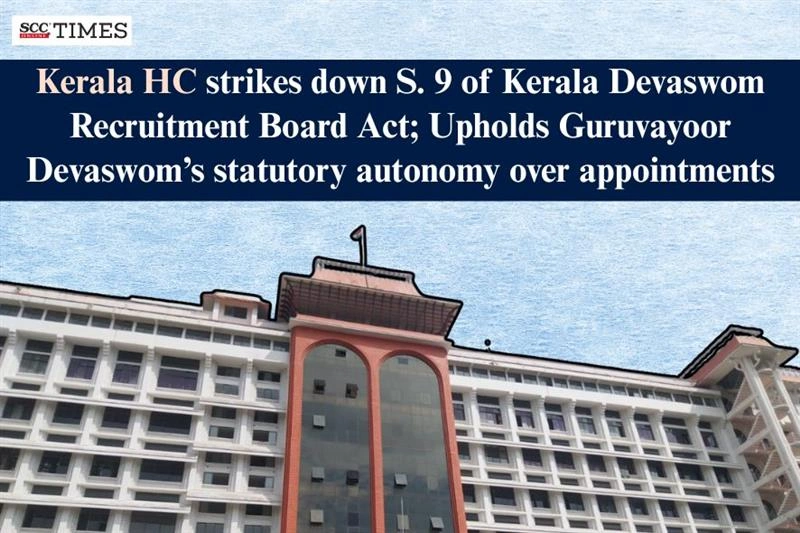
Kerala High Court: In an appeal revolving around whether Section 9 of the Kerala Devaswom Recruitment Board Act, 2015 (‘KDRB Act’), which empowered the Kerala Devaswom Recruitment Board (‘Board’) to prepare select lists for appointments to posts in the Guruvayoor Devaswom, could override the statutory autonomy conferred under Section 19 of the + (‘GD Act’), the Division Bench of Sushrut Arvind Dharmadhikari* and Syam Kumar V.M., JJ., held that the KDRB Act, being a general enactment, could not supersede the special provisions of the GD Act. Consequently, Section 9 of the KDRB Act was declared unconstitutional and inoperative, with the Court directing that all future appointments must be undertaken strictly under the GD Act.
Background:
A writ petition was filed seeking a declaration that Section 9(1) of the KDRB Act, which conferred authority upon the Board to draw up select lists for appointments to various posts within the Guruvayoor Devaswom, was illegal, unconstitutional, and therefore inoperative. However, the writ petition was dismissed by the Single Judge at the threshold placing reliance on Guruvayoor Devaswom Managing Committee v. Mayadevi K.S., 2022 SCC OnLine Ker 4405.
In the present writ appeal, the petitioners contended that conferring the power of appointment of officers and employees on a separate Board, other than the representative of the denomination i.e. Guruvayoor Devaswom Managing Committee (‘GDMC’), was violative of Article 26 of the Constitution. It further contended that Section 19 of the GD Act was promulgated with the President’s assent and therefore, any provision of the KDRB Act and the Rules contrary to the GD Act would be repugnant and ultra vires. They also argued that once the Guruvayoor Devaswom Act, 1971 (‘Act of 1971’) was declared unconstitutional, the legislature could not seek to validate the actions taken thereunder by enacting the KDRB Act, because when an earlier legislation has been struck down or rendered inoperative by a Court, any subsequent legislation re-enacting or validating the same provisions, without curing the defects identified by the Court, would also be ultra vires.
On the other hand, the respondents defended the KDRB Act as a necessary reform to ensure transparency and fairness in selection and appointment, citing the recommendations of the Justice Paripoornan Commission. It was initially decided to entrust the recruitment for five Devaswom Boards in the State to the Kerala Public Service Commission, but it expressed its unwillingness to undertake the recruitment process, and consequently, it was decided to constitute a separate recruiting agency, i.e., the Kerala Devaswom Recruitment Board.
The respondents argued that although Section 19(1) of the GD Act empowered the GDMC to appoint all officers and other employees of the Devaswom, the KDRB Act, as expressly provided under Section 9(1)(i), superseded all other enactments, including the GD Act. Regarding the violation of Article 25 of the Constitution, it was contended that the denominational character was expressly preserved through the recruitment process undertaken by the KDRB, wherein the posts were notified exclusively for members of the Hindu denomination. Furthermore, the appointments to hereditary posts were not made by the KDRB. They alleged that the purpose of filing the writ appeal was to interfere with a transparent process and to ‘upset the apple cart’ that was functioning smoothly and safeguarding the legitimate rights of the community.
Issues:
-
Whether the GD Act prevails over the KDRB Act?
-
Whether Section 9 of the KDRB Act, conferring power on the Board to select candidates for appointment to various posts in the Guruvayoor Devaswom, must be declared illegal and unconstitutional in the light of Krishnan v. Guruvayoor Devaswom Managing Committee, 1977 SCC OnLine Ker 62,?
-
Whether, by enacting new legislation under the KDRB Act and the Rules framed thereunder in respect of the Guruvayoor Devaswom, the Guruvayoor Devaswom has lost its fundamental rights under Articles 25 and 26 of the Constitution to administer, control, and manage its own affairs regarding the selection and appointment of its officers and employees?
-
Whether the legislature has enacted the KDRB Act in violation of the directions in Krishnan (supra) and in violation of Article 26 of the Constitution?
Analysis:
The Court noted that the Sree Krishna Temple at Guruvayoor is an ancient temple of unique importance, which owns extensive properties and endowments and in which millions of devotees from all over India place their faith and belief. The Kerala Government first enacted the Act of 1971 to replace the historical management with a state-appointed Managing Committee. The Act was immediately challenged in Court, and in Krishnan (supra), it was struck down, ruling that it violated Articles 25 and 26 of the Constitution. Subsequently, the GD Act was promulgated to address the legal flaws identified by the Court, and later, the KDRB Act was enacted to bring transparency to the recruitment process within the various Devaswom Boards in Kerala. While the GD Act focused specifically on the administration of Guruvayoor, the KDRB Act addressed personnel management across all major Devaswom Boards.
The Court did a comparative analysis of Sections 19 of the GD Act and Section 9 of the KDRB Act, and observed that while the GD Act provides that the GDMC (the representative of the denomination) should make the appointments and selections through a sub-committee of the GDMC, the KDRB Act provides that the Board (an external statutory body) should prepare the select list for those appointments.
On Issues (i) and (ii)
The Court observed that the KDRB Act, a general enactment on recruitment across Devaswom Boards, cannot take away the statutory appointment power expressly conferred under Section 19 of the GD Act without explicit legislative mandate. Accordingly, Section 9 of the KDRB Act must be read harmoniously and subject to Section 19 of the GD Act, to preserve the special statutory autonomy of the Guruvayoor Devaswom Board, and any interpretation of complete supersession would contradict settled principles of statutory interpretation laid down by the Supreme Court.
The Court opined that it is settled that a special law prevails over a general law, and a non obstante clause in a later enactment cannot obliterate the legislative intent of a prior special statute, particularly one governing a unique and constitutionally protected religious institution like the Guruvayoor Devaswom. Therefore, the Court held that Section 9 of the KDRB Act cannot override Section 19 of the GD Act, which is a special, self-contained statute enacted to regulate Guruvayoor Devaswom, expressly vesting appointment powers in the Managing Committee.
On Issues (iii) and (iv)
The Court observed that the right to appoint staff is an integral component of the right to manage religious affairs under Article 26 of the Constitution, and noted that the principle established in Krishnan (supra) that vesting appointment powers in a body separate from the denominational representative violated Article 26, remains valid. The Court opined that the composition and function of the Board, though termed autonomous, essentially mirrored the problematic separation of powers found in the Section 20 of the Act of 1971, which had already been struck down.
The Court emphasised that the GD Act being a special enactment promulgated with the President’s assent, must prevail over the general provisions of the KDRB Act passed by the State Legislature, especially on a concurrent list subject. Applying the principle laid down in LIC v. D.J. Bahadur, (1981) 1 SCC 315, the Court reiterated that a special law prevails over a general law unless there is a clear legislative intent to override it.
Decision:
The Court held that the Single Judge erred in dismissing the writ petition based on Mayadevi (supra) without addressing the constitutional validity of Section 9 of the KDRB Act. The Court observed that under the constitutional framework governing conflict resolution and judicial precedent, Section 19 of the GD Act is the stronger provision and would prevail, thereby rendering Section 9 of the KDRB Act inoperative as it is inconsistent with Section 19 of the GD Act, and accordingly, struck down Section 9 of the KDRB Act.
Further, the Court, while allowing the writ appeal, set aside the Single Judge’s judgment dated 30-5-2025, and directed that:
-
Section 9 of the KDRB Act is unconstitutional and shall be inoperative.
-
Any proceedings relating to the appointment or selection of candidates to various posts shall be undertaken strictly in accordance with the provisions of the GD Act.
-
The notifications issued by the Board inviting applications for various posts shall stand quashed, and the Board will not conduct any selection proceedings for appointments. However, any appointments already made by the Board shall remain undisturbed.
-
The GDMC shall initiate the appointment process afresh by issuing notifications inviting applications for various posts.
-
With a view to manage the transition and avoid administrative difficulties, an independent committee will be constituted to ensure a free, fair, and transparent selection process to supervise and oversee the recruitment process undertaken in accordance with Section 19 of the Act of 1978. The committee shall comprise of:
-
Justice P. N. Ravindran (Retd.)
-
The Administrator, GDMC
-
An advocate.
-
[Guruvayur Devaswom Employees Union Congress v. State of Kerala, 2026 SCC OnLine Ker 230, decided on 9-1-2026]
*Judgment authored by: Justice Sushrut Arvind Dharmadhikari
Advocates who appeared in this case:
For the Petitioners: M.U. Vijayalakshmi, K. Jaju Babu (Sr.), Brijesh Mohan, Sachin Ramesh, Manikantan S. Kandathil, Aishwarya Satheesan, Sreelakshmi S.N., Advocates.
For the Respondents: K.P. Harish (Sr.GP), V.V. Nandagopal Nambiar, SC, T.K. Vipindas, SC.