
Disclaimer: This has been reported after the availability of the order of the Court and not on media reports so as to give an accurate report to our readers.
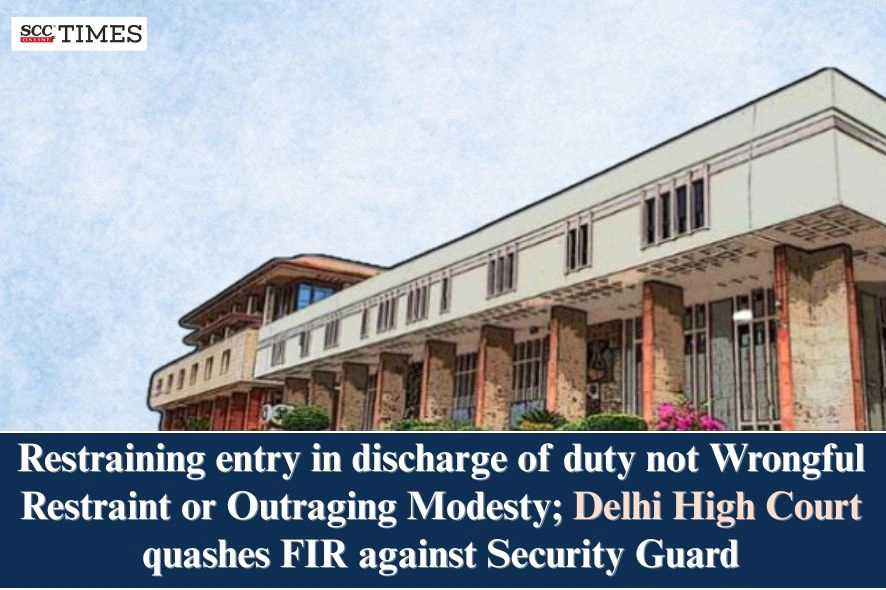
Delhi High Court: In an application filed under Sections 482 and 483 of the Criminal Procedure Code, 1973 (CrPC) seeking quashing of the FIR, charge-sheet and orders framing charges against petitioners, two security guards, who were accused of wrongfully restraining and assaulting the modesty of the widow of a company director while preventing her from entering office premises, a Single-Judge Bench of Neena Bansal Krishna, J., held that petitioners acted in good faith in discharge of their duty as security guards and consequently quashed the FIR, charge-sheet and orders framing charges under Sections 341/34 and 354 of the Penal Code, 1860 (IPC).
In the instant matter, the petitioners were employed as security guards on 17-09-2015 and posted at the office premises of VLS Group of Companies, New Delhi. Their appointment followed the untimely and mysterious death of one of the Directors of VLS Group (the deceased), on 22-08-2015.
After the demise of the deceased, disputes arose between the deceased’s widow (Respondent 2), and her in-laws concerning the control and ownership of the companies and assets left behind by the deceased. The Respondent 2 alleged that her father-in-law and brother-in-law were attempting to deprive her of her legitimate share and were exerting pressure upon her to relinquish her rights.
On 18-09-2015, Respondent 2 visited the office premises of VLS Group. At the entrance, she was stopped by the petitioners who were posted there as security guards. According to her complaint, one of the guards was carrying a weapon and they informed her that they had instructions from her father-in-law and brother-in-law not to allow her entry into the office. When she tried to proceed inside, petitioner held her upper arm and restrained her.
Respondent 2 first made a complaint on 19-09-2015 to the ACP primarily alleging threats and pressure by her in-laws, with a passing reference to the incident of 18-09-2015. As no action was taken, she filed a second complaint dated 22-09.2015 at Police Station, specifically alleging wrongful restraint and assault on her modesty by the petitioners.
On the basis of the second complaint, FIR under Sections 341/506/34 IPC was registered. After investigation, charge-sheet was filed. The Metropolitan Magistrate framed charges under Section 341/34 IPC. On revision, the Additional Sessions Judge directed framing of an additional charge under Section 354 IPC. Aggrieved thereby, the petitioners approached this Court seeking quashing of the FIR, charge-sheet and orders framing charges.
The Court observed that the undisputed factual matrix showed that the petitioners were employed as security guards on 17-09-2015 and were posted at the office premises following the mysterious death of the deceased. The incident occurred against the backdrop of an intense family dispute over property and control of the company.
The Court reproduced Section 339 IPC which defines Wrongful Restraint, and is punishable under Section 341 IPC and held that the essential ingredients of wrongful restraint are:
-
there is an obstruction;
-
the obstruction prevents a person from proceeding in any direction, and
-
the person so proceeding must have a right to proceed in the direction concerned.
The Court noted that the complainant nowhere asserted that she had a legal right to enter the office premises. On the contrary, her own complaint showed that the guards had been posted by her father-in-law and brother-in-law and were discharging their duties.
The Court held that “the Petitioners being Security Guards, had the bounden duty to ensure that no unauthorised person enters the office premises. The Complainant had nowhere asserted or even prima facie stated that she had a right to enter into the Office premises.”
The Court held that the act of restraining her from entering an office where she had no established right of entry, and that too in good faith in discharge of official duty, squarely fell within the exception to Section 339 IPC. Hence, no offence under Section 341 IPC was made out.
The Court reiterated that for an offence under Section 354 IPC, criminal force must be used with intent to outrage the modesty of a woman. From the complainant’s own version, the only act attributed to the petitioners was that one of them held her upper arm to restrain her from entering the office premises.
The Court asserted that there was no allegation of any sexual overtone, gesture or intention and the act was purely in the nature of restraining entry. The Court categorically held that “by no stretch of imagination, can it be said that this act was intended with a ‘sexual intent’ to outrage her modesty.” Therefore, no offence under Section 354 IPC was disclosed.
The Court noted that the first complaint dated 19-09-2015 was essentially directed against the in-laws and only made a passing reference to the incident. When no action was taken, the second complaint dated 22-09-2015 was filed, making the guards the main accused.
The Court observed that “it is evident that in this family fight, the Petitioners, who were the Security Guards who had been employed just a day before the incident, were targeted when the Complainant was unable to mobilize the Police against her in-laws.” The Court held that the proceedings were nothing but an abuse of the process of law.
The Court allowed both petitions and quashed the FIR, charge-sheet and orders dated 18-04-2017 and 03-08-2018 framing charges under Sections 341/34 IPC and 354 IPC. The Court discharged the petitioners from all offences.
[Manoj Mishra v. State (NCT of Delhi), 2026 SCC OnLine Del 16, Decided on 05-01-2026]
*Judgment by Justice Neena Bansal Krishna
Advocates who appeared in this case:
Mr. Parmesh Bali, Mr. Gagan Garg, Mr. Shivam Srivastav, Mr. Keshav Maheshwari and Mr. Abhishek Nandan, Counsel for the Petitioner
Mr. Shoaib Haider, APP for the State. Mr. Yashpal Singh, Mr. Abhinandan Gautam and Mr Himanshu Baliyan, Counsel for the Respondent 2
Buy Code of Criminal Procedure, 1973 HERE
Buy Penal Code, 1860 HERE