
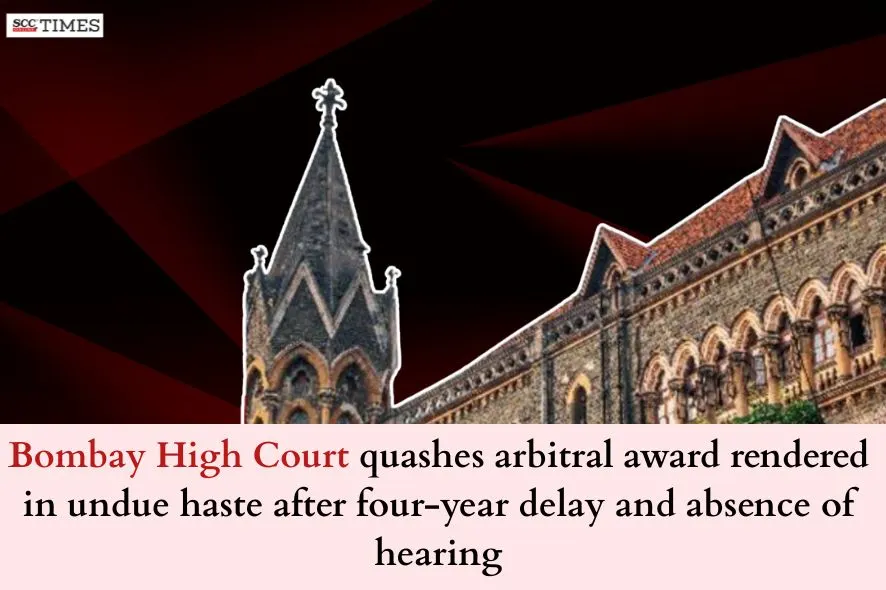
Bombay High Court: In a petition under Section 34 of the Arbitration and Conciliation Act, 1996 (‘Arbitration Act), a Single Judge Bench of Sandeep V. Marne, J., held that the arbitral award dated 31-05-2021 was passed after expiry of mandate, without hearings, and in undue haste following directions of the General Manager. The Court noted that the arbitrator wrongly cited non-existent Covid-19 restrictions to justify years of delay, yet hurried to deliver the award during actual lockdowns. Finding clear misconduct and violation of natural justice, the Court annulled the award as unsustainable in law and in conflict with public policy.
Background:
The dispute arose out of a contract relating to annual maintenance work of RMPUs in AC coaches across several railway divisions. The contractor performed work between September 2010 and December 2013, raising claims for payment. Arbitration was invoked in 2012 and 2014, and a sole arbitrator was appointed in 2015. The contractor filed its statement of claim, while the respondent belatedly filed its defence. Only one arbitration meeting was conducted in June 2017, after which no further hearings were held.
The contractor requested substitution of the arbitrator in March 2021, but instead the General Manager directed the arbitrator to finalise proceedings. The arbitrator thereafter hurriedly passed the award on 31-05-2021, rejecting all claims.
The petitioner argued that the award was passed after termination of mandate and undue delay. It was submitted that the award was non est and liable to be set aside. Counsel for the respondent contended that since arbitration was invoked prior to insertion of Section 29A of the Arbitration Act, there was no time limit for passing the award, and that the award had adjudicated disputes between the parties. It was argued that constitution of a fresh tribunal was meaningless once the award had already been made.
Analysis and Decision:
The Court emphasised that the grounds for invalidating the award were inordinate delay and expiry of mandate. It was noted that the arbitrator conducted only one hearing in June 2017 and thereafter failed to hold proceedings for years. The Court observed that despite requests, no hearing was fixed, and the General Manager’s direction of March 2021 led to hurried passing of the award. The Court highlighted that no hearing was conducted on 20-05-2021, yet the award was made on 31-05-2021, which was sufficient ground for setting aside.
The Court observed that the arbitrator, while referring to just three meetings held in 2016 and 2017 as ‘many occasions,’ has clearly misconducted by citing the pretext of non-existent Covid-19 restrictions for his own inefficiency, but hurriedly making the award when lockdown restrictions actually existed. The Court highlighted that the arbitrator had clearly misconducted, acted in violation of natural justice, and was influenced by the General Manager’s directive.
The Court referred to the Supreme Court’s ruling in Lancor Holdings Ltd. v. Prem Kumar Menon, 2025 SCC OnLine SC 2319, which held that an award would stand vitiated due to the lapses committed by the arbitral tribunal owing to such delay. Applying this, the Court found the delay unexplained, the award made without hearing, and the findings tainted. It was observed that the arbitrator merely completed the formality of delivering the award after learning of substitution proceedings. Therefore, the Court concluded that the award was in conflict with public policy, unsustainable, and liable to be set aside.
Finally, the Court noted that a new arbitral tribunal had already been constituted by order dated 22-09-2025, and therefore the award needed to be annulled to enable proper adjudication of claims and defences. The petition was accordingly allowed, and the impugned award dated 31-05-2021 was set aside, with no order as to costs.
[Amit Engineers v. Union of India, 2025 SCC OnLine Bom 5527, decided on 08-12-2025]
Advocates who appeared in this case:
For the Petitioner: Minakshi Jyoti with Anmol Jain i/b. Prem S. Motiraman
For the Respondent: Narayan R. Bubna
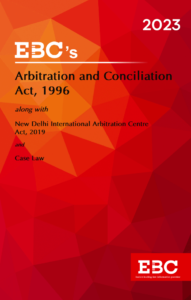
Buy Arbitration and Conciliation Act, 1996 HERE