
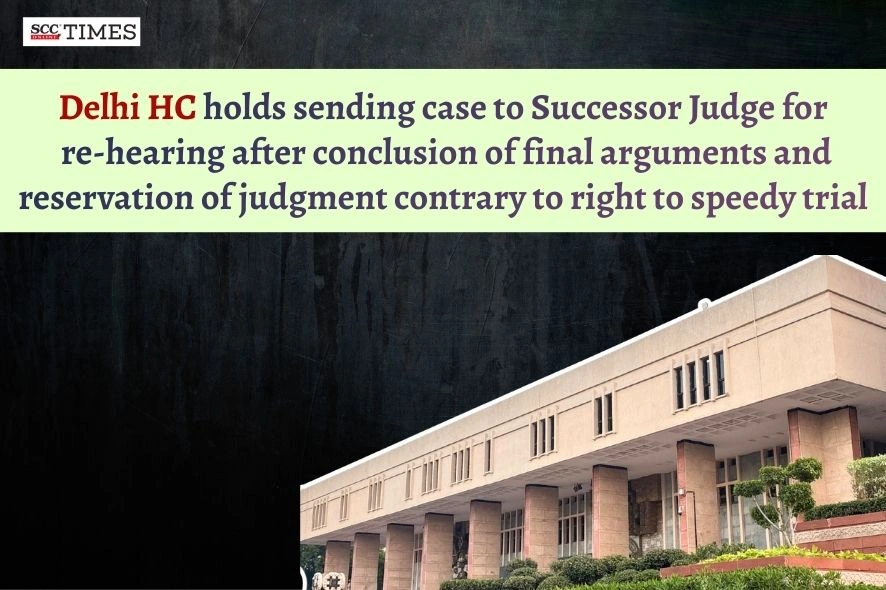
Delhi High Court: In a petition seeking transfer of sessions case registered at Police Station Special Cell, Delhi, for offences punishable under Sections 3 and 4 of the Maharashtra Control of Organised Crime Act, 1999 [‘MCOCA’] from the Court of the Successor Judge, Patiala House Courts, New Delhi, to the Court of the Predecessor Judge, who is presently posted as Judge, Family Court-02, North-East District, Karkardooma Courts, Delhi, for the limited purpose of pronouncement of judgment, Swarana Kanta Sharma, J., directed the sessions case to be transferred to the Court of the Predecessor Judge.
The petitioner is the main accused in the FIR pertaining to an organised crime syndicate allegedly being run by him along with his associates. The FIR was registered in 2019 and the chargesheet was filed on 17-07-2020. The trial commenced and prosecution evidence concluded on 15-10-2024, final arguments on behalf of the petitioner concluded on 06-03-2025, and those on behalf of the remaining accused persons concluded on 05-04-2025. Final arguments on behalf of all the accused persons as well as the State, including rebuttal, were concluded on 04-07-2025, whereupon the matter was reserved for judgment and fixed for pronouncement on 30-07-2025.
The judgment, however, could not be pronounced on the scheduled date and on subsequent dates. On 07-11-2025, the Predecessor Judge was ready to pronounce the judgment but deferred the same as the accused persons appearing through video conferencing and were directed to be produced physically on 28-11-2025. In the interregnum, the Predecessor Judge was transferred vide order dated 18-11-2025. Consequently, the matter came up before the Successor Judge on 28-11-2025 and thereafter stood transferred back and forth between the Predecessor Judge and the Successor Judge, ultimately resulting in directions by the Successor Judge for rehearing of final arguments from 06-01-2026 to 09-01-2026.
The issue under consideration is whether the Predecessor Judge was required to pronounce the judgment after reserving the matter, notwithstanding his transfer, in terms of the transfer orders issued on the administrative side of this Court, or whether the direction for rehearing of final arguments by the Successor Judge can be sustained in law.
The Court noted that the record reflects that the case was fixed on several dates exclusively for pronouncement and, in particular, on 07-11-2025, the order sheet reveals that Predecessor Judge was prepared to pronounce the judgment but deferred the same only for the reason that the accused persons were appearing through video conferencing and were directed to remain physically present before the Court.
The Court further noted that directions were given for appropriate measures to be taken to produce him physically on 28-11-2025, which suggests that the judgment was ready for pronouncement. The subsequent observation made on 03-12-2025, that certain clarifications were required from the I.O. Therefore, when seen in the backdrop of repeated listings for pronouncement over a period of nearly five months, raises serious concerns.
The Court observed that re-hearing a matter of this nature, involving multiple accused and a lengthy trial under a special statute, would inevitably consume substantial time. The petitioner has already been in judicial custody for more than five years. After the conclusion of trial, the accused waited for another five months for the pronouncement of judgment. “For an accused, especially one in custody, the period after the judgment gets reserved; each day is spent in anxious anticipation of the outcome. To now compel the accused to undergo another round of final arguments before a new judge would amount to prolonging uncertainty and, in effect, would result in serious prejudice.”
The Court stated that the directions contained in Note (2) appended to the transfer order dated 18-11-2025 and reiterated by the subsequent order issued on the directions of the Chief Justice of this Court, were neither casual nor optional. They were issued precisely to avoid situations such as the present one, where reserved judgments remain unpronounced due to transfers. Permitting a departure from these directions on the ground of belatedly perceived “clarifications” would, in effect, dilute their binding nature and open the door to circumvention. Such an approach, if accepted, may create a precedent where matters in which judgments have already been reserved are, after transfer of the Presiding Officer, sent back to the successor court on tenuous grounds, thereby unsettling the settled procedure governing pronouncement of reserved judgments and introducing avoidable uncertainty into the judicial process.
The Court clarified that this is not a case where, immediately upon reserving judgment, the Predecessor Judge found it necessary to seek any clarification and acted accordingly. On the contrary, the matter remained reserved for nearly five months, despite the settled legal position that judgments ought to be pronounced immediately or not later than six weeks and as per BNSS, within 30 to 45 days. During this entire period, the case was repeatedly listed only for pronouncement of judgment, and a specific date was eventually fixed after directing the physical production of the accused. In such circumstances, the later observation that further clarification was required cannot justify transferring the matter to the learned Successor Judge and directing rehearing of final arguments, particularly when no such requirement was indicated during the extended period for which the judgment remained reserved and the matter was repeatedly listed solely for pronouncement.
Thus, the Court concluded that in the present case, sending back the case to the Successor Judge in December 2025, when the final arguments were concluded in early July 2025 and the matter remained reserved for pronouncement of judgment for five months with the Predecessor Judge, would be manifestly unjustified and contrary to settled legal principles, as well as destructive of the right of an accused to a speedy trial. The Court held that the Predecessor Judge was duty-bound to pronounce the judgment in the said case.
[Parvesh Mann v State NCT of Delhi, 2026 SCC OnLine Del 61, decided on 05-01-2026]
Advocates who appeared in this case:
Mr. Avi Kalra, Mr. Prateek Lakra and Ms. Arya Pathak, Advocates for petitioner
Mr. Manoj Pant, APP for State along with Insp. Ravi Tushir, Special Cell NR