
Disclaimer: This has been reported after the availability of the order of the Court and not on media reports so as to give an accurate report to our readers.
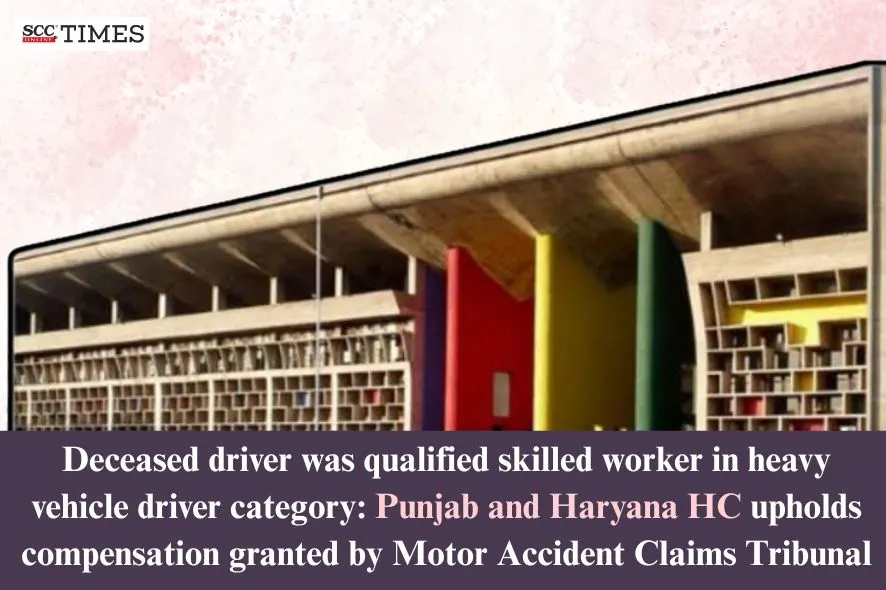
Punjab and Haryana High Court: In an appeal filed by the appellant, an insurance company, challenging the award passed by the Motor Accident Claims Tribunal (‘Tribunal’) on the ground of higher quantum of compensation being awarded as the deceased driver was allegedly wrongly considered for skilled labour in heavy vehicle category, a Single Judge Bench of Sudeepti Sharma*, J., held that the deceased driver’s licence clearly reflected that he was authorised to drive heavy and medium goods vehicles, thus, was duly qualified to be treated as a skilled worker in the category of heavy vehicle driver.
Accordingly, the Court upheld the Tribunal’s order.
Background
In the present case, an award was passed by the Tribunal in the claim petition filed under Section 166 of the Motor Vehicles Act, 1988 (‘MV Act’), wherein, the appellant was held liable to pay the compensation to the respondents of Rs. 19,60,000. Aggrieved by the high quantum of compensation, the appellant approached the High Court.
The appellant contended that the Tribunal erred in assessing the monthly income of the deceased at Rs. 15,680 by placing reliance upon the wage notification issued by the Deputy Commissioner applicable to skilled labour/heavy vehicle drivers, instead of adopting the minimum wages for skilled labour in the State of Haryana, that is, Rs. 8,245. Per contra, the respondents argued that they had preferred a separate appeal seeking enhancement of compensation.
Analysis and Decision
The Court reiterated a well-settled principle and stated that “a Court sitting in appeal does not substitute its own view for that of the Court below merely because an alternative view is possible.” The Court further stated that interference is warranted only where the impugned findings are vitiated by perversity, illegality, or material irregularity, or suffer from such infirmities as render them unsustainable in law. Thus, the Court viewed that in the absence of such vitiating factors, interference in appellate jurisdiction was wholly unwarranted.
The Court pursued the driving licence of the deceased and stated that it clearly reflected that he was authorised to drive heavy and medium goods vehicles, thus, was duly qualified to be treated as a skilled worker in the category of heavy vehicle driver.
Further, the Court noted that there was nothing on record to demonstrate that the wage rates notified by the Deputy Commissioner were not applicable to the deceased. Thus, the Court held that in the absence of any cogent evidence to the contrary, the Tribunal was justified in relying upon the said notification while determining the income of the deceased.
Therefore, the Court stated that the approach adopted by the Tribunal could not be said to be arbitrary or erroneous. The Court dismissed the present appeal and stated that the findings recorded by the Tribunal for the assessment of the monthly income of the deceased suffered from no infirmity or illegality.
[National Insurance Co. Ltd. v. Vimal Kaur, 2025 SCC OnLine P&H 18804, decided on 18-12-2025]
Advocates who appeared in this case:
For the Appellant: Vishavjeet Bedi, Advocate
For the Respondent: Harinder Singh Sandhu, Advocate