Disclaimer: This has been reported after the availability of the order of the Court and not on media reports so as to give an accurate report to our readers.
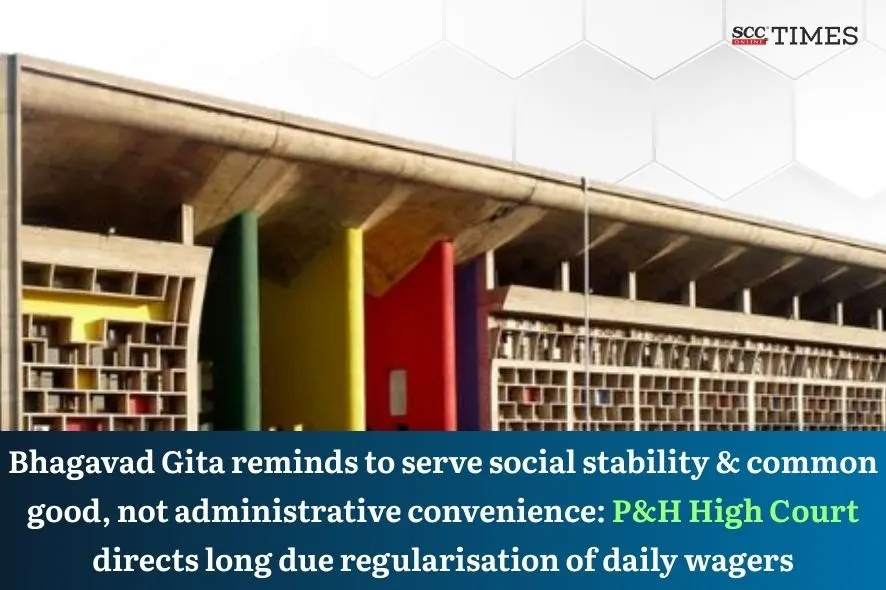
Punjab and Haryana High Court: While considering a bunch of forty-one petitions filed by the daily wage workers seeking directions for the Respondent-Department to regularise their services in accordance with the Governments regularisation policy, a Single Judge Bench of Sandeep Moudgil, J., held that our ancient texts repeatedly place upon the sovereign an obligation to act with nyaya, anrishamsya, balanced governance and the idea of lokasangraha as discussed in the Bhagavad Gita reminds State its duty to common good and that action must serve social stability, not merely administrative convenience.
Accordingly, the Court directed the respondents to regularise the petitioners
Background
In 1994, the petitioner was engaged by the respondent department as a daily wage worker and from his initial engagement, he continued to work with the respondent on the post of Water Pump Operator/Tube-well Pump Operator. His work and conduct remained satisfactory throughout his service.
In 1993, 1996, 2003 and 2014, the Government of Haryana issued various policies for regularisation of services of casual and daily wage employees, but the petitioner’s services were not regularised under any. Even though the petitioner approached the respondent several times, his case was not considered for regularisation.
In September 2025, the petitioner submitted a representation to the respondent seeking regularisation of his services; however, no final decision was communicated to him. Aggrieved by the same, he approached the High Court.
Analysis and Decision
The Court stated that “Judicial review in service jurisprudence is not confined to the margins of administrative discretion. Where State action results in unequal civil consequences, the Court is duty-bound to examine not merely the form but the substance of the decision-making process.”
Thus, the Court noted that the issued involved in the case at hand was that whether or not the respondents acted arbitrarily in declining to consider the petitioner’s claim for regularisation of service despite his long-standing engagement and continuous performance of departmental duties.
The Court stressed that in a constitutional democracy, the State does not function as a private employer free to hire and discharge personnel at will, rather, it acts as a trustee of public power. Where ad hoc employees have, over successive years, shouldered the routine by keeping essential services moving, the law will not permit the State to consume their labour as if it were an endlessly renewable commodity, and then disclaim responsibility by simply labeling them “contractual”. The Court further stated that “The Constitution of our country looks past nomenclature, and asks the harder question as to what is the true character of the engagement, and what does fairness require of a welfare State that has enjoyed benefit of such service for a considerably long period of time.”
The Court referred to State of Karnataka v. Uma Devi (2006) 4 SCC 1 (‘Uma Devi case’) and stated that the petitioner’s case for regularisation was viewed only in capacity of him being a mere contractual or daily wage worker, however, the record reflected that the petitioner had rendered service to the respondent for nearly three decades. Further, despite the existence of multiple regularisation policies and regularisation of similarly situated employees, the petitioner’s claim was neither meaningfully considered nor decided, even upon a formal representation. Such inaction of considering the case of the petitioner for regularisation, coupled with selective application of policy, borne the imprint of arbitrariness.
The Court viewed that the respondent’s approach reflected a perpetuation of temporary status for work of a perennial nature, thereby attracting judicial scrutiny and warranting intervention. The Court stated that the State should not inflict injustice upon members of the lower strata of society who served it for many years and would otherwise suffer undue hardship. The Court further stated that it repeatedly underscored that State should not perpetuate ad-hoc or contractual employment by issuing regularisation schemes at their convenience.
Further, the Court stated that service jurisprudence recognized that the State should not be allowed to profit from its own inaction. When an institution extracted work for decades and then pleads, “there are no sanctioned posts”, it did not state an inevitability of nature rather, it confessed an administrative choice.
Regarding the respondent’s contention that the present petition suffered from delay and latches, the Court stated that once the State Government formulated and published a regularisation policy, it is under an obligation to implement the same, particularly in a socialistic welfare State where hundreds of similarly situated employees were considered. The State, being a model employer, is expected to act as a parent towards its employees, especially where the employees belong to an illiterate class and the lowest strata of society. Further, the Court stated that “In such circumstances, the State is expected to act promptly and not allow its officials to remain in a state of inaction, thereby compelling employees to approach the Court for enforcement of their legal rights, which otherwise ought to have been considered in due course on the basis of the record available with the respondents in a transparent and fair manner, thereby rendering the cause of action as a continuing one.” Thus, the plea of delay and laches was wholly misconceived and could not be permitted to defeat the substantive and accrued rights of the petitioner.
Further, the Court stated that “the ruler’s foremost duty is protection and fairness to those who sustain the State’s functioning. Our ancient texts repeatedly place upon the sovereign an obligation to act with nyaya, anrishamsya, balanced governance and the idea of lokasangraha as discussed in the Bhagvad Gita reminds public power that action must serve social stability and the common good, not merely administrative convenience.”
Thus, the Court held that regularisation could not be claimed as a matter of right where the initial entry was illegal or plainly unconstitutional but where the engagement was long, continuous, against sanctioned vacant posts of duly qualified persons, the State is under a constitutional duty to undertake fair consideration and to complete the one-time regularisation exercise. Further, where the State’s defence is merely a change of label “contractual” while it continues to extract perennial work for years, Courts are entitled to pierce the veil of form, test the action on the anvil of the Constitutional ethics, and prevent the welfare State from becoming an architect of injustice. The Court further stated that “Article 14 & 16 of the Constitution do not merely regulate entry into public service, but they govern the entire life cycle of public employment of State. The constitutional promise is not exhausted once an employee crosses the threshold of appointment, but it is a dynamic guarantee to safeguard against arbitrary action of the State including denial of legitimate consideration.”
Hence, the Court held that since the respondent failed to accord petitioner’s due consideration, the State now should not evade its constitutional and administrative obligations by resorting to procedural objections of its own creation. Thus, the Court allowed the present petition and set aside the orders rejecting the petitioners’ claims for regularisation.
The Court directed the respondents to regularise the petitioners in accordance with the law and under the relevant regularisation policy in force when the petitioner first became eligible, including, but not limited to, the policies of 1993, 1996, 2003, and 2011. The Court further directed that the petitioners who do not fall under the above policies but have rendered services of more than 10 years. Should be granted the benefit of regularisation.
[Joginder v. State of Haryana, 2025 SCC OnLine P&H 18409, decided on 31-12-2025]
Advocates who appeared in this case:
For the Petitioners: Ravinder Malik and Vikas Chatrath, Sr. Advocates, Aman Nain, Rishab Arora, Shalender Mohan, K.S. Khehar, Arnirudh Malhar, Haridhi Aggarwal, Preet Agroa, Navdita Rathore, Tarurag Gaur, Harmanjeet Kaur, R.S. Mamli, Jawahar Lal Goyal, Parth Goyal, Nitin Katoria, Ajay Chaudhary, Raman B. Garg, Mayank Garg, Navdeep Singh, Jai Shree Kaushik, Shrey Goel, R.S. Nain, Sandeep Thakur, G.S. Dhaliwal, D.S. Nain, Satpal Nain, B.S. Beniwal, Deepak Sonak, Raman Sharma, Vinod Bhardwaj, Nipun Bhardwaj, Deepak Grover, Sandeep Sharma, Rohan Moudgil, Maninee, Sanjeev Sheoran, Suvir Sidher, Harlove Rajput, Manjot Bhullar, J.S. Maanipur, Harpreet Kaur, L.K. Gollen, Bharti Gollen, Himanshu Bansal, Jasleen Kaur, Mohit Garg, Ashok K. Sharma, Suman Sharma, Sandeep Sharma, Rohan Moudgil, and Maninee, Advocates
For the Respondent: Deepak Balyan, Addl. AG. Haryana, Mayuri Lakhanpal Kalia, DAG Haryana, R.D. Sharma, DAG Haryana and Jagdeep Singh