
About Anjuman I Islam
Anjuman-I-Islam is a not-for-profit educational institution with a distinguished legacy dating back to 1880, dedicated to developing a world-class education system aligned with national priorities and grounded in excellence, inclusivity and strong moral values. A pioneer of modern education in India, Anjuman-I-Islam played a key role in shaping early education policy by advocating vocational, technical, physical and girls’ education. Incorporated in 1946 as a Section 8 Company and registered under the Maharashtra Public Trusts Act, it serves as the sole trustee of several trusts and waqfs. Over the decades, Anjuman-I-Islam has established an unparalleled network of institutions across general, professional and technical education. Known for initiatives such as kindergarten education, mid-day meals and student support schemes, Anjuman continues to empower learners with knowledge, civic responsibility and values, under the visionary leadership of Dr. Zahir Kazi (Padma Awardee — 2024).
About Anjuman- I-Islam’s Barrister A.R.Antulay College of Law
Anjuman-I-Islam’s Barrister A. R. Antulay College of Law is a reputed Institution dedicated to providing quality legal education with a strong foundation in academic excellence and professional ethics. The College is affiliated with the University of Mumbai and is recognized by the Bar Council of India, ensuring that its programs meet established legal education standards. It offers undergraduate law courses that combine theoretical knowledge with practical training through moot courts, legal aid activities, internships, and seminars. With experienced faculty and a supportive learning environment, the College plays an important role in preparing students for successful careers in law, public service, and related fields. . The
College is accredited by the National Assessment and Accreditation Council (NAAC) B+, reflecting its commitment to maintain high standards in teaching research, and institutional governance
About University of Mumbai
The Department of Law at the University of Mumbai holds a distinguished position in legal education, recognized for its academic excellence at both national and international levels. It has earned international status for its long-standing contribution to legal scholarship and the training of legal professionals. The University of Mumbai is accredited by the National Assessment and Accreditation Council NAAC, reflecting its commitment to maintain high standards in teaching research, and institutional governance. With a robust curriculum, experienced faculty, and opportunities for global academic engagements, the Department of law continues to upholds its reputation as premier institution for legal studies
About Maharashtra State Human Rights Commission
The Maharashtra State Human Rights Commission (MSHRC) was established on 6 March 2001. The Commission in its full strength has a Chairperson and two Members. The MSHRC promotes respect for human rights. It uses education, information and publicity to promote, protect and enforce human rights. It also helps people to resolve situations where there might have been infringement by public servants of fundamental rights enshrined in the
President Anjuman I Islam
Dr. Zahir Kazi
(Padma Awardee — 2024)
Mr. Mushtaq Antulay (Hon. Vice President Anjuman I Islam)
Dr. Abdullah Shaikh (Hon. Vice President Anjuman I Islam)
Mr. Moiz Miyajiwala (Hon. Vice President Anjuman I Islam)
Mr. Shakil Shaikh (Hon. Tresurer Anjuman I Islam)
Mr. Aqeel Hafiz (Hon. General Secretary Anjuman I Islam)
Mr. Shoeb Jamkhanawala (Hon. Joint Secretary Anjuman I Islam)
Mr Shohab Rais (Hon. Joint Secretary Anjuman I Islam)
Mrs. Yasmin Saifullah (Hon. Executive Chairperson of Barrister A.R Antulay College of Law)
CONVENORS
Dr. (Adv.) Falaknaaz Shaikh I/c Principal, Anjuman I Islam’s, Barrister A.R. Antulay College of Law
Dr. Rajeshri Varhade Professor and Head of the Department, Department of Law ,University of Mumbai
CO-CONVENORS
Dr. Zaman Fatima Rizvi
Dr. Sanjay Jadhav
About the Conference
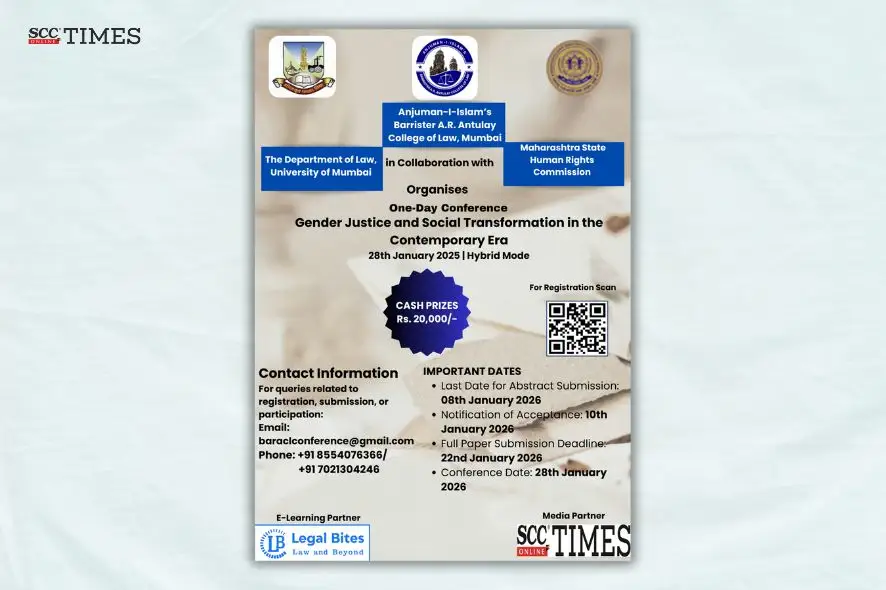
Anjuman-I-Islam’s Barrister A.R. Antulay College of Law, in collaboration with the Department of Law, University of Mumbai, proudly organizes a One-Day Conference on “Gender Justice and Social Transformation in the Contemporary Era” to be held on 28th January 2026 in Hybrid Mode. This Conference aims to bring together academicians, legal practitioners, researchers, human rights activists, policymakers, social workers, and students for an in-depth engagement with contemporary issues surrounding gender justice, equality, human rights, and societal reform. The Conference provides a dynamic platform to share research insights, exchange ideas, and promote awareness on the challenges and evolving frameworks in gender studies and social transformation.
Gender Justice and Social Transformation in the Contemporary Era Sub-Themes (Indicative, Not Exhaustive)
1. Role of Government in Gender Justice and Social Transformation
-
Policy interventions for gender equality
-
Government welfare schemes for women and marginalized genders
-
Gender budgeting and inclusive governance
-
Role of ministries and commissions in gender empowerment
-
Implementation gaps and administrative challenges
-
Government campaigns promoting gender sensitization
-
International cooperation and participation in global gender forums
2. Role of Judiciary in Gender Justice and Social Transformation
-
Landmark judgments advancing gender rights
-
Judicial activism and gender-sensitive interpretation of law
-
Constitutional safeguards and enforcement through courts
-
Role of PILs (Public Interest Litigations) in gender justice
-
Evolution of gender jurisprudence in India
-
Judicial reforms to enhance gender inclusivity
-
Comparative judicial approaches across jurisdictions
3. Statutory Framework in Gender Justice and Social Transformation
-
Central legislations promoting gender equality (e.g., POSH Act, Domestic Violence Act)
-
State-level gender reforms and initiatives
-
National conventions and treaties (CEDAW, ICCPR, ICESCR)
-
Labour laws and gender justice provisions
-
Criminal law amendments on gender-based violence
-
Anti-discrimination laws and policies
-
Challenges in implementation and compliance
4. Role of NGOs in Gender Justice and Social Transformation
-
Grassroots activism and community mobilisation
-
Legal aid and support services by NGOs
-
Awareness campaigns and gender sensitisation programs
-
Policy advocacy and lobbying for reforms
-
Shelter homes, crisis centres, and rehabilitation initiatives
-
Collaboration with government and National bodies
-
Capacity building and research contributions
Important Dates
-
Last Date for Abstract Submission : 08thJanuary 2026
-
Notification of Acceptance : 10th January 2026
-
Full Paper Submission Deadline : 22nd January 2026
-
Conference Date : 28th January 2026
Submission Guidelines
-
Abstract– 250 words Keywords– 5
-
Full-paper — 3000 to 5000 words.
-
Citation: APA
-
Font- Times New Roman
-
Size: Heading– 14, Body– 12, Footnotes– 10
-
Content should not be AI generated.
-
Participants must submit their full paper along with a plagiarism report, ensuring that the similarity index does not exceed 10%.
Registration Details
-
Registration Link: https://forms.gle/gMXZfaYPQJSZEic76
-
Registration QR:
Registration Fees
Category
Fees
Offline
₹ 850/-
Online
₹ 550/-
Publication
-
Selected research papers presented at the conference will be published in the University of Mumbai’s Peer-Reviewed Law Journal with an ISSN number and in an edited book bearing an ISBN.
Publication charges will be communicated to the selected authors
Awards & Certificates
Total Cash Prizes ₹ 20,000/-
-
For Best Research Paper in each theme ₹2,500/- Reward.
-
For Best Paper Presentation in each theme ₹2,500/- Reward
-
All Participants will receive Certificate of Paper