
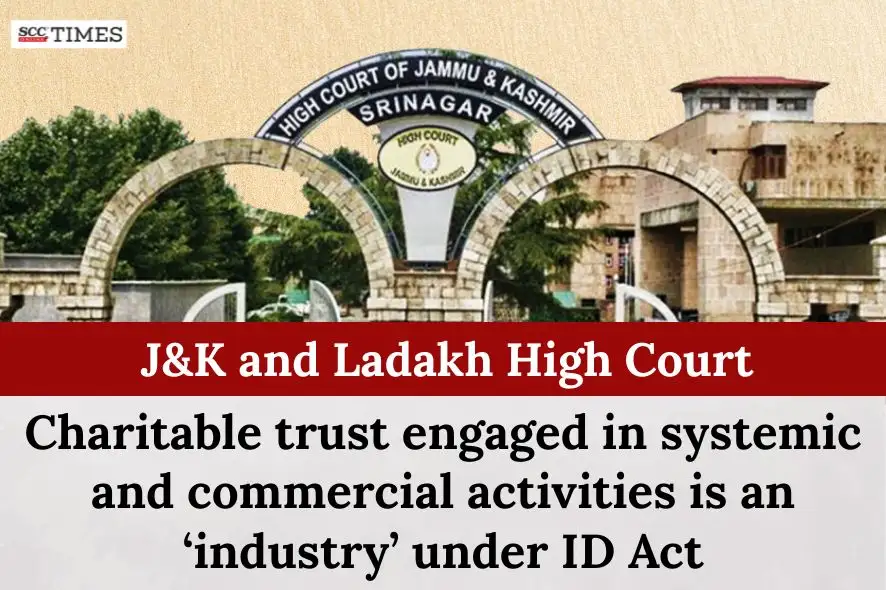
Jammu & Kashmir and Ladakh High Court: The matter concerned whether a charitable trust, engaged in multifarious activities including commercial ventures, could be classified as an ‘industry’ under Section 2(j) of the Industrial Disputes Act, 1947 (‘ID Act’), arising from the termination of a worker which the Industrial Tribunal had quashed as illegal while awarding 50 percent back wages. A Single Judge Bench of M.A. Chowdhary, J., while dismissing the petition challenging the Tribunal’s award, upheld that the Trust’s activities were systemic, organised, and commercial in nature thereby falling within the definition of ‘industry’.
Background:
Respondent 2 (‘worker’) was engaged as a Safaikaramchari on daily wages by the Dharmarth Trust (‘Trust’). The dispute originated when he was terminated due to repeated absence from duty. The Government of Jammu & Kashmir referred the matter to the Industrial Tribunal, which passed an ex parte award on 09-09-2003, declaring the termination illegal and granting 50 percent back wages from the date of his termination till the passing of the award.
The Trust challenged the award on the grounds that it was not an ‘industry’ under Section 2(j) of the ID Act, and therefore the worker was not a workman, making Section 25-F inapplicable. It was argued that the Tribunal acted without jurisdiction and that the proceedings suffered from non-compliance with fundamental judicial procedures and misconception as to the provisions under Section 36 of the ID Act. The Trust contended that unless there was a finding recorded by the Tribunal that the Trust was an ‘industry’ and the worker was a ‘workman’, as defined in Section 2(s), and there existed an ‘industrial dispute’, as defined in Section 2(k) of the ID Act, the Tribunal could not have acquired the jurisdiction to adjudicate upon the said reference. It was also alleged that the Trust’s representatives were not allowed to appear before the Tribunal, and the Trust as such had gone unrepresented before it.
However, the worker argued that once a reference was made by the Government, the same was required to be answered by the Industrial Tribunal or Labour Court and had the Trust any grievance against the reference, it was at liberty to challenge the reference order and the omission on their part impliedly admitted the legal position which was now disputed. It was submitted that the writ petition was hit by doctrine of delay and laches as the impugned award passed in the year 2003 was challenged in the year 2005 after a delay of more than two years. It was alleged that the Trust was not a religious and charitable institution, but it carried on multifarious activities and was also involved in the business and trade and therefore, was covered within the definition of ‘industry’.
Analysis and Decision:
The Court opined that to determine whether the ID Act applied to the Trust, it must be seen whether the Trust’s activities were commercial or analogous to trade or business; if the surplus generated was used for charitable purposes; or if the Trust operated factories, production units or any sustained commercial ventures, for example, manufacturing automobiles parts, running a commercial hospital wing, etc. These specific operations fell under the ID Act and if the Trust hired employees for these activities in an organised manner with proper remuneration, they were considered workmen with statutory rights. It was also the law that the ID Act generally did not apply to purely spiritual or religious activities conducted by the Trust. Therefore, the applicability of the ID Act to the Trust must be determined by the functional nature of its specific activities, not just its overall charitable designations.
The Court noted that even though the Revenue Officer of the Trust appeared before the Labour Court, he did so without any authority letter and did not even file objections even after being given the time to do so. The Court observed that the Trust had thus intentionally and deliberately absented itself from the Labour Court which led to the ex parte proceedings.
The Court applied the Triple Test and Dominant Nature Test as crystallized in Bangalore Water Supply & Sewerage Board v. A. Rajappa, (1978) 2 SCC 213, which laid down three criteria:
-
Whether the organization engages in a systemic and organized activity;
-
Whether there is cooperation between the employer and the employees; and
-
Whether the activity of the organization is for the production or distribution of goods or services, designed to satisfy human wants or wishes (excluding those that are merely spiritual or religious in nature).
The Court noted that the Trust was created based on donations for the maintenance, upkeep and welfare of the Hindu religious places, endowments, temples and places of worship. The Court held that as per the Triple Test, the Trust’s activities were systemic and organised, aimed at fulfilling human wants, including spiritual or religious needs, while also involving commercial operations. Therefore, its functions were not purely religious or selfless but carried out in a commercial manner, thus falling within the definition of ‘industry’. The Court further opined that since the activities of the Trust fell within the definition of the ‘industry’ as defined under Section 2(j) of the ID Act, as such, the relationship between the worker and the Trust could be stated to be that of employer and workman as contemplated under the Act.
The Court further observed that the Trust had failed to contest the reference before the Tribunal, thereby forfeiting its right to raise such objections at a later stage. The Court distinguished earlier findings in unrelated cases concerning gratuity claims, noting that those facts could not be applied to the present dispute.
Consequently, the Court upheld the Tribunal’s award and dismissed the petition as misconceived.
[Dharmarth Trust J&K v. Industrial Tribunal, 2025 SCC OnLine J&K 1266, decided on 19-12-2025]
Advocates who appeared in this case:
For the Petitioner: Ashwani Thakur, Advocate.