


Disclaimer: This has been reported after the availability of the order of the Court and not on media reports so as to give an accurate report to our readers.
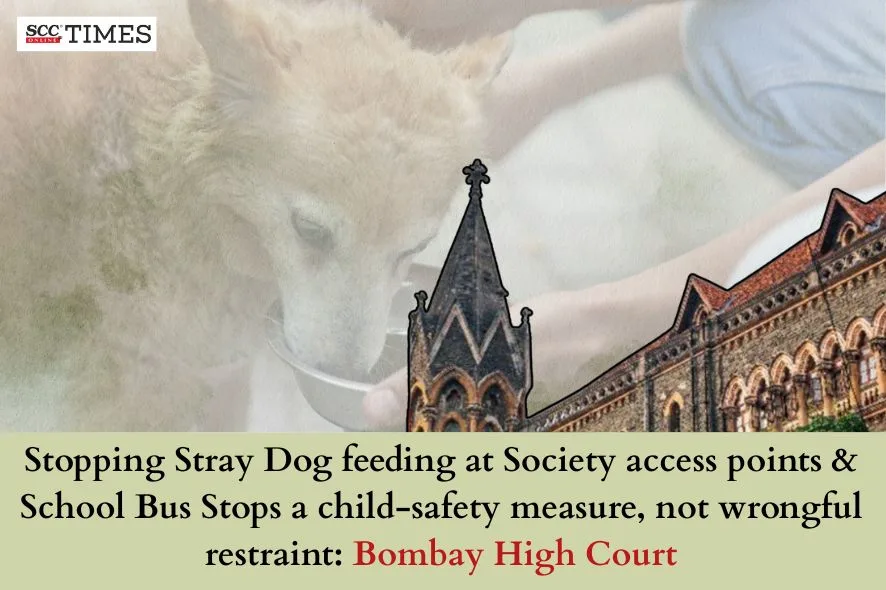
Bombay High Court: In an application filed for quashing and setting aside of the FIR for the offences punishable under Sections 126(2), 351(1), 351(2) of the Bhartiya Nyaya Sanhita, 2023 (BNS) and the consequential criminal proceedings pending before the Judicial Magistrate First Class, Pune, a Division Bench of Revati Mohite Dere and Sandesh D. Patil,* JJ., quashed the FIR and the consequential criminal proceedings and held that stopping someone from feeding stray dogs near footpaths, society entry—exit points and school bus stops is a child-safety measure and restriction thereon is not “voluntary obstruction” under Section 126 of the BNS.
In the instant matter, the FIR was lodged by Respondent 2, an employee of TCS, alleging that on 12-09-2024, while she and her colleagues were feeding stray dogs near Megapolis Mystic Society, the applicant objected to such feeding, questioned their authority and allegedly attempted to snatch her mobile phone when she began recording the altercation. It was further alleged that when the informant proceeded towards her car, the applicant stood in front of the vehicle and thereby prevented her from leaving the spot.
The applicant contended that the feeding of stray dogs was being carried out at entry/exit points of the society and near the school bus pick-up area, thereby posing a serious safety risk to children. It was contended that over the preceding months, nearly 40 incidents of dog bites had occurred in the society, including a serious incident involving a child on 01-09-2024. The applicant asserted that the objection was raised in good faith, in the interest of safety, and that the FIR was a counterblast to complaints earlier lodged by him against the informant.
The Court noted that the gravamen of the allegation was that the applicant obstructed the informant from feeding stray dogs and allegedly stood in front of her car.
Interpreting Section 126 of the BNS, the Court emphasised that wrongful restraint postulates voluntary obstruction so as to prevent a person from proceeding in a direction in which such person has a legal right to proceed. The Court observed that “the essence of Section 126 of the BNS is the voluntary obstruction of any person, so as to prevent a person from moving in any direction they have a legal right to proceed.”
The Court found the allegation regarding blocking of the car to be vague, and noted that the informant had not clarified whether the vehicle was in motion or parked. The Court further observed that preventing feeding of stray dogs at non-designated areas, particularly near school bus stops and society entry/exit points, could not be equated with wrongful restraint.
“Feeding of the stray dogs in an particular areas, more particularly, footpath, entry and exit points of the society and school bus stop, where the kids of the society board and alight of the school buses, is very crucial for the safety of the children and that obstructing from feeding the stray dogs in these areas cannot be said to be a voluntary obstruction within the meaning of Section 126 of the BNS.”
Relying upon the Exception to Section 126, the Court held that obstruction in good faith, based on a belief of lawful right, does not constitute an offence. The Court observed that any reasonable resident of a gated society would be justified in objecting to feeding of stray dogs by a person outside the society, especially when safety concerns were involved.
The Court placed reliance on Re: “City Hounded by Strays, Kids Pay Price” (AIR Online 2025 SC 783), wherein the Supreme Court took judicial notice of the alarming rise in dog bite incidents and underscored the dangers of unregulated feeding of stray dogs in public places. The Court also made reference to the Animal Birth Control Rules, 2023, which contemplate designated feeding areas, reinforcing the Court’s view that feeding at sensitive locations could legitimately be objected to.
With respect to Sections 351(1) and 351(2) of the BNS, the Court noted that these are non-cognizable offences, and in the absence of a cognizable offence under Section 126, registration of the FIR itself was unsustainable.
The Court further took note of the four-month delay in lodging the FIR and the fact that the applicant had filed complaints against the informant prior in point of time, lending credence to the argument that the FIR was retaliatory.
The Court held that the FIR was an abuse of the process of law and that even on a plain reading of the allegations, no offence was made out. Exercising powers under Section 528 of the BNSS, the Court quashed the FIR and the consequential criminal proceedings.
[Ayyappa Swami v. State of Maharashtra, 2025 SCC OnLine Bom 5393, Decided on 18-12-2025]
*Judgment by Justice Sandesh D. Patil
Advocates who appeared in this case:
Mr. Mohan Anant Vishnu, Counsel for the Applicant
Ms. Gauri S. Rao, A.P.P, Counsel for the Respondent No. 1/State
Mr. Sumit Gadade i/b Mr. Shubham Gadade, Counsel for the Respondent No. 2


If animals can’t be fed on footpaths then there is no other place to feed them. They also have the same right to live, as humans and human children do. No court has the right to take away the right to live or the right to feed any animal by citing children all the time. As it is no one has designated any area in any city in India where animals can be fed so that they can eat in peace! Shameful society India has become