
1. To begin with, please introduce yourself to our readers and share a brief overview of your journey in the legal profession.
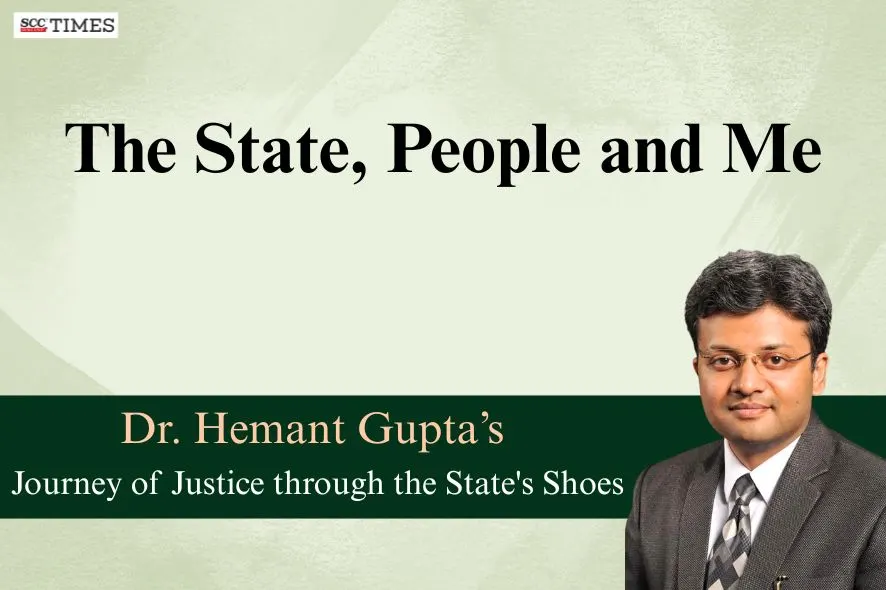
I am Dr Hemant Gupta, a practising Advocate in the Supreme Court of India. I have done my LLB from Maharshi Dayanand University, Rohtak, Haryana, which is also my native place. After doing my LLB, I got enrolled with the Bar Council of Punjab & Haryana, then in early years of practise, I shifted my base to Delhi and since then have been practising across various forums/courts/tribunals/commissions situated in Delhi, including trial courts. I had natural inclination towards law because of my family background, being a third-generation lawyer, however, except me, everyone in my family dealt exclusively in income tax laws.
You must have heard about this popular conventional advice prevalent in our profession that your first cases would come from your family and near relatives. But as a very interesting contrast, I was only my first client and had to file case against statutory bodies concerned for processing my Bar enrolment transfer request, about which of course I am very proud, especially because I had successfully addressed the Delhi High Court all by myself during the infancy days of my career. It has been more than 20 years but I distinctly remember how Justice Manmohan Sarin, who had a characteristic of encouraging young professionals, supported my cause and granted expedited and effective relief due to which my enrolment got transferred from the rolls of Bar Council of Punjab & Haryana to that of Delhi. On a lighter note, it felt really blessed to start the practice with 100 per cent success rate. Thereafter, there was no looking back and the complete focus has remained on the task/client/case at hand.
There is no straitjacket formula and can never be a water tight compartmentalisation with respect to the question of the duration a young advocate must devote to and within a chamber of a Senior/Experienced Advocate. That being said so, as in my career trajectory, I had spent considerably shorter duration than usual with the office of an experienced advocate and was fortunately able to independently stand on my feet in the early days of the profession which could not be possible without the blessings of providence. The same should never be blindly followed by any young professional as what works for you may not work for me and vice-versa. Thus, it is always a wise decision to primarily trust your guts and keep on experimenting which eventually helps you in evolving. Eventually, I gained experience to appear and represent on behalf of Union of India in the Delhi High Court as Government Pleader and also on behalf of the Government of National Capital Territory of Delhi as its Senior Panel Counsel.
2. As the Additional Advocate General for Haryana, how do you navigate the dual responsibility of representing the State while upholding the broader interests of justice?
Irrespective of the fact as to whether your client falls within the definition of Article 12 of the Constitution of India or is a private citizen, the approach to unveil the injustice before the court of law must remain the same. As I believe that one’s ability to protect the interest of a client to the best of his capabilities is paramount, which makes the diligence more important, especially when the State is your client, because many a times, knowingly or unknowingly, effective assistance could not be received without active demand/friendly interrogation made by the State Counsel; as no personal pocket would be at loss if the State losses but as the fact of the matter is, it is ultimately the public exchequer/tax contributor who bears the loss. In fact, in my experience as law officer for the State of Haryana, I have come across many incidents wherein important and crucial documents could not be placed on record because of negligence/fault of the non-supply of such documents by the dealing hand concerned. Many a times, the documents are placed on record first time before the Supreme Court of India by filing additional documents, which itself is a challenging task to get it considered favourably. The Supreme Court rarely exercises its power to take additional documents on record particularly when the special leave petition (SLP) arises out of trial proceedings and not from writ, due to which even the meritorious matters get rejected.
With the spirit of upholding the broader interest of justice, I respect and welcome the judicial activism whereby the courts fix the responsibility of any State Department’s malfeasance and misfeasance to that of erring official and not on the public exchequer. It is worth to mention one of such judgments, i.e. in LDA v. M.K. Gupta3, whereby the Supreme Court had directed the department concerned to recover the compensation-paid from those who are found responsible for such unpardonable behaviour because it is the tax payer’s money which is paid for inaction of those who are entrusted under the Act to discharge their duties in accordance with law.
In this regard, I also would like to touch upon a very important aspect of delay caused in the State matters while filing appeals/petitions, etc. to challenge the impugned orders. It is correct that law of limitation does not discriminate between individual and State as a litigant, however, in actual practice, if cases are being decided strictly taking the said approach, it may cause huge prejudice to the public at large, as in State’s cases there is no one individually affected but the public at large shall suffer on account of a wrong order/writ/decree getting finality only on account of delay and not on merits. Sometimes, huge public property is at stake and the courts simply dismiss the matter solely on the ground of delay without looking into the merits. This approach may not be inconsonance with the interest of justice. The courts must have a liberal approach in dealing with State matters and must consider condoning the delay liberally, especially in cases involving public property/public money/allegations of State officials involved in fraud, etc. as ultimately, it is the public which is going to suffer in case of any perverse order getting upheld due to technicality of delay or other procedural errors/lapses. In support of the above discussion, it is succinct to mention the observation of the Supreme Court retuned in State of Haryana v. Chandra Mani4, wherein it has been observed, while giving due consideration to larger public interest, that:
11. …Considerable delay of procedural red-tape in the process of their making decision is a common feature. Therefore, certain amount of latitude is not impermissible. If the appeals brought by the State are lost for such default no person is individually affected but what in the ultimate analysis suffers, is public interest. The expression “sufficient cause” should, therefore, be considered with pragmatism in justice-oriented approach rather than the technical detection of sufficient cause for explaining every day’s delay…
In my view, for the acts of the State officials in causing delay (whether deliberately done to benefit private party or otherwise), the State should not be made to suffer and it is the individual who must be held responsible and the courts may order enquiry against the erring official causing delay/lapses and may order for imposition of cost while condoning delay to be recoverable from the official concerned.
While dealing with a criminal matter, the conflicting theories of “personal liberty” and “effective investigation” often comes toe to toe. As in my personal belief, in process of upholding Rule of Law, neither one can be purely chosen by neglecting the other, but it is the process of effective investigation with due regard to larger interest of the society collectively with minimum required intervention to personal liberty, should be the resort. Ultimately, every decision particularly with respect to the grant/refusal of bail has to be taken on a case-to-case basis and no straitjacket formula can be applied while dealing with the criminal cases. As a State Counsel, the role and responsibility should not be to implicate someone or to seek custody in every matter by opposing bail petitions but to render effective assistance to the court by putting forth the correct factual position and need for custodial interrogation, however, without compromising or losing sight of the aspect that the habitual offenders/accused of the given case may cause a threat to the society or witness in that particular case.
3. You have an extensive experience in both litigation and arbitration. How do you view the relationship between courts and arbitration in today’s legal landscape?
On a lighter note, I expect this relationship to be as sour as possible so that there could be minimum judicial interference while parties resort to arbitration except to facilitate the latter.
There are countless advantages of arbitration over the conventional courtroom litigation such as confidentiality, convenience of parties, expedited disposal, less complex procedure, adjudicator with subject-matter expertise, less dependency on technicalities of procedural law, etc. With the enforcement of strict timelines for the disposal of arbitration proceedings, we often witness very effective and timely resolutions of disputes every day. The Arbitral Tribunal being an adjudicatory body constituted specifically to adjudicate a particular case only which may have the flexibility to include the subject experts besides legal experts, which is not possible in the case of courts.
In my opinion, if the legislature provides some specific timelines for disposal of Sections 34 and 37 proceedings under the Arbitration and Conciliation Act, 1996 (1996 Act) and establishes specific/dedicated courts to that effect, then in no time, our Nation would rank up as a preferred “International Centre for Arbitration”.
Of course, it is the job of the legislature to provide for scope of the interference in the entire arbitration process at the end of the judiciary, however, when there is a vacuum where the provisions of the 1996 Act are silent, the same necessitates the indulgence of the judiciary to fill up the vacuum by way of judicial pronouncements. The presence of any ambiguous area in any law can be interpreted by the judiciary as it is its important function but what about that legislative vacuum which remains unfilled. If the same are being filled by the judiciary, then it will be quickly termed as judicial overreach, in case it is being left as it is, then it has the potential of becoming potholes in the way of delivering justice. The Supreme Court has faced with such a situation in Arif Azim Co. Ltd. v. Aptech Ltd.5, whereby the question of application of the Limitation Act, 1963 over the petition filed under Section 11, 1996 Act inter alia was in issue, whereby while deciding that Article 137, Limitation Act, 1963 shall apply to the petition seeking appointment of an arbitrator and also observed the following:
97. Before we part with the matter, we would like to mention that this Court while dealing with similar issues in many other matters has observed that the applicability of Section 137 to applications under Section 11(6) of the 1996 Act is a result of legislative vacuum as there is no statutory prescription regarding the time-limit. We would again like to reiterate that the period of three years is an unduly long period for filing an application under Section 11 of the 1996 Act and goes against the very spirit of the 1996 Act which provides for expeditious resolution of commercial disputes within a time-bound manner. Various amendments to the 1996 Act have been made over the years so as to ensure that arbitration proceedings are conducted and concluded expeditiously. We are of the considered opinion that Parliament should consider bringing an amendment to the 1996 Act prescribing a specific period of limitation within which a party may move the Court for making an application for appointment of arbitrators under Section 11 of the 1996 Act. The petition stands disposed of in the aforesaid terms.
(emphasis supplied)
Therefore, the collective efforts of legislature as well as the judiciary’s conscious self-restraint are required, so that the process of arbitration may become preferred, reliable and more effective.
4. You have served as a sole arbitrator and are empanelled with arbitration institution(s). What qualities do you believe are essential for maintaining neutrality and procedural efficiency in arbitral proceedings?
“Justice should not only be done, it should seem to have been done also.” An arbitrator has to strictly adhere to the said norm and is supposed to leave no stone unturned in adopting procedural fairness while conducting arbitration. Firstly, the declaration under Section 12, 1996 Act needs to be submitted at the threshold of arbitration proceedings itself and any fact which may remotely connect the arbitrator with any of the parties must be expressly mentioned in the declaration to rule out the slightest cloud over the impartiality of the arbitrator to adjudicate the issues. The Schedule V as inserted vide Amendment Act No. 3 of 2016 (w.e.f. 23-10-2015) expressly provides for the mandatory duty of the arbitrator to disclose any such reasons/past affiliation, etc. This even otherwise can be read into a basic principle of natural justice providing for a Bar upon a Presiding Officer of a court/tribunal dealing with any matter, which he can be remotely connected with. To say the least, the arbitrator is supposed to make full and complete disclosures regarding any such association with the counsel/party, in accordance with the spirit of Schedule V of the Act of 1996 and any objection arising from any party thereafter, with respect to the independence of arbitrator, may result in voluntary recusal, if the objection is based upon sound reasonings so as to uphold the principle mentioned above. No favours taken in the past as well as none expected in future, can make any office of the adjudicator to function as neutral and with utmost integrity. Parties must have complete faith upon the neutrality and integrity of the arbitrator.
With the enforcement of the Arbitration and Conciliation (Amendment) Act, 2015, more particularly the amendment made in Section 12, 1996 Act and the introduction of the Schedule V therein, have effectively dealt with removing most of the bias from the arbitration proceedings. Whatever scope was left, has also been taken care of by the Supreme Court in the judgments passed in TRF Ltd. v. Energo Engg. Projects Ltd.6, Perkins Eastman Architects DPC v. HSCC (India) Ltd.7, and Constitution Bench judgment in Central Organisation for Railway Electrification v. ECI SPIC SMO MCML (JV)8.
An arbitrator adjudicates a dispute so all the judicial qualities are required to fully justify the responsibility undertaken. In order to ensure procedural efficiency in contemporary times, an arbitrator, as well as the arbitral institutions preferably must be techno friendly with the latest relevant technology, as is the Delhi International Arbitration Centre (DIAC). As a person, the arbitrator presiding an Arbitral Tribunal must reflect the character of Caesar’s wife and there should not be any suspicion or doubt over his integrity, neutrality, independence, etc.
5. Mediation is gaining momentum as a structured mechanism for resolving disputes. From your experience, what makes a mediation process truly effective and enduring?
In the presence of able and trained mediators, we are observing that many disputes are settled even at nascent stage, even before they reach the court of law as in the case of commercial dispute where pre-institution mediation has been made mandatory by the legislature under Section 12-A, Commercial Courts Act, 2015, subject to exceptions. Mandatory nature of pre-institution mediation has already been upheld by the Supreme Court in Patil Automation (P) Ltd. v. Rakheja Engineers (P) Ltd.9.
It was difficult to believe how a non-binding procedure can be effective or fruitful but in contrast to all the criticism, it is effectively preventing clogging of courts of law especially in commercial and matrimonial disputes. Many a times litigation driven by ego and/or revenge end up increasing the pendency of the court with multiple litigations.
Sincerity of the parties to the mediation process, as well as the skills of the mediator in comprehending the dispute and counselling the parties towards mutually satisfactory outcome, while maintaining confidentiality, makes the process effective. Unlike the court of law, the flexibility of the mutually satisfied outcome with the help of the mediator guiding the parties towards resolving the dispute in order to reach a win-win situation for all the parties, makes it enduring as compared to court of law. It is equally important for the mediator to gain the trust of both the parties by having a neutral and impartial approach towards the solution, besides being patient, so that a comfortable and reliable atmosphere can be created during the mediation process. To draft a well-structured, settlement agreement, in accordance with law, is an important duty on the part of the mediator, so that the litigation or the dispute may be given quietus once for all. The legal knowledge of the mediator and his practical experience would definitely aid in drafting effective settlement agreements.
6. Legal aid and access to justice are often cited as areas needing urgent reforms. What steps can the legal community take to make pro bono work more structured and impactful?
This topic needs serious attention which should not only be a one-time effort but must be given a continuous nurturing, discussion and active attention. In present time, there is a common and popular feeling that with the enactment of the Legal Services Authorities Act, 1987 and further constitution of the National Legal Services Authority, State Legal Services Authority and District Legal Services Authority under the said Act, the complete responsibility of pro bono work has been delegated and the rest of the legal community is now relieved from undertaking such work. In suppression of such feeling, the importance of collective efforts needs to be revived and some institutional steps are more than welcome to increase the momentum of said revival. Towards the commitment of structuring the pro bono legal work to enhance access to justice, the legal community can undertake several concrete steps by framing and notifying guidelines qua pro bono policies within Bar Councils, Bar Associations and law firms, with clear annual commitments and quality benchmarks, to ensure consistent and organised delivery of services. It may also be considered that the weightage for providing pro bono work can be increased while deciding the suitability of the candidates applying for designation of Senior Advocate as well as for professional being considered for elevation to the Bench. The same formula can also be applied as eligibility condition for the candidates contesting the election of Bar Council and Bar Associations, which may effectively work as an incentive for the interested candidates. After all, the leaders of the Bar, must act as a flag bearer and a role model for the legal professionals to motivate them in doing their bit for the society. The authorities must also increase the budgetary allocation to the institutions providing legal aid so that the experienced and talented professionals may be attracted and retained in the panel and such legal aid panels may not merely reduce to be a learning stage for the young lawyers. In addition to this, collaborations can be done by involving legal aid authorities, law schools and non-governmental organisations (NGOs) to pool resources, provide training and widen the reach, especially to marginalised communities. To further provide driving force in the form of acknowledgment for investing pro bono working hours, awards can be introduced, professional credits system can be maintained and public acknowledgments can be organised to motivate legal professionals while integrating pro bono work as a criterion in judicial and professional advancements. The courts must more often request the Senior Counsels to accept appearing for litigants belonging to downtrodden and marginalised sections of society by acting as Amicus Curiae in the matter. In contemporary times, it goes without saying that technology can be leveraged to use and develop centralised digital platforms to match clients with pro bono lawyers efficiently, facilitate remote consultations and track impact to enhance accountability and accessibility. Last but not the least, a codified, organised and most impactful step could be taken on the part of legislature which can incorporate mandates or guidelines that recognise and promote pro bono contributions within the legal profession. Together, these initiatives can embed a strong culture of professional social responsibility within the legal community, making pro bono work more structured, impactful, and integral to ensuring equitable access to justice for all. In my opinion, nobleness and dignity of the legal professional will keep thriving as long as pro bono work keeps flourishing.
7. As a legal practitioner before the Supreme Court, what are the unique challenges and responsibilities that come with arguing matters at the highest level of the judiciary?
Before the Supreme Court, the one strategy which applies to everyone without an exception is that, you have put your best arguments in the least possible time. There is no beating around the bush and the ability to quickly think on your feet, as is already difficult to inculcate, becomes more difficult in light of the fact that there is no scope of any further appeal and this would be the last resort towards the process of seeking justice. Also, the limited indulgence expected under Article 136 of the Constitution of India makes it extremely difficult for any SLP to get entertained. Whatever is done here will attain the finality which offers no scope of error.
The qualities such as articulation of thoughts, command over English language, art of delivery, active listening, in-depth research, justice to the brief, etc. are much needed to face the challenges which the Supreme Court practice comes with.
The client is normally not aware of the limited scope of interference, i.e. the highly discretionary jurisdiction which the Supreme Court exercises only where question of law is involved. The client who is litigating/wants to litigate before the Supreme Court comes with a lot of hopes and considers the Supreme Court as a regular Court of Appeal, which in fact is not. Therefore, much actually depends upon the drafting of SLP/petition and utmost care should be taken in drafting of synopsis and list of dates. Often, it is seen that many crucial documents are not filed with SLP at all, leading to dismissal of petition itself.
One such incident which I could recall is that in one of the criminal matters where the conviction was upheld by the High Court despite weak evidence, the client approached with a lot of hope and during the conference became too emotional because of his concerns towards his family and emotionally stated that he would die if his bail is not favourably considered by the Supreme Court. This instilling of faith by the client brings too much of responsibility because it comes with a feeling that the fate of the client is in your hands even when you are well aware that in reality only the hard work is in your hand and rest is up to the judiciary to appreciate the merits. As it is the old saying that “the world stands on hope”, and the test of that hope comes to its final stage before the Supreme Court.
Another testing challenge is the listing of your case, maybe you come to know well in advance or maybe before few days or maybe just the night before the listing. This can only be tackled with your ability of preparedness in a short span of time and with the team of active associates as well as supporting staff. Particularly in State matters, the State Counsels many a times get brief a day before listing and get limited time for its preparation or for taking instructions from the department concerned. At that point of time, counsel has to be prepared for the matter by taking inputs from the petition itself by putting forth his client’s case at a short notice.
8. What is your opinion on the growing role of technology in the legal profession, particularly in court proceedings and arbitration?
Frankly speaking, I myself was very reluctant to rely upon and get in line with the digital transformation which took place more particularly during COVID-19. Even my associates persuaded me to get a tablet for more convenience in handling files, especially bulky case files, but as it is said, “old habits die hard”. It took me considerable time to make up my mind for start using tablet for court proceedings and making notes. Now after getting comfortable with the device and realising its utility and productivity, I can safely say that about COVID-19, that every cloud has a silver lining. Moreover, maybe I should also advice my associates to work upon their persuasive skills.
The role of technology in the legal profession can be suitably termed as “utmost convenience”. Now the parties and their counsels can appear virtually to conduct the proceedings. The Delhi High Court has also notified rules titled as the Electronic Evidence and Video Conferencing Rules, 2025 which inter alia provides conduct examination of witness(es) through virtual mode and other rules related to video conferring which apply to the High Court, all District Courts and Tribunals over which the Delhi High Court has jurisdiction and to all judicial, departmental and mediation proceedings. The same has decreased the occasions which consumes and waste precious judicial time especially the adjournment requests and resulted in being a catalyst in the justice delivery system. Now, the counsels no longer have to lift the bulky case files, reference books, bare acts and also not required to turn around pages, all has been replaced by “Ctrl + F”, linking of documents by way of LiquidText app and a click of a button. The judiciary has also changed its approach as now practically every court is allowing the counsels to appear and argue through Virtual hearing and video conferencing (VC) has been accepted as a normal mode of conducting proceedings. It saves not only the time of the counsels but gives them flexibility to appear in a number of matters in different courts in different jurisdictions, which ultimately results in efficiency in the administration of justice thereby causing lesser adjournments. The clients also are able to engage the counsels of their choice who can better contribute in the delivery of justice by appearing virtually if unable to appear physically. It is also pertinent to point out that judiciary also, is considering the service of pleadings through email and WhatsApp, as a valid mode of service which is gigantically reducing the overall carbon footprint of the litigation field by preserving pages and postal-service usages, besides making the system overall efficient and prompt. When it comes to arbitration, more particularly the ones with more than one arbitrator, technology comes to rescue by allowing the parties as well as the arbitrators to appear virtually from any part of the world, thus making it effective and convenient for all.
There is, however, another side of the coin that many incidents are reported where the counsels/litigants appear through VC in a highly inappropriate and deplorable manner. One has to also realise that there may be some technical malfunctioning in the application or on account of some inadvertent error at the end of VC operator of the court or by the user himself, resulting in accidental switching on the camera or mic and therefore one has to be appropriately dressed and behave properly following all protocols and guidelines all the times while being online and connected with court server. In this regard, various High Courts and Bar Councils have formulated guidelines to be followed while appearing virtually. To mention, the Delhi High Court has notified Rules as mentioned above and the Bar Council of Delhi vide letter dated 4-9-2025 has also framed guidelines for appearance in the courts through video conferencing regulating the VC appearance. One has to realise that even VC appearance is at par with physical appearance and the conduct of the appearing person should be in the same manner, as if appearing physically.
Use of artificial intelligence (AI) in drafting of pleadings has become prevalent, however, in practice it is often seen that there are serious shortcomings also while blindly relying upon the AI generated information. The pleadings generated is often seen to have been incomplete, with full of distorted facts. The research of case laws is specifically has proven to be misleading, dangerous and unless the same is verified from the authentic journals/sources, citing the same in court of law may result in miscarriage of justice as the AI has the potential to even create fake and imaginary cases giving them fictitious citations and case numbers, which actually does not even exist. Many such incidents have been reported throughout world and therefore it is the paramount duty on the part of the counsel to verify the authenticity of the case laws before citing them in court of law.
9. How do you think law schools and the Bar can work together to better prepare students for litigation, arbitration, and public service?
“Exposure teaches as well as inspires.” Law students belonging to colleges/institutions based out of metro cities or where a High Court or its Bench is situated, comparatively get better exposure which makes them more suited to choose career path than the ones who does not have enough exposure. Thus, I would suggest that more and more guest lectures and interactive sessions must be organised where experienced practitioners and Judges could shed some light qua litigation, arbitration, and public service. The arbitral institutions must accept more and more interns from law colleges and must impart them training for becoming better practitioners in their days to come.
We have much conversed, discussed and even appreciated about the imposition of compulsory three years of litigation experience required for an entry level judicial post, but what about the teachers inculcating and breeding budding lawyers and Judges. The question regarding importance of on-ground courtroom/practical experience necessary for a law teacher should be discussed. Courses on trial advocacy, cross-examination, arbitral procedure, evidence handling and legal drafting should be taught by senior practitioners as they have an upper edge over the faculty. Frequent workshops, moot simulations and arbitration sessions can help bridge the gap between theory and practice. There is an immense scope of improving quality of education if some practical training/exposure workshops could be organised with collective efforts of Bar and the teaching force of the country. In absence of such innovative initiatives, the cost of law education which is already on a higher end is keep on increasing as the young graduate or a law student, due to influence of a smart and conscious targeting of his/her insecurities, end up enrolling for several out-of-the-college courses which are advertised on the promise of teaching those things which are not being taught in law schools, but ideally it should be the part of a law school curriculum itself.
Also, Bar Councils can organise pre-enrolment training and professional ethics modules, ensuring students transition smoothly into the profession. By building structured pathways from classroom to courtroom and fostering constant engagement between academia and the practising Bar, the legal system can produce better prepared, ethically grounded and practice ready young lawyers for handling litigation, arbitration or even work in public service.
10. What message would you like to share with law students and young professionals who aspire to work in constitutional litigation and public law advocacy?
The message can be summed up just in two words, i.e. “be prepared”.
It may sound repetitive but it is worth repeating that there is no substitute for hard work. It is a long path to independently deal with a constitutional litigation but throughout the way you need to be updated and keep on studying the ongoing constitutional development. Also, frequently indulge in discussions and dialogues with someone more knowledgeable than you to discover different aspects, scope, interpretation and point of view. In that way, once the opportunity arrives, you would find yourself prepared to deal with the same.
Reading and interpreting law is an art and by enough practice and dedication any one can be an artist. Have a critical approach in dealings even when it is regarding drafting of pleadings. Analyse the reasonings given by the court whose order is under challenge, which would ultimately help in preparing robust grounds of appeal. Two of the many important skills are “observation” and “curiosity” which have the potential to take you to places. So, be curious like a novice child and observant like a forensic expert.
I believe, “One may feel that there are not good enough teachers until he becomes a good enough seeker.”
Never use AI-assistant tools as a teacher instead use them as assistant. Do not depend on it for directive tasks, rather ask “how to” questions. Use AI tactfully and instead of directing it to correct/paraphrase/draft a sentence or paragraph, draft it by yourself and ask it to examine its structural and/or any grammatical error. Bottom line is; one should not allow the AI assistance to take over his own analytical thinking, it can offer to turn into dependency which could ultimately have an adverse impact on creative and thinking skills of oneself.
1. Additional Advocate General, Haryana.
2. Student Ambassador, VIPS, GGSIPU.
3. (1994) 1 SCC 243 : (1994) 80 Comp Cas 714.
5. (2024) 5 SCC 313 : (2024) 3 SCC (Civ) 358.
6. (2017) 8 SCC 377 : (2017) 4 SCC (Civ) 72.
9. (2022) 10 SCC 1 : (2023) 1 SCC (Civ) 545.