
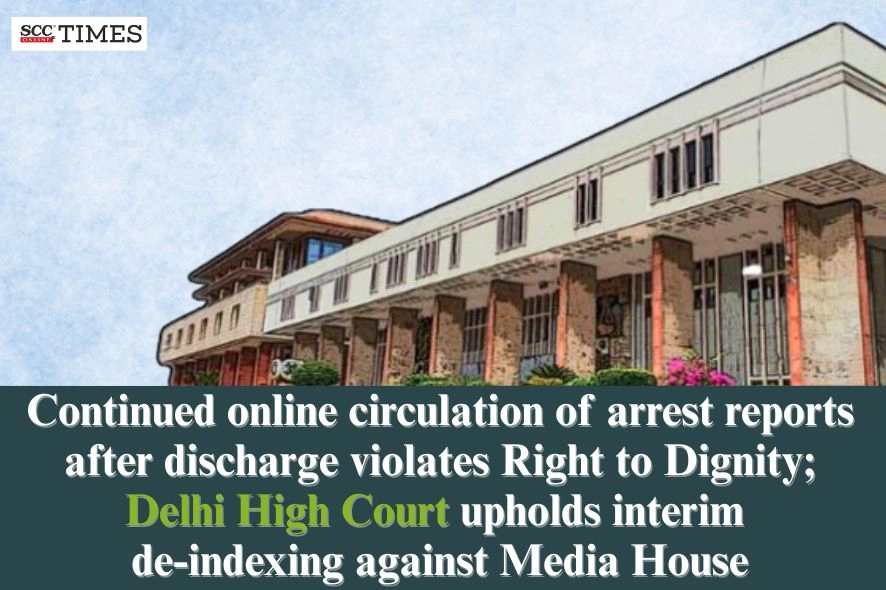
Delhi High Court: In an appeal challenging the trial court’s order allowing respondent-plaintiff’s application under Order XXXIX Rules 1 and 2 of the Civil Procedure Code, 1908 (CPC), a Single-Judge bench of Chandrasekharan Sudha,* J., upheld the interim de-indexing of impugned articles and held that continued online circulation of arrest reports after plaintiff’s discharge violates his Right to Dignity.
In the instant matter, the plaintiff, a professional banker with over seventeen years of experience in reputed international banking institutions, instituted a civil suit seeking permanent and mandatory injunctions along with damages. He asserted that he enjoyed a high standing and unblemished reputation in society. In August 2023, he was arrested by the Directorate of Enforcement in connection with proceedings arising out of alleged irregularities relating to M/s Moser Baer India Limited. Following his arrest, several news reports were published by various media houses and digital platforms, including the defendants, reporting the arrest and associating his name with the alleged offence.
Although these reports were published at different points in time, the plaintiff contended that they continued to remain accessible on digital platforms and search engines, thereby perpetuating an impression of guilt. Subsequently, the court discharged the plaintiff by order dated 17-08-2024, and held that no prima facie case was made out against him.
Despite such exoneration, the impugned articles and reports continued to be hosted, indexed and circulated online. According to the plaintiff, their continued availability of such articles was causing serious harm to his reputation, dignity and professional prospects. He therefore sought interim relief restraining further publication and circulation of such material and prayed for directions for de-indexing and de-referencing of the impugned URLs pending the suit.
The trial court allowed the plaintiff’s application and held that continued circulation of the impugned publications would cause irreparable harm to the plaintiff’s reputation. Aggrieved thereby, defendant 2 preferred the present appeal under Order XLIII Rule 1(r) of the CPC.
The Court noted that the principal issues that fall for determination are —
-
Whether the reliefs sought by the plaintiff, insofar as they were premised on the “right to be forgotten”, were liable to be rejected at the threshold on the ground of limitation under Article 75 of the Limitation Act, 1963 (Limitation Act)?
-
Whether the discretion exercised by the trial court in balancing the competing rights under Articles 19(1)(a) and 21 of the Constitution warranted interference in appeal under Order XLIII Rule 1(r) CPC?
The Court noted that there was no dispute regarding the plaintiff’s arrest in August 2023 or the contemporaneous publication of the news reports. Further, it was equally undisputed that the plaintiff was discharged on 17.08.2024 and that the criminal proceedings had culminated in his favour. However, the publication, circulation and indexing of the impugned articles continued even after such discharge.
On the plea of limitation, the Court observed that a perusal of the plaint revealed distinct prayers, including reliefs founded on the plaintiff’s right to privacy, dignity and right to be forgotten, apart from the claim for damages for defamation. The Court asserted that the question whether the plaintiff was ultimately entitled to such reliefs was a matter for trial, but it could not be said that the suit was barred in limine under Article 75 of the Limitation Act. The Court found that the plaintiff had approached the civil court shortly after culmination of the criminal proceedings in his favour. The Court rejected the contention that the suit was barred by limitation.
On the merits of the interim injunction, the Court relied on Dejo Kappan v. Deccan Herald, 2024 SCC OnLine Ker 6494, and observed that while the media enjoys freedom of speech and expression under Article 19(1)(a), such right “is not absolute and stands correspondingly delimited by the right of an individual to dignity and reputation traceable to Article 21 of the Constitution.” The Court reiterated that in appropriate cases, particularly where continued dissemination of content results in disproportionate harm to an individual, the right under Article 19(1)(a) must yield to the right under Article 21.
The Court held that the impugned order did not impose any blanket or pre-emptive restraint on journalistic activity as the relief granted was narrowly tailored and confined to the continued availability and circulation of specific articles relating to the plaintiff after the criminal proceedings had culminated in exoneration. The Court emphasised that “While reporting of arrests and investigations may serve public interest at the relevant time, the perpetual digital availability of such materials, even after the factual foundation has ceased to exist, raises serious concerns of enduring reputational harm and stigma.”
The Court rejected the argument that a brief update reflecting the plaintiff’s discharge sufficiently neutralised the harm and observed that “the mere addition of a brief/short clarification at the bottom of the alleged offending articles does not necessarily neutralise the dominant narrative or the continuing impact of the original publication.”
On balance of convenience, the Court agreed with the trial court that the prejudice to the plaintiff’s dignity, reputation and professional life was immediate and irreparable, whereas any inconvenience to the appellant was limited and reversible. The Court further noted that the impugned content was archival and behind a paywall, and therefore the interim relief would not materially affect its interests.
Finding no perversity or arbitrariness in the trial court’s direction, the Court held that no interference was warranted under Order XLIII Rule 1(r) CPC. Accordingly, the Court dismissed the appeal and allowed the interim injunction to continue pending final adjudication of the suit.
[IE Online Media Services (P) Ltd. v. Nitin Bhatnagar, 2025 SCC OnLine Del 9281, Decided on 18-12-2025]
*Judgment by Justice Chandrasekharan Sudha
Advocates who appeared in this case:
Mr. Nachiket Joshi and Ms. Chanan Parwani, Counsel for the Appellant
Mr. Trideep P., Sr. Advocate with Ms. S. Singh, Ms. Sakshi Jain, Mr. Nitesh Kumar Jha, Mr. Akshit Mago and Ms. E. Kashyap, Counsel for the Respondent 1
Ms. Apar Gupta, Ms. Avanti Deshpande, Mr. Naman Kumar and Ms. Indumugi C., Counsel for the Respondent 11
Ms. Mamta Rani Jha, Ms. Shruttima Ehersa, Mr. Rohan Ahuja, Ms. Aishwarya Debadarshini, Ms. Jahanvi Agarwal, Counsel for the Respondent 10
Mr. Manu Seth, Counsel for the Respondent 5 and 6
Buy Constitution of India HERE