
In the span of a year, the Supreme Court of India has delivered two decisions that significantly recalibrate the treatment of non-signatories in arbitration.
Introduction
In the span of a year, the Supreme Court of India has delivered two decisions that significantly recalibrate the treatment of non-signatories in arbitration. Read superficially, the rulings appear to pull in opposite directions.
The first decision, Ajay Madhusudan Patel v. Jyotrindra S. Patel1 is a three-Judge ruling on the powers and jurisdiction of the Referral Court and the conditions under which non-signatories can be referred to an arbitration. The Ajay case arose out of a family settlement recorded under a family arrangement agreement. One of the issues before the Supreme Court in this matter was whether a third family group, which was not a signatory to the instrument, could be considered a “veritable party” to the arbitration agreement to make a reference under Section 11, Arbitration and Conciliation Act, 1996 (Arbitration Act).
The later decision in Kamal Gupta v. L.R. Builders (P) Ltd.2, a Division Bench ruling, shifts the inquiry to a different stage of the arbitral lifecycle. It considers whether a non-signatory may even be present as an observer once the Tribunal is constituted, and whether a Referral Court may issue further directions after appointing the Tribunal.
In this case, the Delhi High Court issued an order permitting a non-signatory to attend the arbitral hearings and to access the pleadings and orders, despite not being a party to the arbitration agreement. This occurred after the Referral Court constituted the Arbitral Tribunal, and the case was otherwise disposed of. The Supreme Court overturned this order, ruling that the High Court had become functus officio once it appointed the arbitrator, and that even a permission to observe would breach the statutory duty of confidentiality under Section 42-A, Arbitration Act.
The central issue in case of Ajay3 and Kamal4 is how flexible the arbitral process should be towards the participation of non-signatories. Ajay advocates for an inclusive and consent-based approach to defining a “party” at the reference stage, warning against a conservative judicial interpretation that would exclude necessary non-signatories from arbitration. In contrast, Kamal adopts a strict privity-based approach where Section 42-A, Arbitration Act was applied to prevent non-signatories from even observing the arbitral hearings. To complicate matters, the decision in the case of Ajay was rendered earlier and by a larger Bench. However, the ruling in Kamal provides a more detailed assessment of the interplay between confidentiality-related requirements under the Arbitration Act and party status, and privity of contract.
Statutory framework governing parties, referral jurisdiction and confidentiality
Section 2(1)(h), Arbitration Act defines the word “party” as a party to an arbitration agreement.
Section 7, Arbitration Act sets out the essential elements of an arbitration agreement. Although the provision does not insist on a signature as a formal requirement, it still proceeds on a distinction between those who are parties to the agreement and those who are not, a status that may be discerned from the terms of the instrument and the surrounding correspondence, as the case may be.
While Section 16, Arbitration Act provides for the competence of Arbitral Tribunals to decide on their own jurisdiction (in line with the competence-competence or kompetenz-kompetenz principle), the Arbitration Act also envisages a limited gatekeeping role of the courts in the reference stage under Sections 8 and 11.
Section 35, Arbitration Act states that an award shall be final and binding on the “parties” and “persons claiming under it”, and this strengthens the traditional distinction between parties and non-parties.
Two additional provisions, which are particularly significant in the Kamal case, include Sections 5 and 42-A, Arbitration Act. Section 5 limits judicial intervention in the arbitral process, unless so stated and provided for in the Arbitration Act itself. Section 42-A (as introduced in 2019) declares that all arbitral proceedings must be kept confidential by the arbitrator, the arbitral institution and the parties to the arbitration agreement, except where the award has to be disclosed in order to be implemented and enforced. Section 42-A is notable for its conciseness. It does not specify clear exceptions or how confidentiality should balance with other factors, such as due process or the practical needs of multi-party complex cases.
It is on that background that Ajay5 and Kamal6 address the moot question.
Ajay Madhusudan Patel
The dispute in the case of Ajay arose from a complex network of familial and corporate relationships. The family groups involved were three in number, each associated with a cluster of companies. In pursuit of a comprehensive settlement, two of these groups, the AMP Group and the JRS Group, as identified in the judgment, entered into a family arrangement agreement (FAA) in February 2020, which incorporated an arbitration clause. This mechanism was further reinforced by an amendment to the FAA in May 2020.
Although the FAA was executed solely by the AMP and JRS Groups, it acknowledged certain obligations to be fulfilled by entities affiliated with a third group called the SRG Group. Pursuant to the FAA and its amendment, the petitioners, belonging to the AMP Group, filed a petition under Section 11, Arbitration Act, to appoint a sole arbitrator for resolving disputes with the respondents. A key issue was whether the non-signatory SRG Group could be subjected to arbitration.
The SRG Group opposed the petition, asserting that it was neither a signatory to the FAA nor a confirming party and, lacking a direct arbitration agreement, could not be compelled to arbitrate.
A significant portion of the judgment elaborates on the scope of the jurisdiction of Section 11 Court. The Supreme Court reaffirmed that a Referral Court’s function is limited to a prima facie review rather than conducting a mini-trial on disputed facts. If, upon a reasonable interpretation of the available material, an arbitration agreement appears to exist, and the dispute arguably falls within its scope, the Court must refer the matter to arbitration, leaving complex issues such as joinder and jurisdiction for the Arbitral Tribunal under Section 16, Arbitration Act. This reflects legislative and judicial trends post-2015, emphasising limited judicial intervention at the pre-reference stage and respecting the Tribunal’s competence-competence principle.
The Supreme Court then addressed the issue of non-signatories, citing evolving jurisprudence in decisions such as Cox & Kings Ltd. v. SAP India (P) Ltd.7, which held that Sections 2(1)(h) and 7, Arbitration Act do not restrict arbitration to be confined to signatories alone. The governing principle, often termed the group of companies doctrine, is also rooted in consent, which may be demonstrated by surrounding circumstances.
In applying this doctrine, courts and Tribunals consider factors such as the mutual intent of the parties, the relationship between the signatory and non-signatory, the similarity of the subject-matter, the integrated nature of the transaction, the performance of the underlying contract, and any actions by the non-signatory indicating acceptance or alignment with the contractual obligations. The absence of a signature is a relevant factor but not determinative.
Furthermore, the Supreme Court clarified that simply labelling the agreement as an FAA does not prevent it from being recognised as a commercial contract that includes an arbitration clause covering a wider group of parties. In essence, substance takes precedence over form.
The Supreme Court observed that, based on the facts presented, significant disputes existed regarding the role of the SRG Group in negotiating and executing the FAA. These issues required detailed scrutiny, which was inappropriate for Section 11 Court. Whether the SRG Group was a party capable of being bound by the arbitration agreement was a matter suitable for the Arbitral Tribunal to determine as a preliminary issue.
As a result, the petition was allowed to the extent of appointing an arbitrator, while the Tribunal was responsible for deciding whether the non-signatory SRG Group could be made subject to the arbitration agreement.
Two overarching themes emerge from Ajay. First, it challenges the narrow, signature-centric view of party status, recognising that entities central to the dispute in terms of economics and relationships may nonetheless operate outside the formal arbitration agreement framework, yet their involvement must be recognised for effective dispute resolution. Second, it asserts that courts should refrain from extensive inquiry into questions of consent and participation at the preliminary stage, focusing instead on establishing a prima facie case and leaving detailed jurisdictional questions to the Arbitral Tribunal.
Kamal Gupta
The disputes in Kamal8 came up in a family conflict of a different nature. Pawan Gupta (PG) and Kamal Gupta (KG) had signed a family settlement, which was documented in form of a memorandum of understanding/family settlement deed (FSD) in July 2019. The FSD contained an arbitration clause. Rahul Gupta (RG), son of KG, was not a signatory of the FSD.
As disputes arose between the PG Group and the KG Group, proceedings under Section 11(6), Arbitration Act were initiated before the Delhi High Court seeking the appointment of a sole arbitrator. A petition seeking interim reliefs was also filed under Section 9, Arbitration Act. The High Court appointed a sole arbitrator and directed that the Section 9 petition should be filed as an application under Section 17 before the Tribunal. The order dated 22-3-2024 disposed of both petitions.
RG filed an application in the disposed of proceedings under Section 11 several months later, seeking to be allowed to participate fully in the arbitral hearings, including having access to pleadings, orders, and the final award. A similar application was made on behalf of nine non-signatory companies controlled by RG. The Delhi High Court considered these applications, and by order dated 7-8-2024, authorised RG and the non-signatory companies to be present either personally or through counsel in the arbitral proceedings. This permission was granted unconditionally, and a further order on 12-11-2024 clarified that, among other provisions, any property belonging to the intervenor companies would not be subject to the arbitral process.
The issues before the Supreme Court were as follows:
(i) whether a non-signatory to an arbitration agreement may be allowed to be present at the arbitration proceedings; and
(ii) whether, once an arbitrator has been appointed under Section 11(6), Arbitration Act, the Referral Court in such disposed proceedings may continue to make subsequent directions regarding arbitral proceedings.
The responses to both questions were in the negative. On the second question, the Court stated that after an arbitrator is appointed under Section 11(6), the Referral Court becomes functus officio. As such, Section 5, Arbitration Act limits judicial intervention only to particular situations envisaged in Part I. Section 11, Arbitration Act does not give the Referral Court the power to reconsider the matter even after its disposal and give directions regarding the manner in which the arbitration would take place.
In the first question, the Supreme Court connected the issue of presence of a non-signatory with party status and confidentiality-related principles. It held that Section 35, Arbitration Act applies solely to parties to the arbitration agreement, and to individuals raising claims under it. Section 2(1)(h), Arbitration Act defines a party as someone involved in an arbitration agreement. RG and the intervenor companies were neither signatories nor entities acting on behalf of the signatories, nor were they impleaded as parties to the arbitration. Consequently, they were unacquainted with the arbitral proceedings.
The Supreme Court further examined Section 42-A, Arbitration Act, noting that all arbitral proceedings are subject to confidentiality obligations imposed by law on the arbitrator(s), the arbitral institution, and the parties to the arbitration agreement. The Supreme Court highlighted that the primary purpose of confidentiality is clear: Permitting a stranger to observe the proceedings would constitute a violation of Section 42-A.
Accordingly, the High Court’s orders permitting RG and other non-signatories to observe arbitral proceedings were set aside due to a lack of jurisdiction and breach of statutory confidentiality obligations.
The decision in Kamal9 confirms three key points. First, it reinforces that the Referral Court’s role under Section 11 is limited to appointing the Tribunal. Once this is accomplished, the Referral Court cannot reopen the matter to consider other extraneous issues which would otherwise fall in the domain of the Arbitral Tribunal. Second, participation rights are linked to formal party status. The right to be present during hearings, access pleadings and orders, and receive the arbitral award are derived from being a party under Section 2(1)(h), Arbitration Act. Non-signatories who are not claiming under the signatories are not entitled to these privileges. Third, the decision strengthens the jurisprudence revolving Section 42-A, Arbitration Act. Confidentiality is construed not merely as a duty not to disclose information, but as a structural component of arbitration that precludes third parties from being present in the proceedings.
Reconciling Ajay Madhusudan Patel and Kamal Gupta: Non-signatories, party status and confidentiality in Indian arbitration
At first glance, Ajay10 and Kamal11 appear to articulate competing visions of non-signatory participation in arbitration. A closer reading, however, reveals that the two decisions operate in distinct procedural domains. Properly understood, they are less contradictory than complementary, together delineating the boundaries of inclusion and exclusion of non-signatories across different stages of the arbitral process.
Ajay addresses the question of who may be treated as a “party” for the limited purpose of a reference to arbitration. The Supreme Court adopts a consent-based functional approach to party status, holding that non-signatories are not per se excluded where the factual matrix demonstrates consensual participation in the underlying contractual arrangement. Importantly, this inquiry is situated at the reference stage. The Supreme Court emphasises that the role of a Referral Court under Section 11 is confined to a prima facie assessment. Where the record discloses a tenable case that a non-signatory satisfies the recognised indicia of consent, the matter must be referred, leaving the final determination of jurisdiction and party status to the Arbitral Tribunal under Section 16.
Kamal, by contrast, addresses a different and later moment in the arbitral lifecycle. The Tribunal had already been constituted, and the Referral Court had disposed of Section 11 proceedings. The issue was not whether a non-signatory could be treated as a party, but whether a non-party could nevertheless be permitted to attend arbitral hearings or access pleadings and orders as an “observer”. The Supreme Court answered this question in the negative, grounding its reasoning in two interlinked principles. First, once an arbitrator is appointed, the Referral Court becomes functus officio and lacks jurisdiction to issue further directions affecting the conduct of arbitration. Second, Section 42-A, Arbitration Act mandates confidentiality of arbitral proceedings, which the Court construed as a structural feature of arbitration rather than a mere obligation against disclosure. On this view, permitting the presence of a non-party, even in an observational capacity, would breach statutory confidentiality.
Read together, the two decisions suggest a calibrated legal framework. At the threshold, the law remains open to the inclusion of non-signatories as parties where consent and commercial reality so warrant, subject to adjudication by the Arbitral Tribunal. Once that threshold has not been crossed, however, Kamal makes clear that non-signatories have no residual entitlement to visibility into the arbitral process. Party status is the gateway not only to participation but also to presence. Absent such status, Section 42-A, Arbitration Act operates to exclude non-parties entirely, regardless of the scale of their economic interest or the practical impact of the arbitral outcome.
Critique and conclusion
Taken individually, both decisions are defensible. Ajay12 modernises Indian arbitration law by recognising that rigid, signature-centric notions of party status sit uneasily with the realities of complex family arrangements and multi-entity commercial structures. By lowering the threshold at the reference stage and entrusting the Tribunal with the final determination of consent, the Supreme Court reinforces efficiency, avoids premature judicial fact-finding, and preserves the kompetenz-kompetenz principle.
Kamal13, conversely, fortifies arbitration’s institutional discipline. It draws a firm line against post-reference judicial supervision and treats statutory confidentiality not as a malleable norm but as a defining feature of the arbitral forum.
The difficulty emerges when these principles intersect in practice. In increasingly intricate commercial dealings and family disputes, non-signatories whose rights and liabilities may be materially affected by an arbitration may find themselves in a procedural limbo: Unable to satisfy the consent threshold conclusively at the outset, yet entirely excluded from the process while that very question remains unresolved. A strict application of Section 42-A, Arbitration Act, as endorsed in Kamal14, risks rendering such actors practically remediless, at least during the pendency of the proceedings, even where their proximity to the dispute is undeniable.
For Indian arbitral jurisprudence to remain credible to both domestic and international users, the law must ensure that confidentiality does not become a blunt instrument that excludes legitimate stakeholders without recourse. Whether through careful doctrinal refinement, measured statutory intervention, or authoritative guidance from a larger Bench, the challenge ahead lies in preserving arbitral privacy without allowing procedural exclusion to eclipse substantive justice.
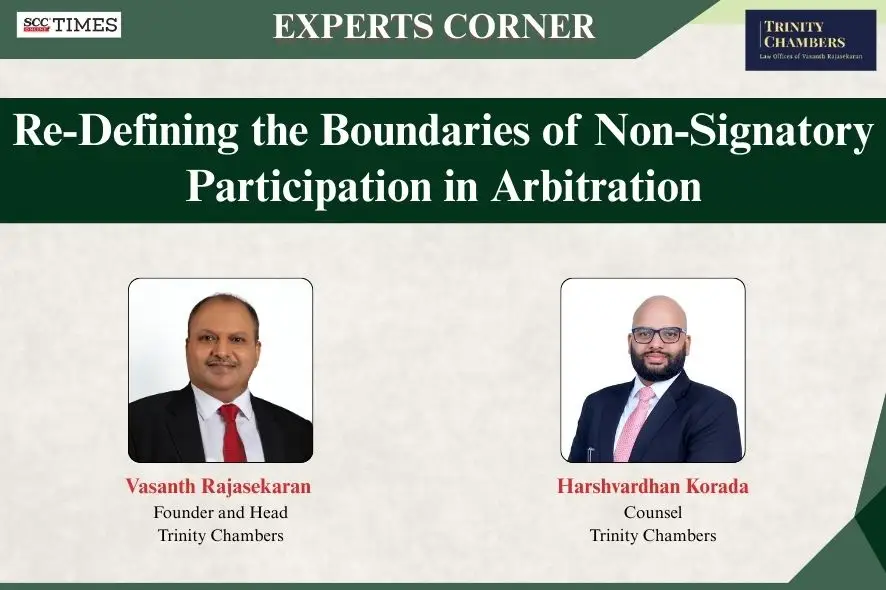
* Founder and Head of Trinity Chambers, Delhi.
** Counsel at Trinity Chambers, Delhi.
3. Ajay Madhusudan Patel v. Jyotrindra S. Patel, (2025) 2 SCC 147.
4. Kamal Gupta v. L.R. Builders (P) Ltd., 2025 SCC OnLine SC 1691.
5. Ajay Madhusudan Patel v. Jyotrindra S. Patel, (2025) 2 SCC 147.
6. Kamal Gupta v. L.R. Builders (P) Ltd., 2025 SCC OnLine SC 1691.
7. (2024) 4 SCC 1 : (2024) 2 SCC (Civ) 1 : (2024) 251 Comp Cas 680.
8. Kamal Gupta v. L.R. Builders (P) Ltd., 2025 SCC OnLine SC 1691.
9. Kamal Gupta v. L.R. Builders (P) Ltd., 2025 SCC OnLine SC 1691.
10. Ajay Madhusudan Patel v. Jyotrindra S. Patel, (2025) 2 SCC 147.
11. Kamal Gupta v. L.R. Builders (P) Ltd., 2025 SCC OnLine SC 1691.
12. Ajay Madhusudan Patel v. Jyotrindra S. Patel, (2025) 2 SCC 147.
13. Kamal Gupta v. L.R. Builders (P) Ltd., 2025 SCC OnLine SC 1691.
14. Kamal Gupta v. L.R. Builders (P) Ltd., 2025 SCC OnLine SC 1691.