
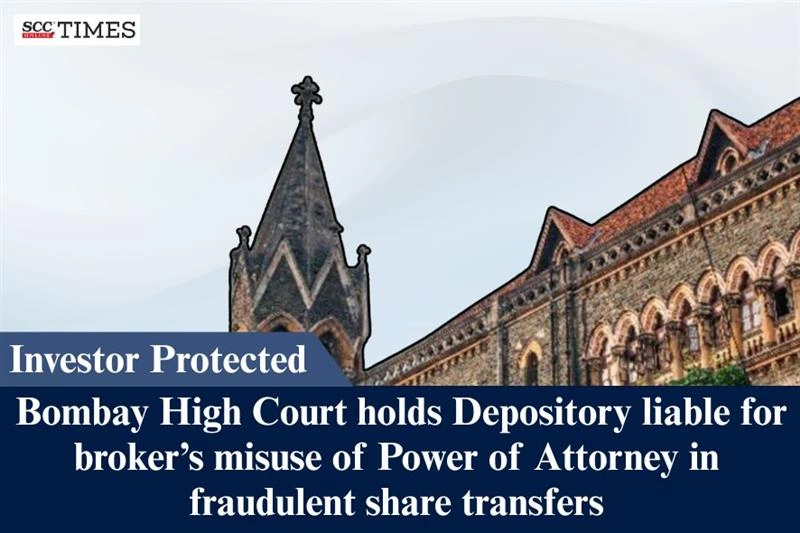
Bombay High Court: While deciding a petition under Section 34 of the Arbitration and Conciliation Act, 1996 challenging the arbitral award, a Single Judge Bench of Sandeep V. Marne, J., upheld the award which had directed payment of Rs 86 Lakh, being the value of lost shares, along with 9 per cent simple interest per annum. The Court observed that the acts were also performed in the capacity of Depository Participant and therefore liability under Section 16 of the Depositories Act, 1996 (‘Depositories Act’) was attracted, making the Depository responsible to indemnify the beneficial owner.
Background:
The dispute arose when shares were transferred from a demat account into Trading Member/Clearing Member (‘TM/CM’) accounts by misuse of a Power of Attorney (‘POA’). These shares were subsequently pledged with HDFC Bank Ltd. (‘bank’) to avail loan facilities, and upon default, the pledged securities were sold. The investor approached regulatory and appellate forums, which eventually led to initiation of arbitration proceedings.
The petitioner contended that the impugned Award was patently illegal and perverse, as it erroneously attributed liability to the Depository for acts committed by the broker. It was argued that the pledging occurred from the broker’s own TM/CM account, where ownership had already transferred, and therefore no pledge request from the investor was necessary. It was further submitted that the Depository had no visibility over reasons for transfer or pledge, and its role was limited to verifying availability of securities and obtaining concurrence of the pledgee. Reliance was placed on Securities and Exchange Board of India (‘SEBI’) circulars to argue that responsibility lay with the Exchange, not the Depository.
The respondent asserted that the Arbitral Tribunal (‘Tribunal’) had correctly found negligence in supervision, as the Depository was required to monitor and prevent fraudulent acts of its agent. Regulations and circulars in force at the relevant time cast a duty on the Depository to protect investors, and failure to implement safeguards resulted in loss of securities. It was alleged that the Tribunal’s findings were plausible and consistent with statutory provisions.
Analysis and Decision:
The Court emphasised that the real key to the dispute was to determine the exact capacity in which the acts were committed. It was noted that the broker was acting in dual capacity as registered broker and Depository Participant (‘DP’). The Court observed that the transfers were not in pursuance of any trades effected on the Stock Exchange, but were affected by misusing the POA, thereby involving the role of DP. It was highlighted that the Depository had authorised the transfer of shares based on the POA and therefore could not contend that the acts were purely those of a broker.
The Court further noted that the Tribunal had dissected the entire transaction into three legs and recorded detailed findings. It was observed that in the second leg BRH as DP failed to obtain the “Pledge Request” from the client before pledging the client’s securities as required under SEBI (DP) Regulations and Central Depository Services Limited (‘CDSL’) Bye-Laws, which actually amounted to serious manipulation by DP on its clients. The Court emphasised that this was not a one-off case but involved 9493 clients having credit balance of securities in their demat accounts.
The Court held that Section 16 of the Depositories Act makes the Depository directly liable to indemnify the beneficial owner in respect of negligent acts of the participant. The Court observed that the moment some role of DP gets attracted in the transaction, however minor it may be, the Depository’s liability comes into play. The Court highlighted that the fraudulent acts were a composite act of stark fraud, engineered to secure loan amounts by pledging stolen shares, and that the Depository had permitted its own DP to unauthorisedly transfer shares of thousands of clients.
The Court concluded that whether the Depository was in knowledge of fraudulent acts or not was immaterial, since Section 16 of the Depositories Act makes the Depository liable for negligent acts of DP irrespective of responsibility. It was emphasised that the objective behind Section 16 of the Depositories Act is to ensure quick and smooth compensation to victims of negligent acts committed by DP, and that the Depository can recover from the participant the amount indemnified.
The Court finally observed that the findings of the Tribunal were plausible, not perverse, and that the Depository was liable to indemnify the investor for the value of lost shares amounting to Rs 86,02,768, along with simple interest at 9 per cent per annum.
[Central Depository Services (India) Ltd. v. Daksha Narendra Bhavsar, 2025 SCC OnLine Bom 4816, decided on 01-12-2025]
Advocates who appeared in this case:
For the Petitioner: Ravi Kadam, Rohan Kadam, Vaibhav Singh, Radhika Indapurkar, Rahil Shah & Pranav Chandhoke, i/b Veritas Legal
For the Respondent: Vishal Kanade, Harsh Moorjani, Priyanka Chaddha, Abhay Dhadiwal & Vidhi Karia, i/b Jayakar & Partners