
Disclaimer: This has been reported after the availability of the order of the Court and not on media reports so as to give an accurate report to our readers.
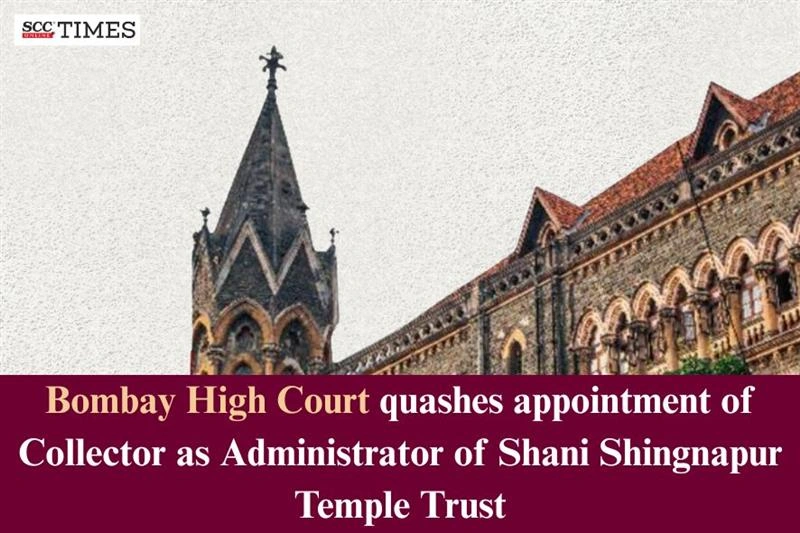
Bombay High Court: In a writ petition filed by the elected trustees of Shree Shanaishwar Devasthan Trust, Shingnapur, challenging the Government Resolution appointing the Collector as “Administrator” of the Trust and the subsequent appointment of Management Committee by the Collector, a Division Bench Vibha Kankanwadi* and Hiten S. Venegavkar JJ., held the Collector’s appointment as Administrator, to be illegal and ultra vires to the Shree Shanaishwar Devasthan Trust (Shingnapur) Act, 2018 and all consequential actions taken pursuant thereto equally unsustainable in law.
Factual Matrix
The Shree Shanaishwar Devasthan Trust at Shingnapur is a public trust registered under the Maharashtra Public Trusts Act, 1950 since 1961. The petitioners were elected trustees of the said Trust pursuant to elections held on 23-12-2020. The corresponding change report was approved by the Assistant Charity Commissioner on 15-09-2021, and the petitioners assumed charge on 01-01-2021. Their term was to continue till 31-12-2025.
The State Legislature enacted the Shree Shanaishwar Devasthan Trust (Shingnapur) Act, 2018 (“Shingnapur Trust Act”). Although the Act received the assent of the Governor in August 2018 and was published in the Official Gazette, it remained dormant for several years. On 22-09-2025, the State Government issued a notification bringing the Act into force with immediate effect. On the very same day, by a Government Resolution issued by the Law and Judiciary Department, the Collector, Ahilyanagar was appointed as Administrator of the Trust, thereby bringing the tenure of the elected trustees to an abrupt end.
The petitioners challenged (i) the notification dated 22-09-2025 bringing the Shingnapur Trust Act into force in the manner adopted, (ii) the Government Resolution appointing the Collector as Administrator, and (iii) the subsequent communication dated 30-09-2025 by which the Collector, in his capacity as Administrator, appointed a Management Committee to assist him.
Parties’ Contentions
The petitioners contended that the Shingnapur Trust Act contemplates a structured statutory transition, beginning with constitution of a Management Committee under Section 5, followed by transfer and vesting of properties under Sections 3 and 4. It was contended that there is no provision in the Act permitting the State Government to appoint an Administrator as a stop-gap arrangement immediately upon the Act coming into force. It was further stated that Section 36 of the Act permits appointment of an Administrator only when a duly constituted Management Committee is found incompetent or persistently defaults, a condition precedent that was wholly absent.
The petitioners argued that no hearing was afforded to the elected trustees, and the entire exercise was undertaken in undue haste, allegedly prompted by political considerations. It was further stated that the Charity Commissioner’s proceedings under Section 41D of the Maharashtra Public Trusts Act were still pending, and no finding of mismanagement warranting such drastic action had attained finality. It was lastly contended that the State’s action amounted to arbitrary executive interference, violative of Articles 14 and 300-A of the Constitution of India.
On the other hand, the State defended its action contended that upon the Act coming into force, the provisions of the Maharashtra Public Trusts Act ceased to apply by virtue of Section 44 of the Shingnapur Trust Act. It was contended that a vacuum would have been created if an Administrator was not appointed immediately to ensure continuity of administration. It was contended that the appointment of the Collector was justified under Sections 36, 44 and 48 of the Act, read together. It was further contended that serious irregularities in staffing and administration had been revealed during inspections conducted by the Charity Commissioner and Joint Charity Commissioner, necessitating urgent State intervention.
Moot Points
-
Whether the State Government had the power under the Shingnapur Trust Act to appoint the Collector as Administrator on the very day the Act was brought into force?
-
Whether Section 36 of the Act could be invoked in the absence of a Management Committee constituted under Section 5?
-
Whether the impugned Government Resolution and consequential actions were arbitrary, ultra vires the Act, and unconstitutional?
Court’s Findings and Reasoning
The Court observed that the controversy was not with respect to the power of the State to declare the appointed day, but with respect to the manner in which the statutory scheme was implemented thereafter. The Court undertook a detailed examination of the scheme of the Shingnapur Trust Act and observed that —
-
Section 3 provides for reconstitution of the erstwhile Trust and vesting of properties in the Management Committee, not in an Administrator.
-
Section 5 mandates constitution of a Management Committee by the State Government, which is to be a body corporate with perpetual succession.
-
Section 36 can be invoked only when a Management Committee appointed under the Act is found incompetent or in persistent default. In the present case, no such Committee had ever been constituted.
The Court noted that without constituting the Management Committee, the State Government ought not to have fixed the appointed day, since the statute itself does not provide for any interim or stop-gap arrangement. The Court noted that the Government Resolution itself admitted that the appointment of the Collector as Administrator was only “until the Committee is constituted,” thereby acknowledging non-compliance with Section 5.
The Court rejected the State’s reliance on Sections 44 and 48 to justify the appointments and held that Section 48 could be invoked only if a difficulty actually arose in giving effect to the Act, and even then, any order passed must be consistent with the provisions of the Shingnapur Trust Act. The Court held that the appointment of an Administrator prior to constitution of the Management Committee was inconsistent with the statutory scheme.
The Court further observed that even applying the doctrine of purposive construction, the outcome could not be different, since “the executive cannot invoke the purpose of the Act to justify a procedure that the Act itself does not permit.” The Court held that the appointment of the Collector and the subsequent Committee amounted to executive overreach.
On the constitutional plane, the Court held that the deprivation of control over Trust property without authority of law violated Article 300-A, and that the selective and hasty application of statutory provisions rendered the action arbitrary and offensive to Article 14. The Court held once the legislature has occupied the field, the executive cannot create an alternative mechanism under Article 162 and therefore, the Government Resolution dated 22-09-2025 lacks constitutional legitimacy.
“When a statute prescribes the precise manner in which transition of management must occur, the executive cannot selectively apply portions of the Act and bypass the mandatory requirement of constituting a Management Committee under Section 5. The declaration of the appointed day and the simultaneous appointment of an Administrator, without adherence to the statutory pre-conditions, is neither transparent nor rational. The exercise of power is thus vulnerable on the touchstone of Article 14, being arbitrary, unguided and inconsistent with the rule of law.”
The Court also noted that proceedings under Section 41-D of the Maharashtra Public Trusts Act were still pending before the Charity Commissioner, and therefore, the alleged mismanagement could not be used to short-circuit the statutory procedure prescribed under the Shingnapur Trust Act.
With regards to the subsequent action of the Collector appointing a Management Committee on 30-09-2025, the Court held that the same to be without jurisdiction, as the Act confers no such power on an Administrator.
“Even Section 36 does not empower the Administrator to appoint a Committee to assist him.”
Court’s Decision
The Court held that the State Government had no power under the Shingnapur Trust Act to appoint the Collector as Administrator in the absence of a duly constituted Management Committee; the Government Resolution dated 22-09-2025 appointing the Collector, Ahilyanagar as Administrator was illegal and ultra vires the Act; and all consequential actions taken pursuant thereto were equally unsustainable in law.
The Court partly allowed the writ petition and
-
Quashed and set aside the Government Resolution dated 22-09-2025, appointing the Collector, Ahilyanagar as Administrator of the Shree Shanaishwar Devasthan Trust;
-
Quashed the communication dated 30-09-2025 issued by the Collector appointing a Committee;
-
Directed to restore the Status quo ante, and ordered to reinstate the position prevailing prior to the impugned Government Resolution.
-
The State Government was left at liberty to bring the Act into force strictly in accordance with law, after duly constituting the Management Committee under Section 5 and framing necessary rules and regulations.
[Bhagwat Sopan Bankar v. State of Maharashtra, 2025 SCC OnLine Bom 5076, Decided on 12-12-2025]
*Judgment by Justice Vibha Kankanwadi
Advocates who appeared in this case:
Mr. S. B. Talekar, Advocate h/f Talekar and Associates, Counsel for the Petitioners
Mr. A. R. Kale, Additional G.P., Counsel for the Respondent No. 1 to 3
Mr. S. D. Kotkar, Advocate h/f Mr. Tejas Kotkar, Counsel for the Applicants in Civil Application No.12385 of 2025.
Buy Constitution of India HERE