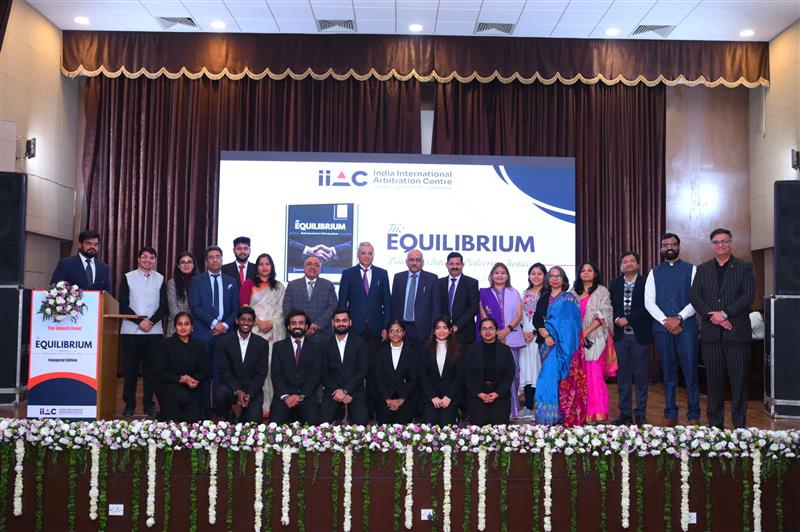

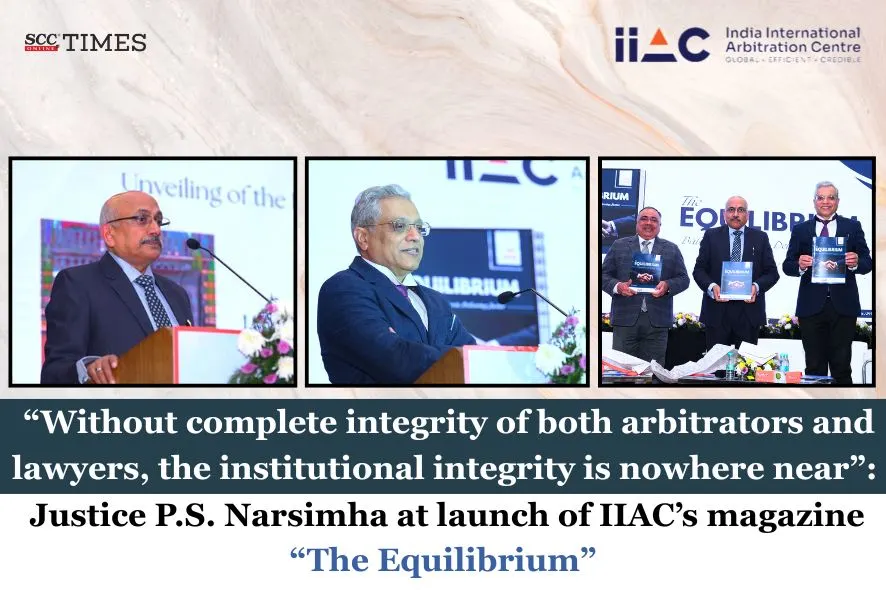
On 09-12-2025, the India International Arbitration Centre (“IIAC”) organized an event for the launch of its magazine titled “The Equilibrium” as well as the exchange of an MoU with Prayaya, ADR Society, Law Centre-I, University of Delhi.
The event began with a brief introduction of IIAC, an institution established by the Indian Government to address the bottlenecks in the dispute resolution mechanisms in India. With its state-of-the-art facilities, rules and regulations consistent with best global practices, guidance and inputs of distinguished experts, and a pool of experienced and credible arbitration professionals across disciplines, IIAC has all the requisites necessary to establish itself as a premier arbitral institution.
In India’s pursuit of global recognition as a prominent player in the field of arbitration, the establishment of the IIAC was a significant milestone. IIAC affirmed the nation’s standing in the international arbitration community by providing a dedicated and specialized platform for arbitration and will enhance the accessibility and efficiency of dispute resolution in India.
With this introduction, the moderator for the panel discussion was invited to begin the session.
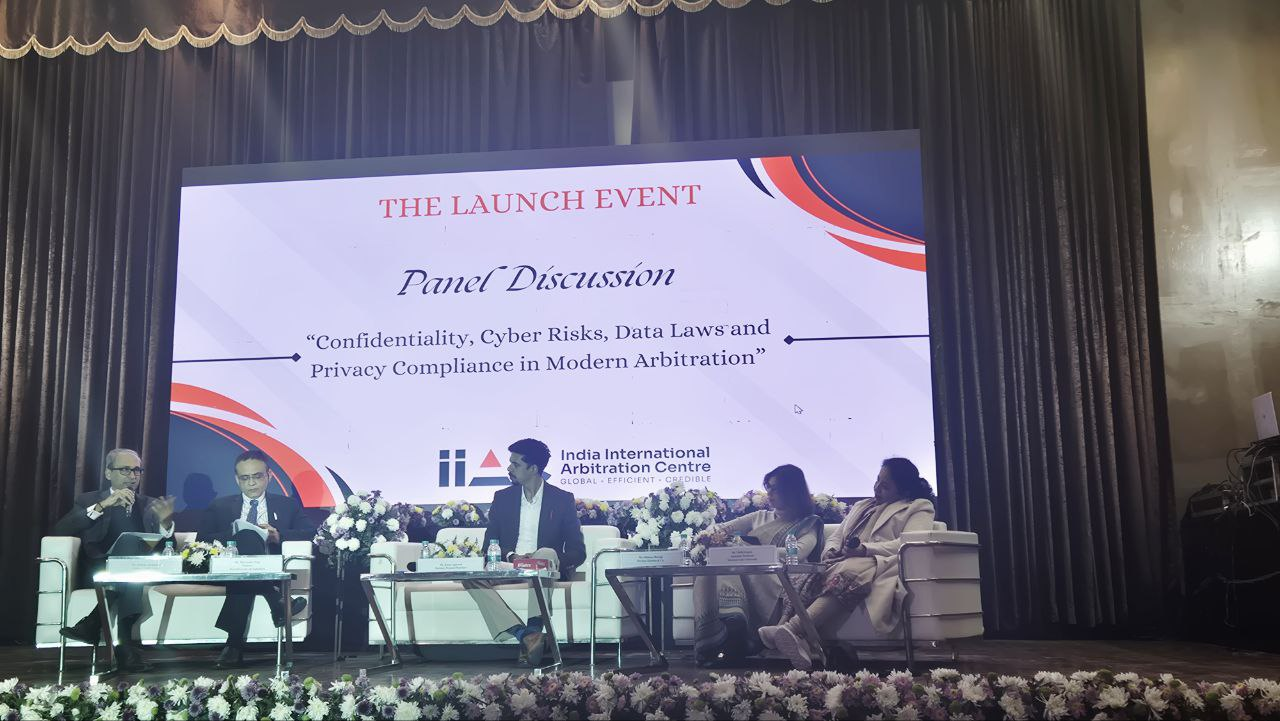
Panel Discussion: “Confidentiality, Cyber Risks, Data Laws and Privacy Compliance in Modern Arbitration”
Moderated by Mr. Kanu Agrawal, AOR and Partner, Pramati Partners, the discussion consisted of eminent panellists, namely, Dr. Nidhi Gupta, Associate Professor, NLU Delhi; Ms. Abhisaar Bairagi, Partner, Khaitan & Co; Mr. Dhirendra Negi, Partner, JSA; and Mr. Dinesh Pardasani, Partner, DSK Legal.
Kickstarting the session, Mr. Kanu Agrawal provided a brief overview of the agenda. He stated that with the rise of artificial intelligence, the ability of global tech companies to mine metadata, profile individuals and corporations, the principles of confidentiality and privacy, which were the cornerstone of arbitration, were under serious threat.
Existing Framework for Confidentiality in Arbitration
Underscoring the relevance and necessity of confidentiality in arbitration, Ms. Nidhi Gupta remarked that the world was grappling with the challenge of regulating privacy to ensure confidentiality. India, in this regard, introduced the confidentiality clause in 2019 via an amendment to the Arbitration and Conciliation Act, 1996(“the Act”). With the introduction of Section 42A, she remarked, India became one of the few countries with a statutory requirement/provision for confidentiality. Regarding the two exceptions to the mandate of confidentiality- implementation and enforcement, Ms. Gupta stated that exceptions were more important.
Lastly, she remarked that the main contention was the direct conflict between confidentiality and transparency.
Speaking from the global perspective, Ms. Abhisaar Bairagi opined that confidentiality in arbitration was like a family secret, and everyone had their own definition. She referred to a few jurisdictions:
-
UK: They read confidentiality into their arbitration act, but there was no express provision.
-
Hong Kong and Singapore: They have made comprehensive mentions as to what confidentiality is, who it covers, and what it covers. Hong Kong considers that everybody, not just the parties, the arbitrator, and the institution, but also cloud service providers, transcribers, expert witnesses, and people working with the expert witnesses, is involved. They also cover the arbitration proceedings and the arbitration award.
-
France: Its domestic arbitration law has a confidentiality clause, but the international arbitration law does not.
-
India: It lies in the middle as it covers the arbitrators, the parties, and the institutions. However, India had not caught up with the world and broader ambits.
Expanding the scope of confidentiality
Regarding the inclusion of data handlers and record-keeping services/ servers in confidentiality clauses, Ms. Bairagi stated that, though technological changes were rapid, arbitral institutions could include a clause detailing the persons who would be able to access the data, how they would access and store it, and how long they would retain it. She opined that even if arbitral institutions had their own servers, there was no such solution for ad hoc arbitrations.
Modern challenges and legislative measures
On the aspect of tackling modern challenges concerning confidentiality, Mr. Dhirendra Negi mentioned two aspects that had to be considered: the kind of agreement between the parties and the statutory provision. He echoed that there were several persons involved in the arbitration process to whom the arbitration agreement did not apply, such as the service providers, the tribunal secretary, the experts, etc. He opined that the law should apply to these persons, to hold them accountable, and the law should be strengthened in this regard.
Mr. Dinesh Pardasani added that statutory measures on confidentiality should be liberally interpreted. Furthermore, if a matter was especially confidential, the procedure should be set out from the beginning. Even if the award gets challenged under Section 34 of the Act, requests could be made to the Court for maintaining secrecy.
Thereafter, he suggested that there were ways of ensuring confidentiality beyond statutory and contractual measures, such as enacting a provision which states that arbitration-related Court proceedings shall not be held in open Court, unless determined otherwise.
Cyber Security in Arbitration
Mr. Pardasani stated that cybersecurity was extremely important in an arbitration since there might be sensitive business information in a commercial dispute, or there could be information that may be used either to pursue or defend a claim in the arbitration. If there is a leakage of that information, tremendous loss can be suffered by the party just because it has chosen the option of arbitration.
Furthermore, he emphasised that data protection was also important as arbitration becomes more digital and data is stored in cloud services and transmitted online. The integrity of the data shall be maintained so that no third party has access to information regarding the proceedings.
“If somebody has strong ill will, they could even make that data completely inaccessible to the parties. And it could defeat the whole purpose of the arbitration.”
The rest of the panellists also chimed in with their suggestions, insights, and comments.
AI and Arbitration
Mr. Negi underscored the risks posed by the use of AI for the production of fake documents, cases, and conversations, which would have an impact on the reputation of all stakeholders. Thus, he suggested that the admission and denial of documents should be done carefully.
From her experience, Ms. Bairagi added that though practitioners could detect fake case laws, parties had to step up and identify whether fake evidence was being produced. She also suggested that there must be some consequences of such usage of AI to prevent adverse usage.
Furthermore, the panel delved into the applicability of the Digital Personal Data Protection Act, 2023, on arbitration, differentiating overlapping concepts of confidentiality and privacy, arbitration institutions dealing with data breach risks, the cost of privacy, blockchain, and much more.

Exchange of MoU
After the erudite panel discussion, IIAC and Prayaya, ADR Society, Law Centre-I, University of Delhi, exchanged a Memorandum of Understanding to create meaningful opportunities for young law students in the field of Alternative Dispute Resolution.

Launch of the IIAC Magazine
After the signing of MOU, Justice P.S. Narasimha, Judge, Supreme Court of India; Justice Hemant Gupta, Chairperson, IIAC; and Mr. Anant Vijay Palli, Member, IIAC, launched the much awaited IIAC magazine titled “The Equilibrium”.

Keynote Address by Justice Hemant Gupta
Justice Gupta reminisced about the three-year-long journey of IIAC and the vision that guided its establishment, which had been encapsulated in the first edition of the magazine. He underscored that the magazine consisted of diverse articles from eminent dignitaries and arbitrators from India and other countries.
He acknowledged the role of Justice P.S. Narasimha in shaping the arbitration landscape in India by serving as a member of the Sri Krishna Committee, which recommended the amendment in the Act, a member of the IIAC, and a member of the Arbitration Council of India.
Lastly, Justice Gupta concluded his address by thanking the dignitaries, contributors, and everyone who joined the occasion and supported the launch.

Keynote Address by Chief Guest Justice P.S. Narasimha
At the outset, Justice Narsimha recalled his connection with IIAC and remarked how it demonstrated the transformation of India’s arbitration landscape. He underscored how individual contribution had slowly transitioned into institutional contribution towards the adaptation of arbitration in India.
He opined that the success of arbitration in India would depend on the answers to the following questions:
-
Was there an institutional conviction about arbitration? How much do we believe that arbitration as a remedy for the resolution of disputes is viable?
He stated that the conviction about arbitration was inching towards the belief that arbitration can resolve disputes. “That conviction, if it lodges securely in the hearts of advocates and litigants, then perhaps you can say that there is an institutional conviction.”
-
How much human resource was pre-equipped for making arbitration an institution?
He opined that the success would also depend upon the capability, equipment, and preparedness of the arbitrators and arbitration stakeholders.
-
What did institutional arbitration lack earlier?
Justice Narsimha underscored that now institutional arbitration is equipped with the authority or recognition, and decisions of an arbitrator are well-recognized by the statute. He mentioned that one concern with the institutionalization of arbitration was its infrastructure, but with the amendments to the Act, arbitration institutions were slowly cropping up.
-
What is the integrity of our arbitration institutions?
He emphasized the importance of institutional integrity, i.e., the integrity of the arbitrators and lawyers. It also includes the level of engagement of the institution with the subject matter of arbitration, discussing the issues affecting arbitration, and reviewing the existence of the present arbitration infrastructure.
“Without the total and complete integrity of both the arbitrators as well as the lawyers, the institutional integrity is nowhere near.”

Regarding the magazine, Justice Narsimha remarked that it would be a good magazine about arbitration as it would discuss the arbitrators, the institution of arbitration, and the stakeholders of arbitration. It reflects, comments, criticizes, and appreciates the domain of arbitration, which would benefit everyone. It upgrades our knowledge, reviews the existing systems, and informs us of the deficiencies and how we can improve. Thereafter, he gave some suggestions for the magazine.
Furthermore, he opined that arbitration should not be confined to commercial disputes and it could be extended to other civil disputes that were pending in Courts for many years. He added that arbitration must be taken to the grassroots level of litigation and become an integral part of a small institutional discipline.
Lastly, he concluded by emphasising how everyone should endeavour to improve India’s arbitration institutions.
Vote of Thanks by Mr. Navin Kumar Singh, CEO, IIAC

In his vote of thanks, Mr. Singh thanked the Chief Guest Justice Narsimha, Justice Gupta, the panellists for the discussion, ADR Society Prayaya, Mr. Karan Kanwal, Deputy Registrar, Ms. Nehal and Ms. Pranali, students of Law Center I of Faculty of Law, contributors to the magazine, IIAC staff, guests, participants, and students, for making the event and the magazine a success.