
Top Stories:
Jammu and Kashmir Tenancy Act, 2025
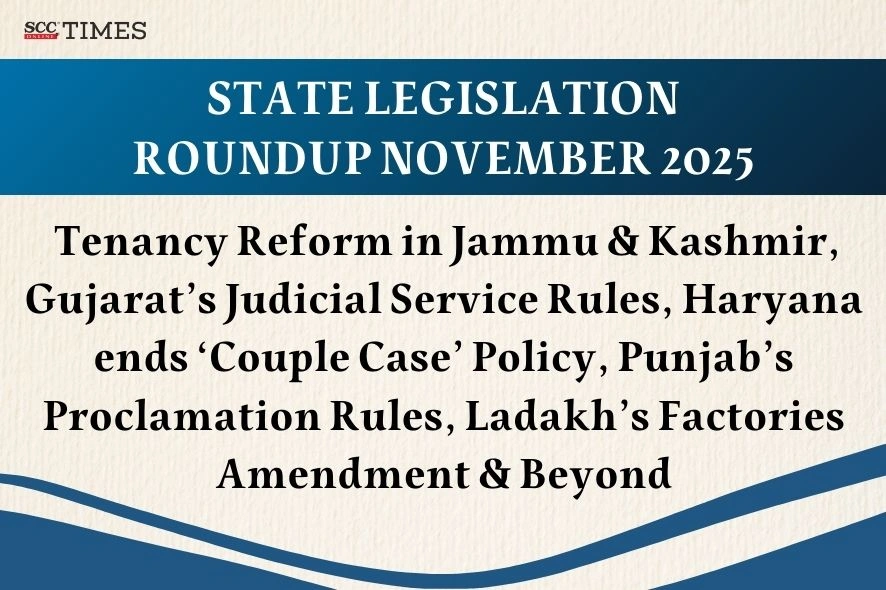
On 1-11-2025, the Jammu and Kashmir Tenancy Act, 2025 was enacted to regulate renting of premises, safeguard landlord and tenant rights, and establish a speedy dispute resolution mechanism. The Act requires all tenancy agreements to be in writing and registered with the Rent Authority, which maintains a digital platform and issues unique identification numbers.
The Act defines landlord, tenant, subtenant, property manager, rental agent, Rent Authority, Rent Court, and Rent Tribunal. It binds successors to tenancy agreements in case of death, restricts subletting except through supplementary agreements, and regulates rent payable, revision, disputes, and security deposits (capped at 2 months’ rent for residential and 6 months for non-residential premises).
Rights and obligations include duplicate tenancy agreements retained by both parties, mandatory rent receipts, deposit of rent with the Rent Authority if landlords refuse acceptance, shared repair and maintenance responsibilities, tenant duties to care for premises, and landlord entry with 24hour notice except in emergencies. Essential services like water, electricity, sanitation, parking, and communication links cannot be withheld.
Eviction is permitted only through Rent Court orders on specified grounds such as nonpayment, misuse, unauthorized subletting, or structural changes. Legal heirs can seek possession upon the landlord’s death if they have bona fide need. Tenants overstaying will be required to pay enhanced rent, double for 2 months, then quadruple thereafter. Orders for recovery of possession bind all occupants, and tenants will give at least 1 months’ notice before vacating.
The Act establishes Rent Authorities (Deputy Collectors), Rent Courts (Additional Collectors/ADMs), and Rent Tribunals (District Judges/ADJs). Appeals from Rent Courts lie to Rent Tribunals within 30 days, to be disposed of within 60 days.
The Act repeals the Jammu and Kashmir Residential and Commercial Tenancy Act, 2012 but saves pending proceedings under it.
Kerala Reserves 2 Supernumerary Seats for Transgender Applicants in Law Colleges
On 26-11-2025, the Government of Kerala notified the allocation of additional supernumerary seats for Transgender applicants in the Integrated Five-Year / Three-Year Law Courses offered by Government and Self-Financing Law Colleges participating in the admission process.
“Her Rights Are Non-Negotiable”: Assam Cabinet Approves Bill to Ban Polygamy Statewide
On 9-11-2025, the Assam cabinet approved Assam Prohibition of Polygamy Bill, 20251 to ban the practice of polygamy across Assam. This landmark decision marks a significant step toward strengthening women’s rights and promoting gender equality.
Bills/Ordinances:
Haryana Shops and Commercial Establishments (Amendment) Ordinance, 2025
On 12-11-2025, the Haryana Government notified the Haryana Shops and Commercial Establishments (Amendment) Ordinance, 2025. The Ordinance applies provisions of the Haryana Shops and Commercial Establishments Act, 1958 to establishments employing twenty or more workers, while Section 13A covers those with fewer than twenty. Working hours have been revised, extending daily limits from 9 to 10 hours and rest intervals from 5 to 6 hours. A new online registration system has been introduced for establishments, with mandatory updates and penalties for non-compliance. Employers will now issue appointment letters with photographs and identity cards to all workers. Penalty provisions have been strengthened, with fines ranging from ₹3,000 to ₹25,000 and daily penalties for continuous violations. The Ordinance, effective from 12-11-2025, also aligns references with the Bharatiya Nyaya Sanhita, 2023, modernizing compliance and enforcement in Haryana’s commercial sector.
State Amendments:
Karnataka Lokayukta (Amendment) Rules, 2025
On 3-11-2025, the Government of Karnataka notified the Karnataka Lokayukta (Amendment) Rules, 2025. The amendment inserts a new provision in Rule 6 of the 1985 Rules, entitling the Upalokayukta to a charge allowance of 10% of the salary of the additional post. This allowance applies when the Upalokayukta discharges the functions of the other Upalokayukta for a minimum of ten working days, as ordered by the State Government. The measure ensures fair compensation for additional responsibilities and has been given retrospective effect from 15-6-2022.
Kerala Right to Public Service Act, 2025
On 4-11-2025, the Kerala Government notified the Kerala Right to Public Service Act, 2025. The Act guarantees citizens the right to obtain notified public services within a stipulated time frame, ensuring transparency and accountability in governance. Heads of departments will publish services, time limits, designated officers, and appellate authorities, while all public authorities are required to deliver services electronically wherever feasible. It establishes a two-tier appeal system and a revision mechanism before the Kerala State Right to Service Commission, a single-member body vested with civil court powers. Penalties ranging from ₹1,000 to ₹15,000 can be imposed on officers for delays, deficiencies, or non-compliance, with compensation payable to affected citizens. The Act replaces the Kerala State Right to Service Act, 2012, with a stronger framework for time-bound and digital service delivery.
Bharatiya Nagarik Suraksha Sanhita the State of Maharashtra Electronic Processes (Issuance, Service and Execution of e-summons/e-warrant) Rules, 2025
On 28-11-2025, the Government of Maharashtra notified the Bharatiya Nagarik Suraksha Sanhita the State of Maharashtra Electronic Processes (Issuance, Service and Execution of e-summons/e-warrant) Rules, 2025. Effective immediately, these rules mandate courts to issue summons, warrants, and other processes electronically through the Case Information System (CIS), encrypted and authenticated with the court’s seal and eSign, with arrest warrants requiring the Presiding Officer’s eSign. Processes received via CCTNS in secure electronic form are presumed valid, and printouts carry the same legal effect as originals. Police and complainants will record verified electronic contact details of accused, victims, and witnesses, though victim and witness details cannot be disclosed to the accused. Summons served via email or messaging apps are deemed valid upon acknowledgment, with screenshots or automated confirmations serving as proof. If electronic service fails, officers will execute printouts with reports and photographs, while warrants executed in person will be reported electronically through CCTNS/NSTEP. Special safeguards apply in offences against women and children to protect victim identity, and the rules supplement existing High Court provisions, with the Government empowered to remove difficulties in implementation.
Punjab Bharatiya Nagarik Suraksha Sanhita (Publication of Proclamation) Rules, 2025
On 28-11-2025, the Punjab Government announced Punjab Bharatiya Nagarik Suraksha Sanhita (Publication of Proclamation) Rules, 2025, effective immediately. These Rules prescribe the manner of publishing proclamations: publicly announced by drumbeat or customary means, read aloud and affixed at conspicuous places such as the residence or workplace of the person and Magistrate offices. Orders will also be uploaded on official district and municipal websites and will be published in local newspapers for wider circulation.
Karnataka Scheduled Castes and Scheduled Tribes (Reservation of seats in Educational Institutions and of Appointments or posts in the services under the State) Rules, 2025
On 12-11-2025, the Karnataka Government notified Karnataka Scheduled Castes and Scheduled Tribes (Reservation of seats in Educational Institutions and of Appointments or posts in the services under the State) Rules, 2025. These rules, framed under the Karnataka SC/ST Reservation Act, 2022, empower the Department of Personnel and Administrative Reforms to issue orders for implementing reservation in educational institutions and state services. The rules provide for a 100-point roster system applicable to direct recruitment and promotions, ensure horizontal reservation within vertical reservation for SC/ST categories, and introduce additional roster points to address backlog posts in promotions. This framework strengthens the systematic enforcement of reservation policies, ensuring fair representation of Scheduled Castes and Scheduled Tribes in education and public employment.
Gujarat State Judicial Service (2nd Amendment) Rules, 2025
On 4-11-2025, the Government of Gujarat notified the Gujarat State Judicial Service (2nd Amendment) Rules, 2025. The amendments revise definitions and restructure recruitment and promotion for District and Senior Civil Judges. For District Judges, 50% posts are filled by merit cum seniority with a suitability test and 25% through Limited Departmental Competitive Examination (‘LDCE’), while Senior Civil Judges are promoted 90% by merit cum seniority and 10% via LDCE. Rule 7 now requires at least 3years’ practice as an Advocate, with law clerk experience counted, and certification from judicial officers or senior advocates. Rule 7A extends identification of posts for PwBD candidates, Rule 19 introduces rosters for promotions, and Rule 22 mandates 1 year of training for Civil Judges recruited directly. New Schedules and Annexures detail procedures for promotion and LDCE, strengthening merit, inclusivity, and training standards in Gujarat’s judicial service.
Odisha Survey and Settlement (Amendment) Rules, 2025
On 12-11-2025, the Orissa Government notified the Odisha Survey and Settlement (Amendment) Rules, 2025. This Amendment introduces a new clause in Rule 34 allows entries in the Record-of-Rights based on valid registered transfer deeds executed before the Final ROR, ensuring proper title flow. This provision excludes government, leasehold, institutional, and religious lands, and does not override orders of the Board of Revenue or under the Odisha Consolidation Act, 1972.
State Amendments to Central Statutes:
Factories (Ladakh) Amendment Regulation, 2025
On 19-11-2025, the President assented the Factories (Ladakh) Amendment Regulation, 2025. The regulation extends the Factories Act, 1948 to the Union Territory of Ladakh with key changes. It redefines “State Government” as the Administrator appointed by the President under Article 239. The amended regulation updates working hours by raising daily limits from 9 to 10 hours and maximum hours from 10.5 to 12 and increases rest intervals from 5 to 6 hours. Section 22 broadens applicability to all adult workers, while Section 66 allows women to work night shifts with consent and safety provisions. The threshold for factory coverage under Section 85 is raised from 10 to 20 workers and from 20 to 40 with power, modernizing labour regulations for Ladakh.
Industrial Disputes (Dadra and Nagar Haveli and Daman and Diu) Amendment Regulation, 2025
On 19-11-2025, the Ministry of Law and Justice announced the Industrial Disputes (Dadra and Nagar Haveli and Daman and Diu) Amendment Regulation, 2025. The regulation defines the “State Government” as the Administrator appointed by the President, expands Section 22 to cover all industrial establishments with notice periods extended from six weeks to sixty days, and raises the threshold in Section 25K from 100 to 300 workmen. These amendments aim to modernize dispute resolution and strengthen industrial relations.
State Notifications/Policies/Schemes:
Karnataka clarifies what includes as Medical Establishments
On 18-11-2025, the Karnataka Government notified that Medical Spas offering cosmetic and wellness treatments (like Botox, chemical peels, laser therapy, liposuction, IV hydration, etc.) and allied health services (such as audiology, behavioural health, occupational therapy, paramedics, radiology, respiratory therapy, speech pathology, etc.) will be classified as private medical establishments under the Karnataka Private Medical Establishments Act, 2007.
Mizoram on Dearness Allowance
On 20-11-2025, the Governor of Mizoram sanctioned enhanced Dearness Allowance (‘DA’) for state employees at 44%, effective from 1-112025, up from 40%. The allowance will be paid in cash to all categories of regular employees, with Non-Practicing Allowance included in calculations. It remains a distinct element of remuneration, not treated as basic pay under FR 9(21). Payments will be rounded off to the nearest rupee. The DA rate will further rise by 2% to 46% from 1-4-2026.
Uttarakhand’s AI Mission—2025
On 26-11-2025, the Governor Lt. Gen. Gurmit Singh (Retd.) launched the “Uttarakhand AI Mission—2025”2. The policy, aligned with the National AI framework, aims to harness satellite data and digital solutions for inclusive, sustainable development. The Governor emphasized ethical, human-centric AI to bridge the digital divide and benefit remote communities. Startups and research institutions are offered to contribute towards Viksit Bharat @2047, with several teams recognized for innovative solutions.
West Bengal puts up a Ban on Tabacco products
On 3-11-2025, the West Bengal Government announced banning the manufacture, storage, sale, and distribution of gutkha and pan masala containing tobacco or nicotine for one year. This prohibition is under Regulation 2.3.4 of the Food Safety and Standards Regulations, 2011 and Section 30 of the Food Safety and Standards Act, 2006. The ban became effective from 7-11-2025 across the state to safeguard public health.
No more ‘Couple Case” benefit: Haryana’s Model Online Transfer Policy, 2025 Modified
On 3-11-2025, the Haryana Cabinet chaired by Chief Minister Nayab Singh Saini approved an amendment to the Model Online Transfer Policy, 2025. The change removes the ‘Couple Case’3 clause to enhance transparency and fairness in employee transfers. Under the revised rules, an employee whose spouse is a regular government employee posted in Haryana, Delhi, or Chandigarh will receive five merit points. However, these points will be granted to only one of the two employees in the couple serving under the Haryana Government.
1. https://cm.assam.gov.in/cabinet-decisions-details?articleId=786655
2. 26-11-2025 : Governor launched the “Uttarakhand AI Mission—2025” policy at Raj Bhawan. | LOK BHAVAN UTTARAKHAND | India
3. Press Note | Directorate of Information, Public Relations & Languages, Government of Haryana