
Disclaimer: This has been reported after the availability of the order of the Court and not on media reports so as to give an accurate report to our readers.
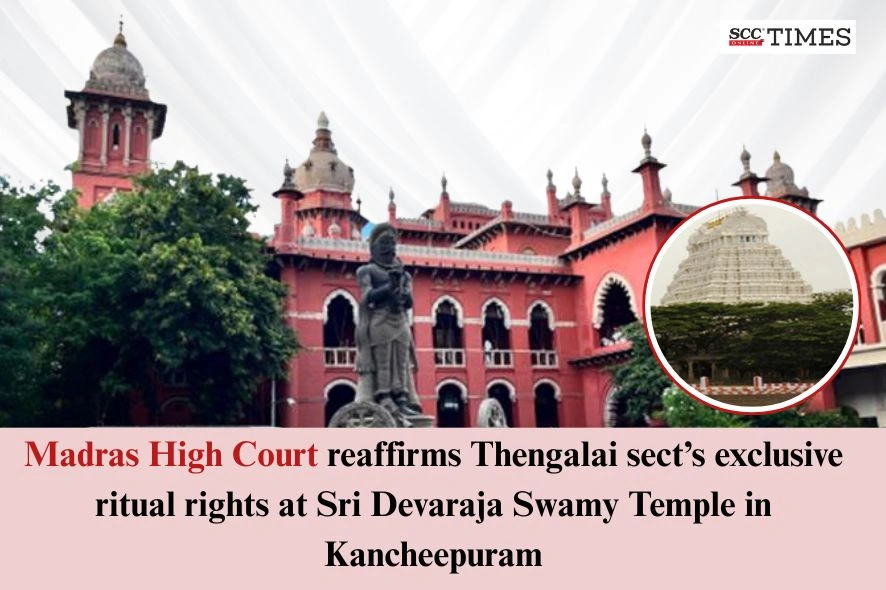
Madras High Court: In the writ petitions arising out of a more than 200 years old sectarian dispute between two sub-sects of the Srivaishnava denomination, Thengalai (Southern Cult) and Vadagalai (Northern Cult), regarding the Ceremonial Worship (Adhiapaka Mirasi) in Sri Devaraja Swamy Temple at Kancheepuram, a Division Bench of R. Suresh Kumar and S. Sounthar, JJ., reaffirmed that Thengalai alone recite the mantram and prabandham during pooja and Vadagalais participate only as worshippers and held that the earlier decrees are binding and final.
Factual Matrix
In the instant matter, the core of the dispute concerns with the Adhiapaka Mirasi, the right to perform certain official services during worship and procession, including, recitation of Sri Sailesa Dayapatram (Southern Cult Mantram), recitation of Nalayira Divya Prabandham and recitation of the Vazhi Thirunamam of Sri Manavala Mamunigal
Historically, a series of judgments, Krishnasami Tatacharyar (1882) and Tirumalai Eachambadi Thiruvengadachariar (1915) held that “Adhiapaka Miras, with the exception of the Thodakam, is the exclusive right of the Tenkalais and appertains to all the members of that sect residing at Kancheepuram.” The Northern Cult was permitted to join only as worshippers and was restrained from reciting their own Mantram or Prabandham during the puja.
In 2022, the Executive Trustee, following the earlier decrees, issued a notice directing that only Sri Sailesa Dayapatram and Manavala Mamunigal Vazhi Thirunamam be recited, Northern Cult members should not occupy the first two rows and Northern Cult mantram Desika Prabandham shall not be recited.
The Executive Trustee’s notice triggered multiple petitions by Northern Cult members alleging violation of Articles 25 and 26 of the Constitution of India. Simultaneously, Southern Cult members sought police protection for implementing the decrees. A contempt petition was also filed alleging disobedience of the decree.
Moot Points
-
Whether pre-constitutional judgments declaring Adhiapaka Mirasi rights of Southern Cult violates the right to worship under Article 25 of the Constitution of India?
-
Whether injunction restraining Northern Cult from reciting their Mantram violates Article 26(b) of the Constitution of India?
-
Whether judicial orders can be challenged in writ proceedings on grounds of violating fundamental rights?
-
Whether the Southern Cult’s writ petition amounts to executing a time-barred decree?
-
Whether earlier judgments granted the Mirasi right to all Southern Cult members or only residents of Kancheepuram?
-
Whether abolition of hereditary rights under Tamil Nadu Town and Country Planning Act, 1971 (Act 2 of 1971) extinguished Mirasi rights?
-
Whether writ appeals against the Single Judge’s interim directions should be allowed?
-
Whether Contempt Petition should be allowed?
-
Whether writ petition by members of Northern Cult should be allowed?
-
Whether writ petition by members of Southern Cult be allowed?
Court’s Analysis
-
Issue 1 — Whether Mirasi rights violates Article 25
The Court noted the Northern Cult’s submission that “they have got freedom of religion under Articles 25 and 26 of the Constitution of India”, and therefore any injunction restraining them from reciting their own Manthram or Prabandham “would amount to interference with their freedom of religion and right to worship.”
The Court observed that all the persons have fundamental right to freedom of conscience and worship under Article 25, however, the said right is subject to public order, morality and health and also to the other fundamental rights recognised under Part-III of the Constitution of India.
The Court analysed Article 25 in light of Article 26 and held that the Adhyapaka Mirasi right is “a perfect blend of religious right as well as property right,” and is “protected under Article 26(c) and (d) of Constitution of India.”
The Court further held that “Right to worship available to the individuals cannot interfere with the right to ceremonies and rituals available to the Members of denomination… which is protected under Article 26(b).” The Court asserted that since the Southern Cult’s Mirasi rights are a denominational right, therefore, they stand superior to the general right of individual worshippers, including the Northern Cult.
The Court held that “the right to worship or freedom of religion available to individual Members of Northern Cult are not affected… They can very well participate… by repeating what is recited by Office Holders,” thus, the injunction granted by the Civil Court against the Members of Northern Cult does not infringe their rights under Article 25 of the Constitution of India. Accordingly, Issue 1 is answered in favour of Members of Southern Cult.
-
Issue 2 — Whether injunction violates Article 26(b)
The Court rejected the Vadagalais argument that they form a “religious denomination” and that prohibiting them from reciting their own mantram violates their rights to manage their own religious affairs.
The Court stated that office-based ritual duties (Adhyapakam) are distinct from denominational rights. The Court stated that the Northern Cult members may join as worshippers but cannot recite their own Mantram during ceremonial worship and this would “invade the office.”
“During Ceremonial Worship, when Members of Southern Cult perform their duties in their capacity as Office Holders of Adhiapaka Mirasi, the Members of Northern Cult are not entitled to recite their Manthra in praise of their Guru or recite their Prabandham in their own way. However, the Members of Northern Cult, in their capacity as ordinary worshippers of God are entitled to join by repeating the Manthras or Prabandhams recited by Members of Southern Cult, who are Office Holders.”
The Court held that Article 26(b) protects the internal religious affairs of a denomination but does not override existing rights attached to a religious office within a temple, especially when such rights have been judicially confirmed for over a century.
The Court emphasised that ritual performance in a public temple, especially duties forming part of an established mirasi is not a denominational right, but a matter governed by custom adjudicated in binding civil decrees. Thus, the Court held that Article 26(b) is not violated.
-
Issue 3 — Challenge to judicial orders under Article 226
The Court relied on Naresh Shridhar Mirajkar v. State of Maharashtra, AIR 1967 SC 1, and noted that no writ of certiorari will lie against judicial orders. The Court categorically stated that “judical orders passed by the Courts cannot be challenged on the ground of violation of fundamental rights and no Writ of Certiorari will lie against judicial orders.” The Court further added that “in case a person is aggrieved by judicial orders, aggrieved party, irrespective of the fact whether he is a party to the litigation or not, can challenge the same only in the manner known to law either before the very same Court which passed orders or before the Higher Forum.”
The Court held that the petitioner in the present writ petition could not directly or indirectly assail the binding decrees of 1915 and 1969 by challenging the Executive Trustee’s notice issued merely to implement them.
-
Issue 4 — Whether Executing Writ petition amounts to time-barred decree
The Court noted that the Northern Cult argued that the decree of 1915 could no longer be executed because limitation for executing injunction decrees had expired.
The Court rejected the execution objection and held that held that the Southern Cult was not seeking execution but seeking prevention of continuous infringement of their mirasi rights, which had already been judicially recognised. The Court further held that the Trustee is duty-bound to implement binding decrees. Therefore, the writ petition seeking police protection did not amount to execution proceedings.
-
Issue 5 — Whether Mirasi rights apply to all Southern Cult members or only Kancheepuram residents
The Court reaffirmed that “Mirasi Rights were available to the Southern Cult residents of Kancheepuram… Any other non-resident Southern Cult Member can join the congregation only as a Member and they are not entitled to any better right as Office Holders.”
The Court also rejected the argument that the decrees were limited to a few families and clarified that the declaration “declaration of Adhiapaka Miras is the exclusive right of Thengalai and that it appertains to all the Members of that sect residing at Kancheepuram,” not to just few families. Thus, the Court held that the decrees bind all members of both sects, not merely the litigating families.
-
Issue 6 – Whether Act 2 of 1971 extinguished Mirasi rights
The Court rejected the argument that Act 2 of 1971 abolished hereditary servants in the Temples under the control of the HR and CE Department and therefore, Southern Cult would automatically lose their right to hold office, as the rule of next person in line of succession to enter the office on death of predecessor stood abolished.
The Court noted that the Mirasi rights are rights to perform religious service, not mere hereditary office. The Court categorically held that the abolition of hereditary office under the HR&CE Act does not nullify judicially determined ritual rights, particularly where the earlier decrees concerned ritual performance, not appointment or emoluments. Moreover, the earlier decrees, which attained finality, were not nullified by the Act 2 of 1971.
-
Issue 7 — Writ Appeals against interim order
The Court held that the Single Judge’s interim directions had the effect of “modifying the judgment and decree passed by this Court, which attained finality long back,” thus, they were unsustainable. The Court allowed both the writ appeals and set aside the interim order issuing directions.
-
Issue 8 — Whether contempt was made out
The Court noted that the Executive Trustee consistently allowed the Southern Cult to begin recitations and followed the decree until disputes revived in 2018 and an FIR was lodged in 2020. The Court found no wilful disobedience on part of Executive Trustee. The Court dismissed the contempt petition and directed the Trustee to enforce the decrees.
-
Issue 9 and 10 — Whether petitions be allowed
The Court held that the petition seeking direction to Commissioner and Assistant Commissioner of HR and CE Department to arrange for rendition of Prabandham of Aachariya Vedanta Desika at Sri Devarajaswamy Devasthanam, Kancheepuram during his 750th Birthday that fell on 21.09.2018, had become infructuous as 750th birthday was already over and the prayer was contrary to binding decrees as only one Manthram can be recited in a Temple. Thus, the Court dismissed the petition.
The Court noted that notice dated 14.05.2022, which was challenged in the petition, was simply restated the decrees, i.e., Mantram of Southern Cult must be recited, Vadagalais shall not occupy first two rows, and Desika Prabandham shall not be recited during puja. The Court dismissed the petition and held that trustee’s notice was “in tune with the judgment and decree passed in the earlier litigation” and challenge to same amounts to challenging earlier decrees and hence, cannot be allowed.
The Court accepted that there were attempts by Members of Northern Cult to interfere with the Adhyapaka Service right declared in favour of the Members of the Southern Cult. Thus, the Court allowed the petition and directed the Executive Trustee to implement the earlier decrees in letter and spirit and granted police protection to ensure its implementation.
Court’s Decision
The Court allowed the petition filed by Sourthen Cult, set aside single judge’s interim order and directed the Executive Trustee to implement the earlier decrees “in letter and spirit” with police assistance if necessary. The Court dismissed the petitions filed by the Northern Cult and also dismissed the contempt petition.
[P.B. Rajahamsam v. S. Narayanan, 2025 SCC OnLine Mad 11792, Decided on 28-11-2025]
*Judgment by Justice S. Sounthar
Advocates who appeared in this case:
Mrs. Hema Sampath, Mr. Srinivasa Raghavan, Mr. A.K. Sriram, Mr. P.V. Balasubramaniam, Mr. K.B.S.Rajan for M/s. M.V. Swaroop, Counsel for the Appellant
Mr. G. Rajagopalan for M/s. Abhinav Parthasarathy, Counsel for the Respondent No. 1
Mr. N.R.R. Arun Natarajan Special Government Pleader assisted by Mr. K. Karthikeyan Government Advocate, Counsel for the Respondent No. 2 and 3
Mr. R. Bharanidharan, Standing Counsel, Counsel for the Respondent No. 4
Mr. R.Palaniandavan and M/s. Varuni Mohan, Counsel for the Respondent No. 5