
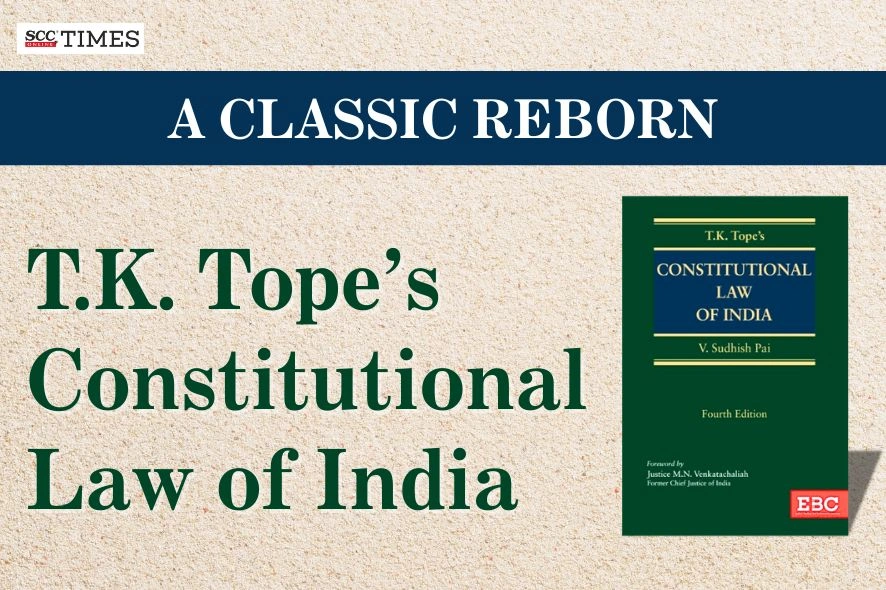
After almost 15 years, EBC is proud to come out with a new edition of TK Tope’s Constitutional Law revised by well-known scholar and thinker of Constitutional Law, Mr V Sudhish Pai. The previous edition of the book was revised by Justice Sujata Manohar, former judge of Bombay High Court. Prof. Trimbak Krishnarao Tope’s seminal work on Constitutional Law is widely considered as an authority on the subject since it was first published in 1982.
About the book
This authoritative book offers a comprehensive and analytical exposition of India’s constitutional framework, tracing its evolution, principles, and judicial interpretation. It shows how the Constitution controls the powers of the government, protects people’s rights, and keeps a balance between different organs like the Legislature, Executive, and Judiciary. The new edition updates significant recent Supreme Court rulings, contemporary debates, and thematic developments, providing a balanced blend of classical scholarship and modern analysis. Instead of just listing many cases, the author focuses on explaining the main principles in a clear and meaningful way. This revised edition by V. Sudhish Pai introduces a new chapter on Constitutions, constitutional law, and constitutionalism. Developments have been updated with reference to decided cases, with an emphasis on elucidating principles rather than cataloguing case law.
Coinciding with the 75th anniversary of the Constitution and the Supreme Court of India, this updated edition becomes even more special and stands as an indispensable, timely, and reliable resource.
Key Features
-
A classic, authoritative work on Constitutional Law, trusted by Judges, Lawyers, and scholars since 1982.
-
Revised and updated edition by V. Sudhish Pai, capturing the latest Supreme Court decisions and major constitutional developments of the past year.
-
A new chapter has been added on Constitutions, Constitutional Law, and Constitutionalism, enriching conceptual understanding.
-
Focus on principles over mere case listing, offering sharp analysis and coherent doctrinal clarity.
-
Timely release marking 75 years of the Constitution and the Supreme Court, reflecting on India’s constitutional endurance and evolution.
This book is designed for lawyers, judges, academicians, and anyone interested in understanding India’s constitutional journey.
In his foreword, Justice MN Venkatchaliah, Former Chief Justice of India says,
“This is yet another rewarding piece of legal literature from Shri Sudhish Pai, this time the revised edition of “Constitutional Law of India” of Prof. Trimbak Krishnarao Tope, first published by the author himself in 1982 and revised by him in 1992. Another revised edition was brought out in 2010 by Justice Sujata Manohar. Shri Pai is amongst distinguished contemporary scholars, thinkers and commentators on constitutional law.
Prof. Tope’s work, coming as it did in the wake of what may be described as the most profound change in the Indian constitutional history brought about by the Kesavananda Bharati case1, was a significant contribution to the development of constitutionalism.”
Revising author Sudhish Pai says:
“Again, constitutional law is not all law; it is the intersection of law and politics in its nobler sense. The Constitution is a legal document, but is even more a social testament and political instrument which has to be judiciously and wisely worked in order to realise the constitutional vision of justice and to ensure that it remains workable in a broad sense.”
About the author
Dr. Trimbak Krishnarao Tope (popularly known as Dr. T. K. Tope) was an authority on Constitutional Law, a noted educationist, a biographer, an Indian lawyer, and teacher. He was Principal of the Government Law College, Mumbai from 1958 to 1975 and served as the Vice-Chancellor of Bombay University from 1971 to 1977. Tope was also the Sheriff of Mumbai from 10th December, 1985 to 20th December, 1986. He is also said to have participated in the 1930 and 1942 movements for India’s freedom from British Rule. His authoritative book on Constitutional Law was first published in the year 1982 and later revised by him in the year 1992.
About the revising author
V. Sudhish Pai, Senior Advocate is a distinguished lawyer and jurist and an acclaimed author specializing in Constitutional Law and Administrative Law, having been at the Bar for over forty years. He assisted Dr. Durga Das Basu, the world renowned commentator on Constitutional Law, in the revision of his Commentary on the Constitution of India. He is a contributor to the Restatement of Indian Law on Legislative Privileges, a project of the Supreme Court. He was Visiting Chair Professor- Asutosh Mookerjee Chair at the West Bengal National University of Juridical Sciences, Kolkata. He has been a resource person at the National Judicial Academy, Bhopal for continuing legal education for judges. His contribution to academics, particularly in the area of critical constitutional analysis, has been substantial and significant. The Supreme Court and the High Courts have quoted from his writings. Many awards have been conferred on him in recognition of his outstanding contribution to legal scholarship and legal literature.
Justice Venkatachaliah, former Chief Justice of India refers to him as a profound legal philosopher in the lineage of great commentators like HM Seervai and DD Basu (former Indian Jusrists), an accomplished lawyer and jurist belonging to the same distinguished class. Justice Chittatosh Mookerjee, Former Chief Justice of India says that it is scholars who are primarily responsible for the part played by reason and theory in the law, and the role and contribution of Sudhish Pai, a distinguished scholar, has been laudable. Prof. Upendra Baxi, Professor Emeritus remarks that Sudhish Pai has pursued and perfected the art of judicial biographies and has accentuated the true meaning of the Bar as a learned profession. Shri K.K. Venugopal, Former Attorney General for India opines that ‘Sudhish Pai’s work is a fascinating read for anyone interested in the voyage of the foundational document of the world’s largest democracy.’ He is one of the very few experts and commentators in constitutional law in India who can explain the Constitution and its principles succinctly and simply, observes Justice Raveendran, Former Judge, Supreme Court of India. Justice DYC Chandrachud, Former Chief Justice of India says that Sudhish Pai is among contemporary constitutional scholars which the Bar has gifted to the Courts and in-turn to the Constitution. He has the brilliance of articulating what many Indians feel but cannot verbalise. He makes accessible those ideas which confound many students of the Constitution. R. Venkataramani, Senior Advocate and Attorney General for India says Sudhish Pai is a great contributor to various branches of Indian legal literature… He is a national legal treasure house deserving of national recognition.
Why You Should Buy This Book on Constitutional Law
Every significant development in constitutional law and constitutionalism brings to the fore the influence of schoolmen on judicial thinking.
The revising author rightly says that the evolution and shaping of constitutional law is facilitated by those who argue constitutional cases, those who decide constitutional issues and also those who critically assess and comment on them. It is not uncommon to view judgments as the products of scholarship and craftsmanship of Judges who write them. But that is an incomplete narrative of the impact of advocacy on judicial decisions. It has been famously said that some of the celebrated opinions of Chief Justice Marshall as in the Dartmouth College case2 and the Steamboat case3 were Daniel Webster’s arguments reiterated. That highlights the important role and contribution of counsel in the development of law. The lawyer’s voice is reflected in the analysis of the contentions advanced in the case. But that is not the whole story. We must bear in mind the Holmesian aphorism that theory is the most important part of the dogma of the law and that the most far-reaching form of power is the command of ideas. And Prof. Atiyah in his Hamlyn Lectures (1987) on “Pragmatism and Theory in English Law”, talking of the complementary role of Judges and academics in the development of the law, observes that while Judges are engaged in the often very pragmatic business of deciding cases, it is the scholars who are primarily responsible for the part played by reason and theory in the law. Counsels also borrow ideas from scholars and writers. This brings home the importance of the function of illustrious schoolmen as constitutional architects. The development of constitutional law and constitutionalism is thus a combined endeavour and contribution. And Sudhish Pai’s work in that regard is commendable.
Some of the fundamental legal conceptions such as the influence of the natural law theory, the concept of limited government, separation of powers and social contract have had an abiding impact on Constitutions and constitutionalism and that bears witness to the indelible influence of legal philosophers. The study of the influence of academic scholars is in itself a fascinating area of intellectual inquiry. Amidst great changes that science and technology will usher in that might envelop human responses, a steadfast adherence to the basic values of human civilization, articulated by legal scholars and savants, would enable humane responses to the challenges of change.
Order your copy of T.K. Tope’s Constitutional Law of India here and explore the revised edition by V. Sudhish Pai, here.
1. Kesavananda Bharati v. State of Kerala, (1973) 4 SCC 225.
2. Trustees of Dartmouth College v. Woodward, 1819 SCC OnLine US SC 2:
3. Steamboat New World v. Frederick G King, 57 US 469 (1853).