
Disclaimer: This has been reported after the availability of the order of the Court and not on media reports so as to give an accurate report to our readers.
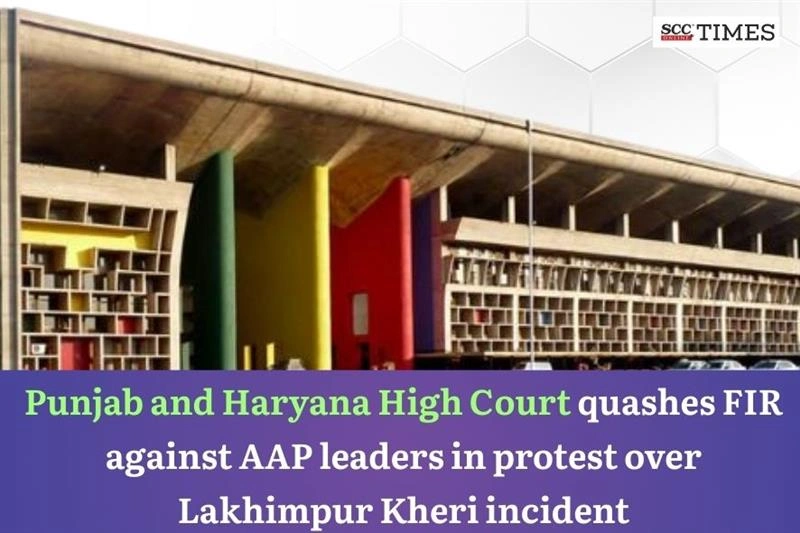
Punjab and Haryana High Court: In a set of six petitions filed by Aam Aadmi Party (‘AAP’) leaders seeking quashing of case filed against them concerning Rally as opposed to the incidence at Lakhimpur Khiri in which they were accused of instigating the protest, a Single Judge Bench of Tribhuvan Dahiya, J., held that ingredients of none of the offences could be said to have been made out against any of the petitioners even on the face of it and it is settled law that an FIR can be quashed if it does not prima facie disclose commission of any of the alleged offences by the accused.
Accordingly, the Court allowed the present petitions and quashed the FIR against the petitioners.
Background
In the case at hand, the FIR was registered under Section 482 of the Criminal Procedure Code, 1973 (‘CrPC’) seeking quashing of FIR under Sections 186, 188, 332, and 353 of the Indian Penal Code, 1860 (‘IPC’) pertaining to a protest organised by AAP leaders and workers at the MLA Hostel, Punjab, concerning the Lakhimpur Khiri incident. A crowd of 500 to 600 individuals gathered and moved towards the residence of the Governor of Punjab. The police had barricaded the area owing to prohibitory orders under Section 144 of the CrPC. The FIR alleged that the petitioners instigated the protesters.
Upon being informed that their gathering violated the said CrPC provision and being asked not to cross the barricades, the crowd allegedly turned violent, pushed the police personnel, attempted to break the barricading, and caused simple injuries to a few police officials, including two Constables. The Medico Legal Reports reflected injuries that the injuries suffered by the officials were simple in nature.
On one hand, the petitioners contended that the police could not prevent peaceful protest, which was protected under Article 19(1)(a) of the Constitution and on the other hand, the respondents argued that the protest turned unruly and that the petitioners, being leaders, instigated the mob which obstructed the police from performing their duties.
Analysis and Decision
The Court stated that the issue involed in the present case pertained to the compliance of mandatory procedure laid down under Section 195 of the CrPC, that is, at what stage compliance of the procedure under Section 195 of the CrPC is mandated?
Relying on Devendra Kumar v. State (NCT of Delhi) 2025 1NSC 1009, the Court specified that the stage of complying with the procedure mandated in the section is when cognizance of the offence is to be taken by the Court, and not at the time of lodging the FIR.
The Court stated that in the present case cognizance had already been taken, charges were framed, and it was not the petitioner’s case that a complaint by the public servant had not been filed before the Magistrate took cognizance.
Further, the Court stated that an FIR can be quashed if it does not disclose commission of any of the alleged offences by the accused on the face of it. The Court highlighted that nobody was named amongst the persons present who allegedly pelted stones on the police force, and the nature of alleged instigation by petitioners had also not been mentioned. Further, no specific words or gestures of any kind were attributed to them. Hence, there was no basis to attribute the alleged act of shoving and bullying to bullying by the mob to the petitioners. The Court opined that it was a case where no act, voluntary or otherwise, had been attributed to the petitioners, and the investigating agency failed to come up with any material indicating any definite role to the petitioners.
The Court stated that the petitioners were not specifically accused of voluntarily causing hurt, assault, or using criminal force, also there was no allegation that the protesters were armed or carrying sticks, stones, etc. Thus, in the absence of any allegation of the commission of offences by an unlawful assembly so much so that the chargesheet was not filed under Sections 147 147 and 149 of the IPC, the petitioners could not be held liable for the alleged acts of the protestors. There could not be any constructive liability, as common objects had not even been alleged.
Therefore, the Court stated that prima facie, none of the ingredients of the offences were made out against any of the petitioners which is why there was no ground to take cognizance of the offences or to frame charges against them.
The Court, thus, allowed the petition and quashed the FIR, chargesheet and order framing charges against the petitioners.
[Aman Arora v. State (UT of Chandigarh), 2025 SCC OnLine P&H 15549, decided on 29-11-2025]
Advocates who appeared in this case:
For the Petitioners: Anmol Rattan Sidhu, Senior Advocate, Pratham Sethi, Advocate, Sandhya Gaur, Advocate, Varun Sharma, Advocate, Kanishk Swaroop, Advocate, Kritima Sareen, Advocate and Raghav Gulati, Advocate
For the Respondent: Manish Bansal, Public Prosecutor, Viren Sibal. Additional Public Prosecutor and Rajiv Vij, Additional Public Prosecutor
Buy Code of Criminal Procedure, 1973 HERE
Buy Penal Code, 1860 HERE

Buy Constitution of India HERE