
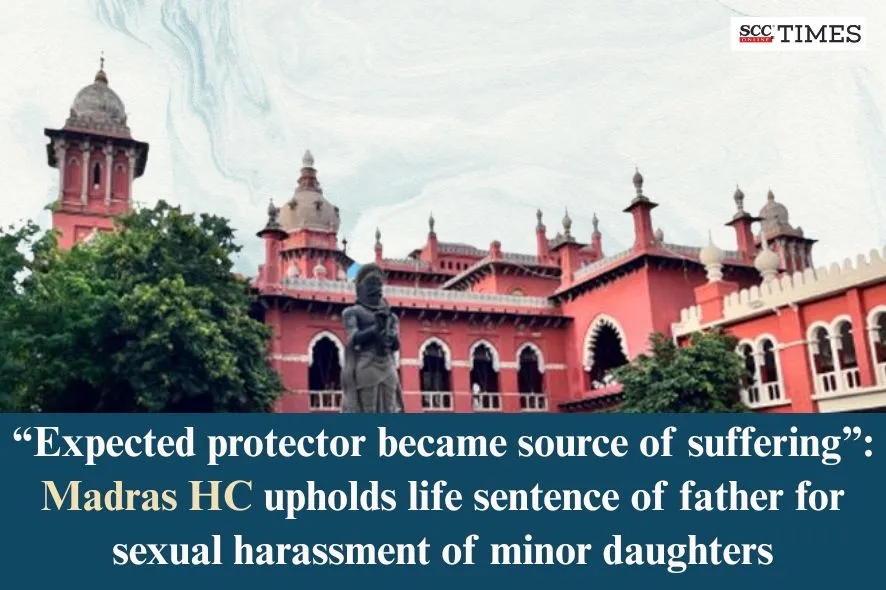
Madras High Court: In a case where a father was accused of sexual harassment of his minor daughters, the Division Bench of N. Sathish Kumar and M. Jothiraman*, JJ., upheld the life imprisonment imposed by the Trial Court and observed that,
“A father’s paramount duty is to ensure the safety, emotional wellbeing, and moral upbringing of his children, and when such responsibility is let down, it strikes at the foundation of the family and society. The Court therefore found no mitigating factor warranting interference with the sentence imposed by the Trial Court and upheld the life imprisonment imposed.”
The accused had challenged his conviction and life sentence under Sections 4 and 10 of the Protection of Children from Sexual Offences Act, 2012 (‘POCSO Act’) on the ground that the case was falsely framed owing to a ten‑month delay in lodging the complaint, further asserting that the victims never disclosed the incidents to either neighbours or their mother. The Court, however, found no mitigating factor and dismissed the appeal.
Background:
The accused, a resident of Salem, first married and had three children. Later, he married again and lived with his second wife in different localities of Salem. From this marriage, four children were born. Due to frequent quarrels and his habit of consuming alcohol, the wife left the matrimonial home in November 2015, taking other children with her, while leaving two minor daughters with the accused.
The accused, along with the two daughters, shifted to a rented house. During this period, he subjected both minor daughters to sexual harassment. One daughter, aged 16, was repeatedly assaulted with forceful sexual penetration, while the younger daughter, aged 13, was also harassed through inappropriate touching and digital penetration. He threatened them with dire consequences if they disclosed the incidents.
The children were later rescued and placed in welfare homes. On enquiry, both victims narrated the assaults to welfare authorities and subsequently to police officials and the Magistrate. Their statements were recorded, including video confession, and medical examinations confirmed sexual abuse, with torn hymen and findings consistent with repeated intercourse.
Consequently, the police registered a case under the POCSO Act and Section 506(ii) of the Penal Code, 1860 (‘IPC’), conducted investigation, gathered medical and documentary evidence, and filed a charge sheet. The Trial Court, after examining witnesses and exhibits, found the accused guilty and convicted him accordingly.
However, on appeal, the accused contended that the case was falsely framed, pointing to a delay of nearly ten months in lodging the complaint. He further alleged that there were family disputes arising from his liquor habits and the daughter’s conduct. He also asserted that if such incidents truly occurred, the victims would disclose them to their neighbours or their mother, which was not considered by the Trial Court.
Analysis and Decision:
The Court observed that the prosecution proved its case through the testimonies of witnesses. The Court emphasised that the Trial Court, on a careful appreciation of oral and documentary evidence and other materials, rightly convicted the appellant. It was noted that at the time of occurrence, as per the first information report (‘FIR’), one daughter was aged about 13 years and 9 months and was studying in the 7th standard, while the other daughter was studying in the 4th standard and was aged about 10 years and 9 months. The Court further highlighted that the elder daughter stated that at the age of 12, the appellant forced her to consume alcohol and also deposed that she used to consume liquor only with her parents.
The Court further noted that the prosecution established the guilt of the accused by corroborating the evidence of the daughters, and the Doctor opined that one daughter was repeatedly forced to have sexual intercourse, while the other daughter was subjected to sexual harassment. The Court observed that the evidence of the second wife did not support the case of the appellant, since she categorically admitted that, due to the offence committed by the appellant, the elder daughter conceived, and a male child was born but died within 7 months. She also admitted that she was deposing only to save her husband.
The Court emphasised that in our culture, father occupies a revered place next to mother and higher than teacher and the divine. It was highlighted that a father’s paramount duty is to ensure the safety, emotional wellbeing, and moral upbringing of his children, and when such a sacred responsibility is let down, it strikes at the very foundation of the family and society.
The Court observed that the present case is indeed peculiar and painful, as the father, who is expected to be the protector and guardian of his children, turned out to be the very source of their suffering. It was further noted by the Court that the case portrays a distressing picture of how addiction to alcohol can destroy family harmony and erode moral values. The Court emphasised that the accused, instead of nurturing and protecting his daughters, allowed his inebriated state to overpower his human instincts and parental duty.
The Court found no mitigating factor warranting interference with the sentence imposed by the Trial Court. Consequently, the Court upheld the life imprisonment awarded to the accused, holding that no reduction or modification of the sentence was warranted
Accordingly, the Court dismissed the criminal appeal, thereby confirming the judgment of conviction and sentence imposed on the accused by the Sessions Court, Magalir Neethimandram, Salem, dated 12-02-2019.
[X v. State of Madras, 2025 SCC OnLine Mad 9864, decided on 11-11-2025]
*Judgment authored by: Justice M. Jothiraman
Advocates who appeared in this case:
For the Appellant: V. Thamizhanban
For the Respondent: A. Damodaran, Addl. Public Prosecutor assisted by M. Aritha Thasneem
Buy Protection of Children from Sexual Offences Act, 2012 HERE
Buy Penal Code, 1860 HERE