Disclaimer: This has been reported after the availability of the order of the Court and not on media reports, so as to give an accurate report to our readers.
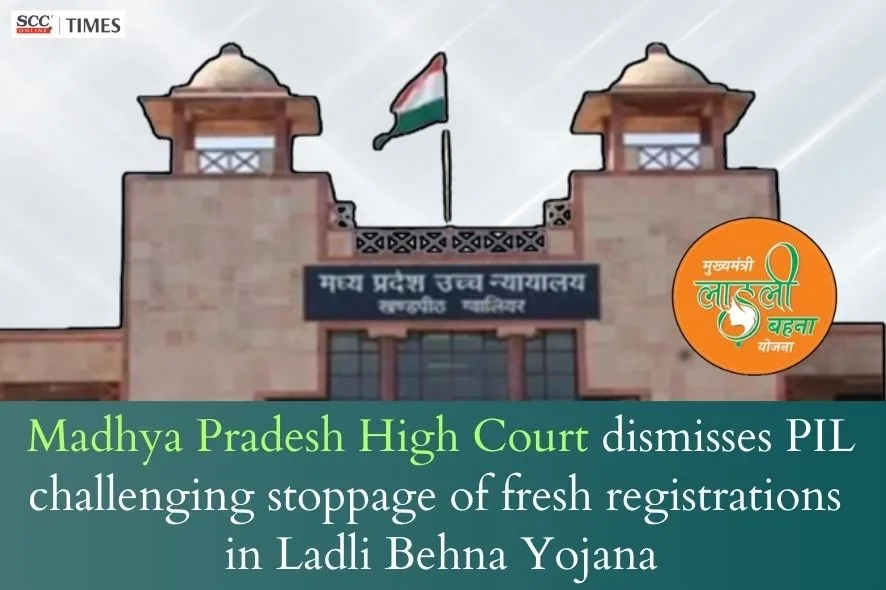
Madhya Pradesh High Court: In a public interest litigation challenging the implementation of the Mukhyamantri Ladli Behna Yojana, 2023, the Division Bench of Vijay Kumar Shukla*and Alok Awasthi, JJ., dismissed the petition, holding that the case did not fall within the scope of judicial review and the issues raised fell within the executive domain.
Background
The petitioner filed the present writ petition public interest litigation (“PIL”) under Article 226 of the Constitution challenging the alleged illegal, arbitrary and discriminatory implementation of the Mukhyamantri Ladli Behna Yojana, 2023 (‘the Scheme’), a welfare scheme introduced by the State of Madhya Pradesh for women empowerment.
The Scheme aimed at improving women’s health and nutrition, promoting economic independence, and strengthening their participation in family decision-making. Clause 6.1 of the Scheme provided that the State shall pay Rs 1,000 in their bank accounts to every woman domiciled within the State who is registered as per the Scheme. Clause 3 of the policy required that the beneficiary must be a domiciled married woman (including widowed, divorced, or abandoned women) aged between 23 and 60 years. By order dated 19-07-2023, the minimum age was reduced from 23 to 21 years.
The petitioner contended that the State unlawfully stopped fresh registrations under the scheme with effect from 20-08-2023, despite the Scheme being of a continuing nature. It was argued that the closure of registrations excluded newly eligible women and amounted to hostile discrimination under Article 14. The petitioner also questioned the fixation of minimum and maximum age limits and sought the reopening of registration and extension of benefits to all women.
On the other hand, the State contended that the scheme constituted a policy decision falling within executive discretion and that no aspiring beneficiary had challenged it.
Issue
Whether an executive welfare policy of the State Government can be subjected to judicial review in a public interest litigation.
Analysis
At the outset, the Court examined the permissible scope of judicial review over governmental policy decisions. The Court referred to Balco Employees Union v. Union of India, (2002) 2 SCC 333, wherein it was held that Courts should not interfere with economic and policy decisions, as judicial review is limited to examining the legality rather than policy wisdom. The Court also referred to Narmada Bachao Andolan v. Union of India, (2000) 10 SCC 664, wherein it was held that Courts do not substitute their views for those of experts in policy matters.
Similarly, in State of M.P. v. Nandlal Jaiswal, (1986) 4 SCC 566, the Supreme Court held that interference with policy decisions is warranted only where the action is arbitrary, discriminatory, or mala fide. Supplementing this view, the Court in Villinaur Iyarkkai Padukappu Maiyam v. Union of India, (2009) 7 SCC 561, held that judicial interference is justified only where policy decisions are unconstitutional, arbitrary, or contrary to the statute.
The Court also relied upon Delhi Development Authority v. Joint Action Committee (2008) 2 SCC 672, the Court reiterated that executive policies may be subjected to judicial review only where they are unconstitutional, dehors the provisions of the Act and the regulations, if the delegatee has acted beyond delegated power, or inconsistent with statutory or a larger policy.
Applying these precedents to the present case, the Court noted that the Scheme was an executive policy and did not fall within the aforementioned requirements for a judicial review as the petitioner’s contention was that the policy was unconstitutional for being violative of Article 14.
Noting the aforesaid, the Court held that the determination of the date of commencement, continuation, or closure of a welfare scheme lies within the domain of the State Government as it was a policy decision. Thus, the Court rejected the contention that the stoppage of fresh registrations was arbitrary.
Regarding the challenge to age eligibility, the Court held that prescribing minimum and maximum age limits is likewise a matter of policy formulation. Considering the object and nature of the Scheme, the Court found no arbitrariness or unreasonableness in prescription of eligibility.
The Court also declined to examine the grievance concerning non-enhancement of monetary benefits, observing that the petitioner was neither an aspirant nor a beneficiary of the Scheme. Such relief, the Court held, could not be considered in a PIL.
Ultimately, the Court found that the case did not satisfy the recognised grounds for judicial interference with executive policy. Accordingly, the petition was dismissed.
[Paras Saklecha v. State of Madhya Pradesh, 2026 SCC OnLine MP 1025, decided on 10-02-2026]
*Judgment authored by: Justice Vijay Kumar Shukla
Advocates who appeared in this case :
For the petitioner: Vibhor Khandelwal, Advocate
For the respondents: Sudeep Bhargava, Deputy Advocate General; Pradyumna Kibe, Government Advocate