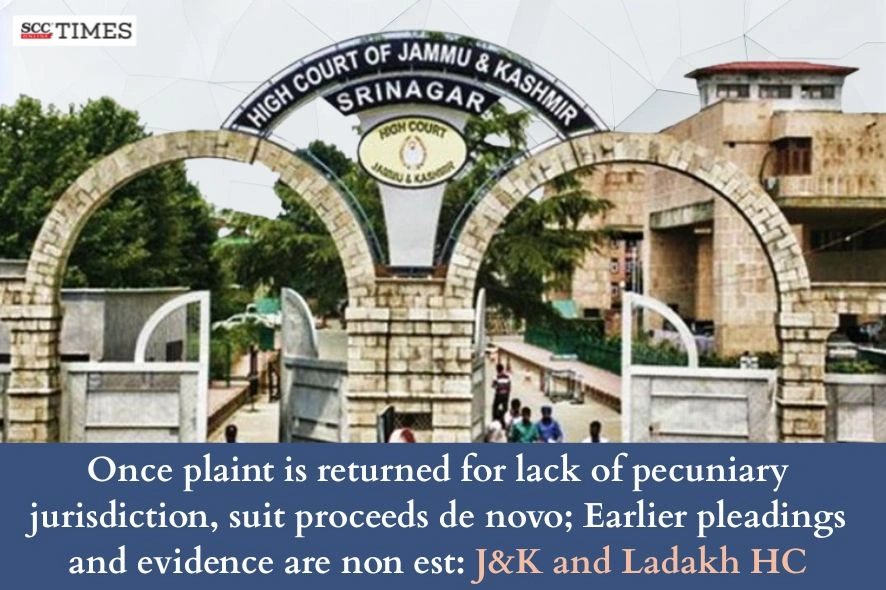
Jammu & Kashmir and Ladakh High Court: In a petition revolving around whether, after a plaint is returned for lack of pecuniary jurisdiction and presented before the competent court, the suit must proceed de novo, permitting a fresh written statement, or whether the 120-day bar under Order 8 Rule 1 of the Civil Procedure Code, 1908 (‘CPC’) would apply, a Single Judge Bench of Sanjay Dhar, J., set aside the impugned order and held that once plaint returned for lack of pecuniary jurisdiction, suit proceeds de novo before the competent court and the earlier pleadings and evidence are non est. Thus, the defendants have the right to file fresh written statements.
Background:
The suit originated before the 2nd Additional Munsiff, Srinagar (‘Munsiff Court’), where the plaintiff sought:
-
a declaration relating to his ownership to the extent of his share in land measuring 5 kanals and 10 marlas and two residential houses situated at Mandi Bagh;
-
a decree for partition of the suit property with a further prayer for putting him into actual physical possession of his share; and
-
a decree of permanent prohibitory injunction restraining the defendants from alienating or transferring any or whole part of the suit property.
The defendants filed their written statement and a counter claim. By order dated 19-4-2022, the Munsiff Court held that the suit had not been properly valued as per the share sought to be partitioned and the relief of injunction and jurisdiction had not been valued separately. Accordingly, the plaintiff was directed to properly value and affix the court fee, failing which the plaint would be liable for rejection under Order 7 Rule 11 CPC. On 3-8-2022, noting compliance, the Munsiff Court observed that it lacked pecuniary jurisdiction and returned the plaint, submitting the original to the Principal District Judge, Srinagar, for placing it before the competent court. On 25-8-2022, the Principal District Judge transferred the case to the 2nd Additional District Judge, Srinagar (‘Trial Court’).
The defendants then moved an application seeking permission to file a fresh written statement, but by an order dated 19-12-2024, the Trial Court dismissed the application, observing that even assuming appearance on 20-9-2022, in view of Order 8 Rule 1 CPC, the maximum period of 120 days from the date of service of summons had expired, and the written statement could not be permitted.
Analysis and Decision:
The Court acknowledged that defendants had a right to file a fresh written statement after the plaint was returned on the ground that the subject matter of the suit was beyond the pecuniary jurisdiction. The Court relied on EXL Careers v. Frankfinn Aviation Services (P) Ltd., (2020) 12 SCC 667, wherein the Supreme Court held that after the return of plaint, the competent court is to proceed de novo, even if evidence of the parties stood concluded before the court which returned the plaint, and that Order 7 Rule 10 read with Rule 10-A CPC cannot be interpreted as permitting the court to proceed from the stage at which the plaint was returned.
The Court noted that the Trial Court resorted to Order 8 Rule 1 CPC while refusing to permit the defendants to file a fresh written statement. The defendants had caused appearance before the Trial Court through counsel on 20-9-2022, and thereafter the case was put up for recording evidence of the plaintiff, which meant that the Trial Court had proceeded from the stage already reached when the plaint was returned.
The Court observed that when a matter is placed before the competent court after the court lacking jurisdiction has fixed a date of appearance of the parties before it, the competent court must proceed in the suit de novo. The Court opined that the procedure adopted by the Trial Court by straightaway directing the plaintiff to produce evidence without calling upon the defendants to file written statement was palpably illegal and could not be countenanced in law. The Court further observed that the defendants were not even required to file an application seeking permission to file a written statement and it was the duty of the Trial Court to proceed in the suit as if the plaint had been filed before it afresh and the defendants had entered their appearance before the said court.
The Court clarified that once it is concluded that the initial proceedings were held before a court that lacked jurisdiction, the written statement and other evidence that may have been led by the parties before the said court become non-est in the eyes of law and the defendants are within their rights to file their written statement before the Trial Court.
Accordingly, the Court, while allowing the petition, set aside the impugned order and permitted the defendants to file their written statement before the Trial Court within thirty days from the date of their appearance. The Court directed the parties to appear before the Trial Court on 26-12-2025.
[Mohammad Shaif Bhat v. Rafi Ahmad Bhat, 2025 SCC OnLine J&K 1208, decided on 5-12-2025]
Advocates who appeared in this case:
For the Defendant: Showkat Ali Khan, Advocate.