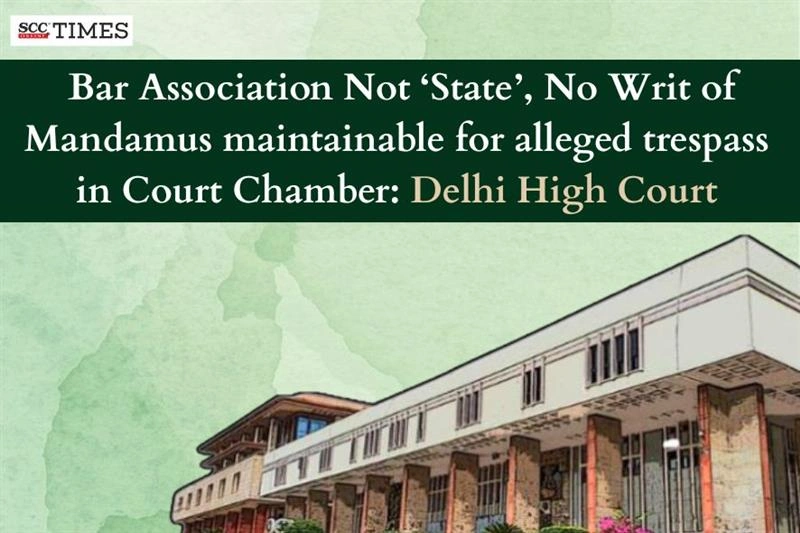
Delhi High Court: In an intra-court appeal arising from a dispute concerning possession and use of a lawyers’ chamber at the Patiala House Courts and the scope of writ jurisdiction against a Bar Association, a Division Bench of Devendra Kumar Upadhyaya,* CJ., and Tejas Karia, J., dismissed the appeal and held that a Bar Association registered under the Societies Registration Act, 1860 is a private body of lawyers and does not perform public functions. It is neither “State” nor an instrumentality of State under Article 12 of the Constitution, and therefore, no writ of mandamus can be issued against it under Article 226 of the Constitution.
Factual Matrix
In the instant matter, the appellant is an Advocate enrolled with the Bar Council in the year 2000. She asserted that she has been a regular practitioner since 2000 and has represented Government agencies and autonomous bodies, and has been on the Senior Panel of Bharat Sanchar Nigam Limited since 2011, as also on the Senior Panels of Mahanagar Telephone Nigam Limited, Delhi Jal Board, Municipal Corporation of Delhi and other bodies.
In the year 2013, one Mr. Asgar Ali approached the appellant and informed her that he was the allottee of Chamber No. 279A at Patiala House Courts. He requested her to use the said chamber on rent. The appellant agreed and started functioning from the said chamber on a monthly rent basis.
The appellant alleged that on a particular day, when she returned from Tis Hazari Courts to the said chamber, she found that Mr. Asgar Ali along with ten other persons were occupying her chamber after breaking open the lock. It was further alleged that these persons threatened, abused and pressurised her to remove her belongings and vacate the chamber.
It was also the appellant’s case that on 04-02-2023, instead of helping her, the office bearers of the New Delhi Bar Association threatened her to vacate the chamber and a lock of the Bar Association was put on the chamber, rendering her belongings, including case files of various Government departments, inaccessible.
The appellant further alleged that despite informing the police, no action was taken and she was advised to approach the Chairperson of the Bar Association. She submitted representations and reminders to the Bar Association and to the Principal District and Sessions Judge, Patiala House Courts, but received no response.
On 06-03-2023, she received a call while appearing before the Central Administrative Tribunal informing her that her files and documents had been thrown out of the chamber and were lying on the street.
Procedural History
By order dated 17-03-2023, the Single Judge directed the District Judge In-charge, Patiala House Courts, to gain access to the chamber and enable the appellant to remove her belongings. The District Judge later reported that the belongings had been removed. Thereafter, the Single Judge directed that the keys be handed over to Mr. Asgar Ali, who undertook that he would use the chamber personally and would not sub-let it for monetary consideration.
A preliminary objection was raised regarding maintainability on the ground that the Bar Association is neither “State” nor an instrumentality of State within the meaning of Article 12 of the Constitution. By order dated 30-10-2023, the learned Single Judge dismissed the writ petition and held that the appellant was not an allottee of the chamber but was only in permissive possession, in absence of any right over the chamber, the writ petition was not maintainable, remedies for criminal trespass were available under the Criminal Procedure Code, 1973 (CrPC) and Bar Association was not amenable to writ jurisdiction.
Moot Point
Whether a writ of mandamus could be issued against the New Delhi Bar Association and whether the writ petition seeking directions for criminal action was maintainable under Article 226 of the Constitution of India?
Court’s Analysis
The Court held that even with respect to prayer ‘B’, “issue a Writ in the nature of mandamus or other suitable writ or order or direction thereby directing the Respondent No. 1 and/or Bar Council of Delhi to take appropriate action against the said Advocates, who have indulged in illegal and criminal activities of committing criminal acts trespassing in respect of the Chamber in question”, the writ petition was not maintainable.
The Court observed that the New Delhi Bar Association is “an Association of Lawyers registered under the Societies Registration Act, 1860 and the primary object of the Bar Association is to ensure welfare of its members.”
The Court stated that Bar Association is a body of private individual lawyers and “in normal discharge of its functions, it does not perform any function which can be said to be a public function.” The Court categorically observed that “it is in fact, a purely private entity and cannot in any manner or for any reason whatsoever be termed to be ‘State’ or its instrumentality or agency or authority.”
The Court held that Bar Association is not a public body therefore it is not covered under Article 12 of the Constitution of India. Accordingly, the Court held that Court, in exercise of our jurisdiction under Article 226 of the Constitution of India, can’t issue writ of Mandamus to Bar Association.
As regards the allegation of criminal trespass, the Court held that such acts may warrant criminal action, but for that purpose, the appellant must take recourse to remedies available under criminal law.
With respect to the Bar Council of Delhi, the Court noted that it is a statutory body entrusted with regulating the legal profession and taking disciplinary action for misconduct. However, the appellant had neither represented her grievance to the Bar Council nor impleaded it as a party.
The Court reiterated the settled principle that “for seeking Writ of Mandamus, the person approaching the Court has to first approach the authorities concerned.” The Court held that since the appellant had not approached the Bar Council of Delhi, no mandamus could be issued against it.
Court’s Decision
The Court upheld the order of the Single Judge and dismissed the appeal, holding that the writ petition was not maintainable. However, the Court observed that it would always be open to the appellant to take recourse to appropriate civil or criminal action, including approaching the Bar Council of Delhi.
[Sangita Rai v. New Delhi Bar Association, 2026 SCC OnLine Del 243, Decided on 16-01-2026]
*Judgment by Chief Justice Devendra Kumar Upadhyaya
Advocates who appeared in this case:
Mr. Shishir Pinaki, Mr. Rakesh Singh and Mr. Shavnam Singh, Counsel for the Appellant
Mr. Ashish Garg and Mr. Govidn Singh, Counsel for the Respondents
Buy Constitution of India HERE

Buy Code of Criminal Procedure, 1973 HERE