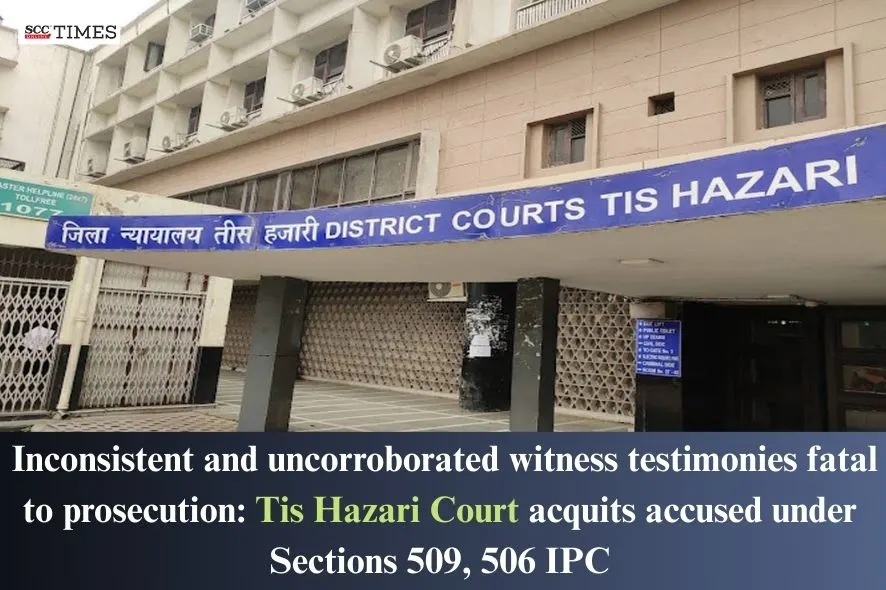
Tis Hazari Court, Delhi: In a case involving allegations under Sections 509 and 506 of the Penal Code, 1860 (‘IPC’), a Single Judge Bench of Preeti, J., held that the prosecution had failed to prove the charges beyond reasonable doubt. The Court observed that the testimonies of the complainant and her witnesses were marked by inconsistencies, lacked clarity, and were not corroborated by independent evidence. Emphasising that ambiguities in the prosecution’s case and contradictions in witness statements entitled the accused to the benefit of doubt, the Court acquitted the accused.
Background:
The dispute arose from an incident dated 02-03-2016 at the Public Grievance Commission, where the complainant alleged that the accused used vulgar language and threatened her. A charge sheet was filed under Sections 509 and 506 IPC, and charges were framed.
The prosecution examined five witnesses, including the complainant, her personal assistant, and an independent education officer. The complainant deposed that vulgar words were used against her and threats were made. The personal assistant corroborated the incident, while the independent officer stated that heated arguments took place and vulgar language was exchanged. Police officials testified regarding the registration of the FIR and investigation.
In defence, witnesses deposed that the accused was not present at the spot and was instead at the Directorate of Education. Documentary evidence such as registers and complaints were produced to support this claim. The defence argued that the accused was falsely implicated due to prior enmity, that the site plan was faulty, witnesses were contradictory, and no independent public witnesses were examined.
The prosecution contended that the guilt was established beyond reasonable doubt through the testimonies of its witnesses. The defence argued that the presence of certain witnesses was doubtful, the accused was not present at the spot, and the complainant had enmity with the accused due to prior cases, thereby seeking acquittal.
Analysis and Decision:
The Court emphasised that the prosecution must prove its case beyond reasonable doubt and observed that the concept of benefit of doubt flows directly from the presumption of innocence. The Court noted that the complainant admitted she got hyper, and PW 3 corroborated that arguments continued between both sides. It was highlighted that the complainant and accused had hostile relations due to prior FIRs, and therefore the sole testimony of the complainant could not be relied upon.
The Court observed that a witness present at the spot was not examined by the prosecution, while in defence he deposed that the accused was not present at the building. It was noted that PW 2, being an interested witness, did not disclose the exact words allegedly used, and PW 3 also failed to specify the words. The Court highlighted that the contradiction though not material, is important in these circumstances when all the witnesses present on the spot have not been cited as prosecution witnesses.
On cumulative evaluation, the Court held that the allegations made by complainant have not been proved beyond reasonable doubt and benefit of doubt must be given to the accused as there are ambiguities in the prosecution case. The Court observed that the lack of clarity with respect to the actual place of occurrence of the alleged incident along-with lack of specific allegations in testimony cast serious doubt over the case of prosecution. The Court emphasised that all these infirmities give rise to reasonable doubt regarding the prosecution story and further, the possibility of false implication by the complainant cannot be ruled out.
The Court referred to S.L. Goswami (Dr) v. State of M.P., (1972) 3 SCC 22, wherein it was held that the accused is entitled to benefit of doubts where the onus of proving ingredients of the offences is not discharged by the prosecution. The Court noted that, in the case at hand, the prosecution failed to discharge the onus of proving the ingredients of the offences, thus, the accused is entitled to the benefit of doubt.
Thus, the Court concluded that the prosecution had failed to establish beyond all reasonable doubt that, on the given date, time, and place, the accused committed the aforesaid offences and accordingly acquitted the accused of offences under Sections 509 and 506 IPC. The Court further cancelled the bail bonds, discharged the sureties, and directed disposal of the case property as per rules.
[State v. Naresh Chaudhary, 2026 SCC OnLine Dis Crt (Del) 1, decided on 13-01-2026]
Advocates who appeared in this case :
For the State: APP
For the Accused: Harsh Tiku