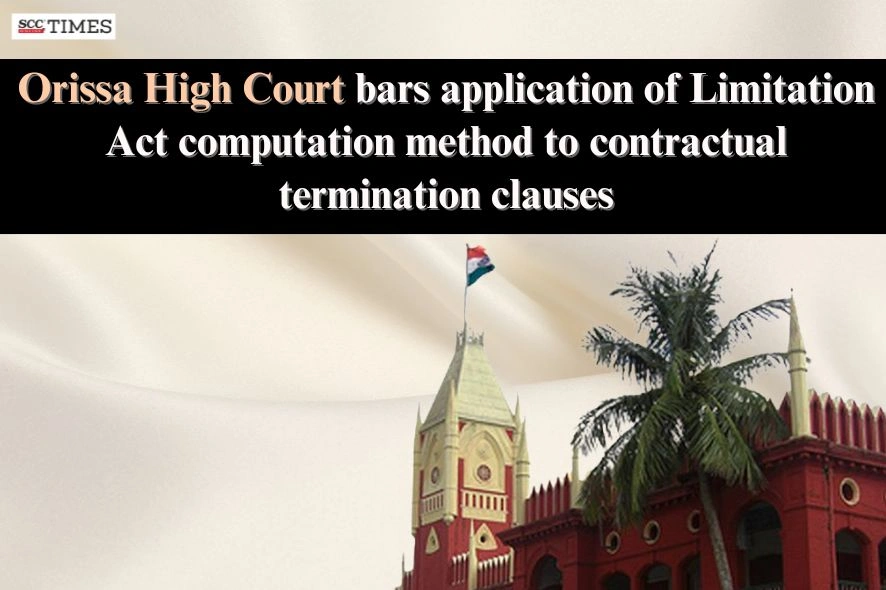
Orissa High Court: In a writ petition challenging the termination of a contract for alleged poor performance, the Division Bench of Harish Tandon* CJ., and M.S. Raman, J., observed that the thirty days’ notice requirement was duly satisfied and principles of natural justice were complied with and accordingly, upheld the termination order. The Court held that
“The method of computation of the period for the purpose of limitation enshrined in Section 12 of the Limitation Act, 1963 cannot be extended and/or applied in contractual field.”.
Background:
In the instant matter, the dispute arose when the contract awarded to the petitioner was terminated after allegations of poor performance of sanitary workers, discrepancies in supply of equipment, non-submission of Employees’ Provident Fund (‘EPF’) and Employee State Insurance (‘ESI’) details, non-payment of salaries, negligence of staff, and failure to replace workers. A notice dated 09-09-2025 was issued, and the petitioner responded on 23-09-2025 denying the allegations and contending that the termination was intended to favour another party.
The petitioner argued that once the earlier termination notice was quashed by the Court, all steps taken prior thereto would perish automatically, and awarding the contract thereafter was per se illegal. It was further submitted that the second course of action was violative of Clause 4.8 of the RFP, as the notice did not contain a clear thirty days. A plea of violation of principles of natural justice was also raised, asserting that no adequate opportunity of hearing was accorded.
The authorities maintained that the notice and termination order were issued in compliance with Clause 4.8 of the RFP, and that the petitioner had been given sufficient opportunity to remedy deficiencies and respond to allegations.
Analysis and Decision
The Court emphasised that Clause 4.8 of the RFP contains an exhaustive mechanism relating to termination of a contract and confers upon the service provider a corresponding right to remedy deficiencies. The Court noted that the clause mandates a thirty days’ clear notice in writing, expressing an intention to terminate, and also provides a fifteen-day period for remedial measures.
The Court observed that the petitioner had indeed replied to the notice, thereby showing that the notice was served and considered. It was highlighted that the authorities took into account both the allegations and the reply before issuing the termination order. The Court was not impressed with the submission that computation of thirty days should exclude the first day, holding that the methodology under Section 12 of the Limitation Act, 1963 could not be extended to the contractual field.
The Court further noted that whether the termination would take effect from a particular date has no nexus to the period provided for issuance of the notice. It was observed that the notice dated 09-09-2025 and the termination order dated 27-10-2025 clearly satisfied the thirty-day requirement. The Court highlighted that Clause 4.8 ensures both remedial opportunity and adherence to principles of natural justice, and found that compliance was readily inferred.
Finally, the Court declined to interfere, holding that the order of termination was not infirm and not in contravention of Clause 4.8 of the RFP. The writ petition was dismissed without costs.
[Group No.5 Security Service v. State of Orissa, 2026 SCC OnLine Ori 196, decided on 13-01-2026]
*Judgment authored by: Chief Justice Harish Tandon
Advocates who appeared in this case:
For the Petitioner: Susanta Kumar Mishra, Advocate
For the Opposite Parties: Sanjay Rath, Addl. Government Advocate, Satya Smruti Mohanty, Advocate