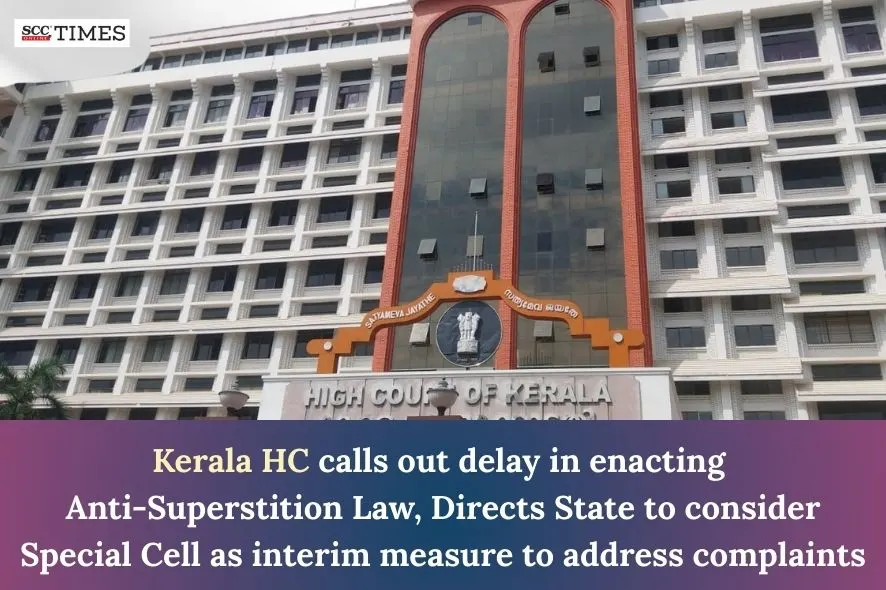
Kerala High Court: In a case addressing whether the State had taken adequate steps to prevent atrocities committed in the name of black magic, sorcery, and other inhuman practices, the Division Bench of Nitin Jamdar, CJ., and Syam Kumar V.M., J., while acknowledging its limitations in issuing a writ of mandamus compelling the State to enact Anti-Superstition Law, held that the State cannot remain passive in the face of such practices. Ultimately, the Court directed that interim measures be considered, including the establishment of a Special Cell to deal with complaints of this nature, thereby demonstrating the seriousness of the State in addressing these concerns.
The petition was filed by a registered cultural organization on 15-10-2022, seeking measures against black magic and witchcraft, emphasizing the need to protect rationalism, humanism, and scientific temper. The petitioner highlighted recent incidents of human sacrifice and pointed out that Karnataka and Maharashtra had enacted legislation prohibiting such practices.
The State Attorney initially submitted that Kerala was contemplating legislation, and later affidavits clarified that existing laws such as the Bharatiya Nyaya Sanhita, 2023, the Drugs and Magic Remedies (Objectionable Advertisements) Act, 1954, the Kerala Police Act, 2011, and other special statutes like Scheduled Castes and Scheduled Tribes (Prevention of Atrocities) Act, 1989, the Protection of Children from Sexual Offences Act, 2012, and the Juvenile Justice (Care and Protection of Children) Act, 2015, were sufficient to prosecute criminal acts committed under the guise of supernatural claims.
The Chief Secretary further stated that although a Bill titled Kerala Prevention and Eradication of Inhuman Evil Practices, Sorcery and Black Magic Bill, 2022 had been proposed based on the Law Reforms Commission report of Justice K.T. Thomas (2019), the Council of Ministers decided not to proceed with it. However, the enactment of an Anti-Superstition law remained under active consideration, with consultations ongoing among various departments and stakeholders.
The Court opined that though the Court has limitations in issuing a writ of mandamus directing the State Government to enact legislation, but in none of the affidavits has the State come on record endorsing the practices highlighted in the petition. The Court noted the relevance of Article 51-A(h), which enjoins citizens to develop a scientific temper, humanism, and the spirit of inquiry, and the petitioner’s reliance on Article 21 of the Constitution. The Court further noted that despite repeated adjournments and assurances, the State had neither enacted legislation nor conclusively declined to do so over a span of nearly four years.
Regarding the State’s stand that existing statutory provisions also deal with practices of black magic, witchcraft and sorcery, the Court observed that the State ought to consider setting up a Special Cell to deal with complaints of this nature, which would demonstrate the State’s seriousness in taking measures against such inhuman practices. The Court opined that such arrangements can be made irrespective of the steps that the State Government is already contemplating towards enacting special legislation. The matter is posted for further hearing on 10-2-2026.
[Kerala Yukthi Vadhi Sangam v. Union of India, 2026 SCC OnLine Ker 227, decided on 6-1-2026]
Advocates who appeared in this case:
For the Petitioner: O.V. Radhakrishnan (Senior Advocate) along with P.V. Jeevesh, Advocate.
For the Respondents: Suvin R. Menon, Senior Panel Counsel, N. Manoj Kumar, State Attorney.
Buy Protection of Children from Sexual Offences Act, 2012 HERE

Buy Constitution of India HERE