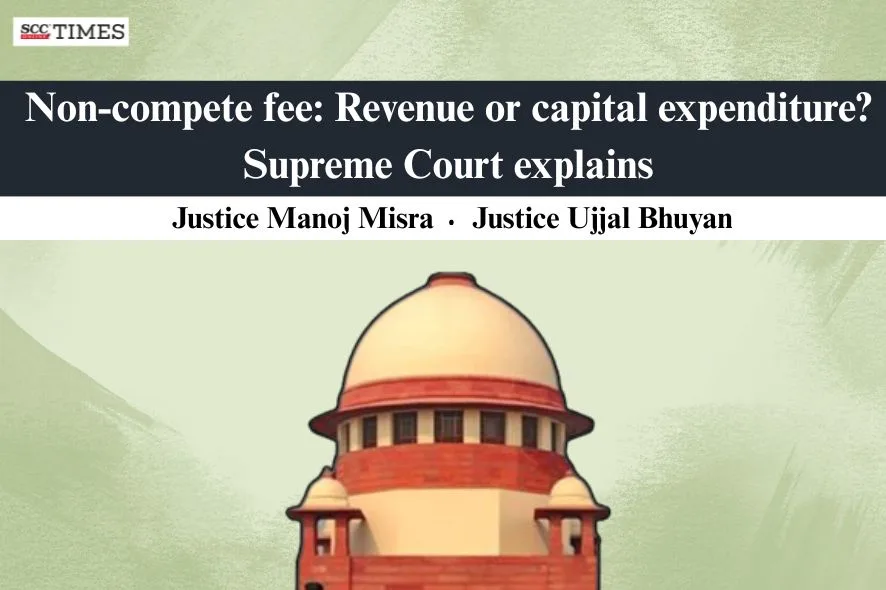
Supreme Court: In a batch of appeals dealing with divergent views taken by various High Courts on a recurring question whether non-compete fees paid by an assessee amounts to revenue expenditure or capital expenditure, a Division Bench of Manoj Misra and Ujjal Bhuyan,* JJ., held that payment made by the assessee as non-compete fee is an allowable revenue expenditure under Section 37(1) of the Income Tax Act, 1961 (the Act).
Factual Matrix
The Sharp Business System (assessee) was incorporated in 2000 and was engaged in the business of importing, marketing and selling electronic office products in India. During the assessment year 2001—02, it entered into a non-compete agreement with Larsen & Toubro Limited (L&T), under which L&T agreed not to engage in or assist any competing business for seven years, in consideration of Rs. 3 crores.
The assessee claimed this payment as a deductible revenue expenditure under Section 37(1) of the Act. The Assessing Officer, however, held that the payment was made to eliminate competition and conferred an advantage of enduring nature, thereby treating it as capital expenditure and therefore disallowed the claim.
The Commissioner of Income Tax (Appeals) affirmed the assessment and held that the assessee was not entitled to depreciation since the non-compete right did not constitute a depreciable asset. The Income Tax Appellate Tribunal and the Delhi High Court concurred with this view and held that the right acquired was a right in personam, not a “business or commercial right” within the meaning of Section 32(1)(ii) of the Act.
The present appeal is filed by appellants, a joint venture between Sharp Corporation and L&T, challenging the Delhi High Court judgment dated 05-11-2012, which had dismissed the assessee’s claim.
The other connected appeals arose from judgments of the Madras High Court, Bombay High Court and Delhi High Court involving assessees such as Pentasoft Technologies Ltd. and Piramal Glass Ltd., where conflicting views had been expressed and held the non-compete fees paid in the course of acquisition of business divisions to be intangible assets eligible for depreciation.
Moot Points
-
Whether non-compete fee paid by an assessee constitutes revenue expenditure allowable under Section 37(1) of the Act?
-
If such expenditure is capital in nature, whether the non-compete right acquired qualifies as an intangible asset eligible for depreciation under Section 32(1)(ii)?
-
Whether interest on borrowed funds invested by the assessee in its sister concern and also provided as interest free advances to the sister concern and its directors, are an allowable business expenditure?
Court’s Analysis
The Court noted that despite the long line of authorities on the subject, disputes of this nature continue to arise because the distinction between capital and revenue expenditure is not governed by any rigid or inflexible rule and must necessarily depend on the facts and commercial realities of each case.
-
Nature of Non-Compete Fee: Capital or Revenue
The Court analysed the settled principles laid down in Assam Bengal Cement Co. Ltd. v. CIT, (1955) 27 ITR 34; Empire Jute Co. Ltd. v. CIT, (1980) 124 ITR 1 and Alembic Chemical Works Co. Ltd. v. CIT, (1989) 3 SCC 329, and observed that while the test of “enduring benefit” is not conclusive by itself, it remains a significant indicator where the advantage lies in the capital field.
Applying these principles, the Court noted that the assessee was a newly incorporated joint venture which entered into a non-compete agreement with L&T to ensure that its joint-venture partner would not engage in competing activities for a period of seven years. The Court observed that the payment was not made to acquire any asset or profit-earning apparatus, nor did it result in creation of any new business structure.
The Court held that the non-compete fee merely enabled the assessee to run its business more effectively and profitably, without interference from a potential competitor. It did not bring into existence any capital asset, nor did it alter the fixed capital structure of the assessee.
“non-compete fee only seeks to protect or enhance the profitability of the business, thereby facilitating the carrying on of the business more efficiently and profitably. Such payment neither results in creation of any new asset nor accretion to the profit earning apparatus of the payer. The enduring advantage, if any, by restricting a competitor in business, is not in the capital field.”
The Court held that even if the benefit endures for a number of years, that by itself does not render the expenditure capital, so long as the advantage is confined to facilitating business operations and leaving the capital framework untouched.
“Such payment made by the appellant to L&T did not create a monopoly of the appellant over the business of electronic products/ equipments. Payment was made to L&T only to ensure that the appellant operated the business more efficiently and profitably. Such payment made to L&T cannot, therefore, be considered to be for acquisition of any capital asset or towards bringing into existence a new profit earning apparatus.”
Accordingly, the Court held that the payment made by the appellant to L&T as non-compete fee is an allowable revenue expenditure under Section 37(1) of the Act.
-
Depreciation under Section 32(1)(ii)
The Court opined that in the interests of justice it would be best to restore the matters to the respective ITATs for a fresh adjudication. The Court observed that the Tribunal, being the final fact-finding authority, ought to re-examine the appeals in the light of the ratio laid down by the Supreme Court, keeping in view the nature of the transaction, the commercial context, and the purpose and effect of the non-compete arrangements involved.
Accordingly, the Court directed that all appeals and cross-appeals filed before the ITATs shall stand revived, and that the Tribunal shall hear and decide them afresh in accordance with law, uninfluenced by its earlier conclusions. The Court further observed that, since the matters were being reopened pursuant to the present judgment, the parties would be at liberty to raise additional grounds.
-
Issue of Interest on Borrowed Funds
The Court noted that the Assessing Officer had disallowed the interest expenditure on the premise that the borrowed funds were utilised either for acquiring shares of the subsidiary company to obtain controlling interest or were advanced interest-free to the sister concern and its directors and therefore were allegedly not used for business purposes.
The Court reiterated the settled legal position laid down in SA Builders Ltd. v. CIT, and observed that the decisive test is not whether the borrowed funds were utilised in the assessee’s own business, nor whether the advances yielded immediate profits, but whether the advances were made as a measure of commercial expediency.
“Once it is established that there was nexus between the expenditure and the purpose of the business (which need not necessarily be the business of the assessee itself), the revenue cannot justifiably claim to put itself in the arm-chair of the businessman or in the position of the board of directors and then decide how much would be the reasonable expenditure.”
The Court further held that income tax authorities must put themselves in the shoes of the assessee and assess the transaction from the perspective of a prudent businessman, rather than from their own viewpoint. The Court clarified that a businessman cannot be compelled to maximise profits, and commercial decisions cannot be second-guessed merely because the expenditure does not result in immediate income.
The Court held that —
-
Interest on borrowed funds invested by the assessee in its sister concern for acquiring controlling interest is allowable as a business expenditure under Section 36(1)(iii) of the Act.
-
Interest on borrowed funds advanced interest-free to the sister concern and its directors is also allowable, where such advances are made on grounds of commercial expediency.
-
The determination must be based on business prudence and commercial realities, and not on the revenue’s subjective assessment of profitability.
The Court found no infirmity in the concurrent findings of the ITAT and the High Court, which had allowed the deduction of interest under Section 36(1)(iii). The Court answered in favour of the assessee and against the revenue and upheld affirmed the decision of the ITAT as upheld by the High Court.
Court’s Decision
The Court set aside the Delhi High Court’s judgment and held that the non-compete fee was revenue expenditure allowable under Section 37(1).
In respect of the remaining appeals and cross-appeals, the Court directed that —
-
The matters be remanded to the respective Income Tax Appellate Tribunals;
-
All appeals and cross-appeals before the ITATs shall stand revived and heard afresh, having due regard to the ratio laid down in the present judgment; and
-
The parties shall be at liberty to raise additional grounds based on the present judgment.
[Sharp Business System v. CIT, 2025 SCC OnLine SC 2892, Decided on 19-12-2025]
*Judgment by Justice Ujjal Bhuyan