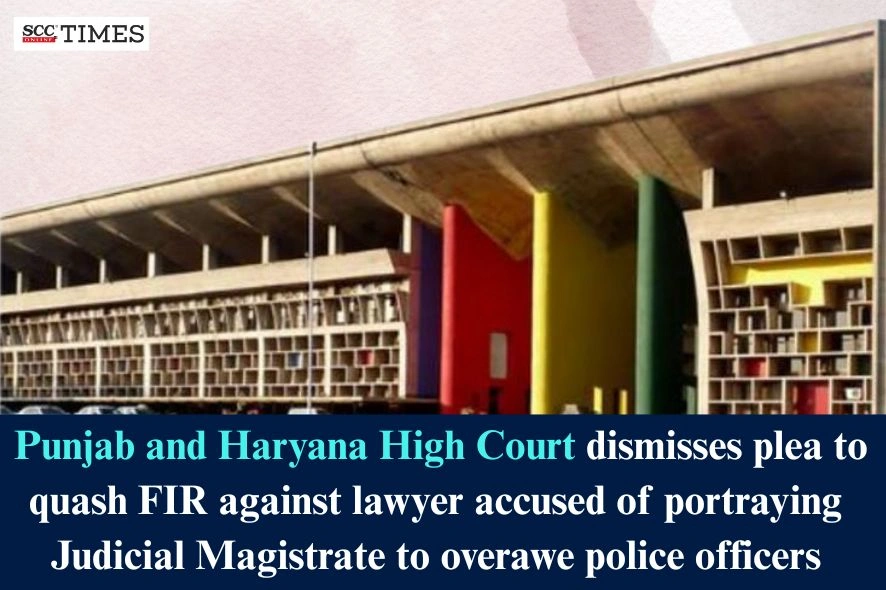
Punjab and Haryana High Court: In a petition under Section 528 of Bharatiya Nagarik Suraksha Sanhita, 2023 (‘BNSS’) filed by the petitioner, a budding lawyer, seeking quashing of FIR where he was accused of violating traffic rules and obstructing the police officers from discharging official duty, a Single Judge Bench of Surya Partap Singh, J., referred to Neeharika Infrastructure Pvt. Ltd. v. State of Maharashtra 2021 SCC Online SC 315 (‘Neeharika Infrastructure case’) and held that the petition was not liable to be quashed.
Background
In the present case, an FIR was lodged stating that in May 2024, upon spotting a car with front number plate covered by a cloth, the complainant, Assistant Sub-Inspector of Police (‘ASI’), along with a constable signaled to stop the car. The car stopped beyond the ‘Zebra’ crossing and when constable started videography, its driver alighted from the car and upon demand for his driving license, he refused to provide the same.
The ASI alleged that the car driver introduced himself as Judicial Magistrate and when again license was demanded, he fled from the spot by speeding up his vehicle. It was further stated that on the front windshield of the car the sticker of Judge was affixed. When the matter was reported to Senior Police Officers, particulars of the vehicle were verified, and it was found that the car did not belong to a Magistrate. The investigation resulted in the arrest of the petitioner.
The petitioner contended that the FIR was lodged over a false case as the entire Chandigarh Police started nursing grudge against him because he had filed two complaints against Respondent 4 – Deputy Superintendent of Police (‘DSP’) of Traffic Police.
Issues, Analysis and Decision
The Court pursued the petition and stated that the following issues required determination:
Whether the petition was liable to be quashed on the ground that false story has been projected by the police in the FIR?
Considering the contents of the FIR, the Court noted that it was an admitted fact that the petitioner was present on the spot on the alleged incident. Thus, it was pertinent to determine which out of the two versions was true. The Court further stated that deciding the same in the quashing petition without proper evidence could result in miscarriage of justice.
The Court relied on the guidelines laid down in Neeharika Infrastructure case (supra) and stressed that the accusation against the petitioner was prominent that when two police officers were discharging their duty, he violated traffic rules, and when he was asked to show his driving license, instead of showing his driving license he tried to overawe the police officers by projecting himself to be a Judicial Magistrate and when he failed in doing so, and the police officers continued to insist for his driving license, he drove away from the spot against the instructions of police officers.
Thus, the petition was not liable to be quashed.
Whether the bar enshrined under Section 195(1) of the Criminal Procedure Code 1973 (‘CrPC’) was applicable in the present case?
Considering that one version of the incident was regarding commission of offences punishable under Sections 170 and 419 of the Penal Code 1860 (‘IPC’) and another one is for the commission of offence punishable under Section 186 IPC, the Court stated that the bar of Section 195(1) of the CrPC was not attracted to the former. However, it is a settled law that the said bar is applicable with regard to commission of offence punishable under Section 186 of the IPC.
The Court viewed that the above mentioned two types of offence allegedly committed by the petitioner were independent of each other and capable of being split, thus, the prosecution of petitioner under Sections 170 and 419 of the IPC based on FIR could not be held to be defective. Further, the Court stated that with respect to the said bar, the proper course available to the petitioner was to raise the plea before the Trial Court at the time of framing of charge. Thus, quashing of FIR on the above-mentioned grounds was not permissible.
Whether the petitioner was entitled to claim immunity as prescribed under Section 84 of the IPC?
The Court stated that the plea raised by the petitioner with regard to immunity under Section 84 of the IPC was related to the dates subsequent to the commission of alleged offence, hereby the petitioner who had not claimed that at the time of commission of offence he was entitled for such immunity, could not seek quashing of FIR on such grounds.
Further, the Court stated that if the petitioner claimed that trial against him could not proceed due to his above-mentioned incapacity, such plea could be raised by him before the Trial Court during trial only. Thus, filing of petition for quashing of FIR on the above-mentioned grounds was not permissible.
Therefore, the Court held that there was no ground for quashing of FIR, as claimed by the petitioner, and thus, the present petition was devoid of merit. Hence, the Court dismissed the petition at hand.
[Parkash Singh Marwah v. State (UT of Chandigarh), 2025 SCC OnLine P&H 16384, decided on 9-12-2025]
Advocates who appeared in this case:
For the Petitioner: Hardial Singh Baath, Advocate
For the Respondent: Ganesh Sharma, Addl. P.P.
Buy Code of Criminal Procedure, 1973 HERE

Buy Penal Code, 1860 HERE