Disclaimer: This has been reported after the availability of the order of the Court and not on media reports so as to give an accurate report to our readers.
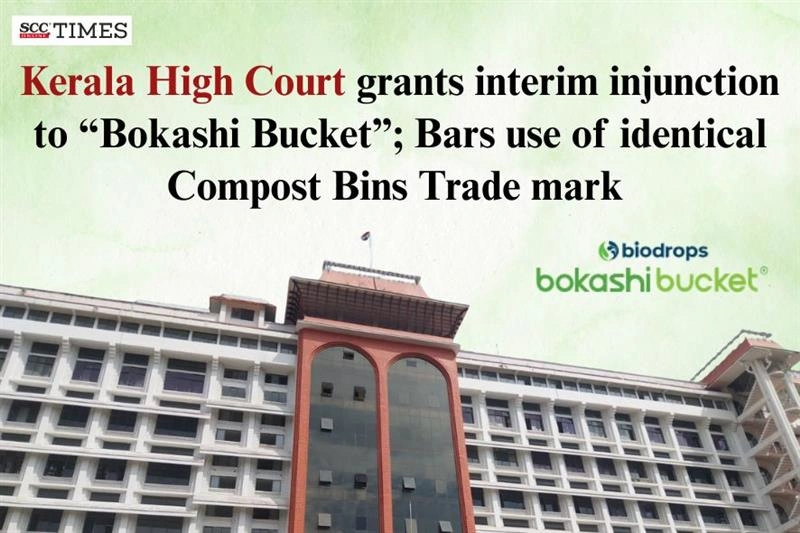
Kerala High Court: In an appeal against the trial court’s order vacating the interim injunction and dismissal of application for alleged infringement of the registered trade mark “BOKASHI BUCKET,” a single-judge bench of S. Manu, J., set aside the trial court’s order and granted the interim injunction restraining the respondent from manufacturing, selling, or promoting compost bins infringing the registered trade mark “BOKASHI BUCKET.”
In the instant matter, the appellant, a proprietor of MS Global Pharmaceuticals, owns the registered trade mark “BOKASHI BUCKET” for a compost bin design registered under the Designs Act, 2000. The appellant’s product, capable of converting biodegradable waste into manure in 15 days, is popular and sold extensively, including to Suchitwa Mission and local government bodies. The appellant asserted the design and trade mark have acquired a high market reputation through exclusive and extensive use.
The appellant alleged the respondent, a proprietor of Mariya Hygene Solution, was selling an identical product mimicking the shape, design, and get-up of the appellant’s “BOKASHI BUCKET” and thus infringing the registered trade mark and passing off the goods as that of the appellant.
The appellant filed a suit alleging trade mark infringement and passing off and sought interim injunction preventing the respondent from manufacturing and selling the impugned product. The trial court initially granted ad interim injunction but later dismissed the appellant’s interim injunction application after the respondent raised defenses including non-novelty, genericness of the mark, and a rectification petition against the appellant’s trade mark registration, leading to the present appeal.
The respondent admitted using the term “BOKASHI BUCKET” but claimed it is a generic descriptive term in the market since 2013, and that he had prior user rights, selling “MARIA BOKASHI BUCKET” since 2013. The respondent also challenged the novelty of the appellant’s design and validity of trade mark registration citing an ongoing rectification petition against the appellant’s registration and alleged non-filing of a counter statement by the appellant in the rectification proceedings. The respondent contended that the trade mark registration is generic and publicly descriptive, and no injunction should be granted. The respondent argued that the appellant’s trade mark registration had become ineffective due to non-filing of counter statements on rectification petitions as per Rule 98 of the Trade Marks Rules, 2017.
The Court analysed the scope of trade mark infringement solely on the basis of registered trade mark rights as contended by the appellant.
The Court rejected the respondent’s argument that the registration ceased to have effect due to procedural lapse in rectification and noted that Rule 98 of the Trade Marks Rules provides for consequences relating to evidence filing but does not mandate annulment or cessation of registration. The Court held that the registration certificate for the mark “BOKASHI BUCKET” was indisputable. Thus, the Court held that the appellant’s rights conferred by registration are to remain valid for interim relief purposes.
Referencing the Supreme Court’s decision in Renaissance Hotel Holdings Inc. v. B. Vijaya Sai, (2022) 5 SCC 1, the Court reiterated that in trade mark infringement cases if the defendant uses a mark identical to the registered mark on identical goods, confusion is presumed as per Section 29(2)(c) of the Trade Marks Act. The Court further reinforced that differences in packaging or brand name are immaterial for trade mark infringement once the essential features are copied.
The Court distinguished infringement from passing off, emphasising that exact or colorable imitation of the registered trade mark suffices to establish infringement without requiring proof of confusion or deception.
The Court noted that the products of both parties were identical compost bins, and the respondent admitted use of the term BOKASHI BUCKET, which is the registered trade mark of the appellant. The Court held the respondent’s use of the term “BOKASHI BUCKET” for identical goods constitutes trade mark infringement as per Section 29(2)(c) of the Trade Marks Act. The Court emphasised that no proof of actual deception or damage is required for injunction in trade mark infringement.
In the light of facts of the case, arguments advanced and authorities cited, the Court opined that the appellant established a prima facie case for infringement and “is entitled for temporary injunction and the Court below went wrong in dismissing the interim application for injunction by the impugned order.”
Consequently, the Court set aside the trial court’s order dismissing the injunction and granted the interim injunction restraining the respondent from manufacturing, selling, or promoting compost bins infringing the registered trade mark “BOKASHI BUCKET” till the suit is disposed of.
[Rajeev K.P. v. Unais K.K., 2025 SCC OnLine Ker 12426, Decided on 18-11-2025]
*Judgment by Justice S. Manu
Advocates who appeared in this case:
Sri. P.Martin Jose, Sri. K.M.Jamaludheen, Sri. P.Prijith, Sri. Thomas P.Kuruvilla Sri. R.Githesh, Shri. Ajay Ben Jose, Sri. Manjunath Menon, Shri. Sachin Jacob Ambat, Smt. Anna Linda Eden, Shri. Harikrishnan S., Smt. Anavadya Sanil Kumar, Smt. Anjali Krishna and Sri. S.Sreekumar, Counsel for the Appellant
Sri. K.Mohammed Rafeeq, Shri. P.P.Abdul Sageer, Sri. Bibin Mathew, Sri. P.M. Mathew, Sri. Amarnath R Lal, Shri. Sanaldev E.P., Smt. Vishnumaya Anandan, Shri. Sonymon Antony, Smt. Shifana M., Smt. Fida P. and Shri. Abhijith P.A., Counsel for the Respondent