
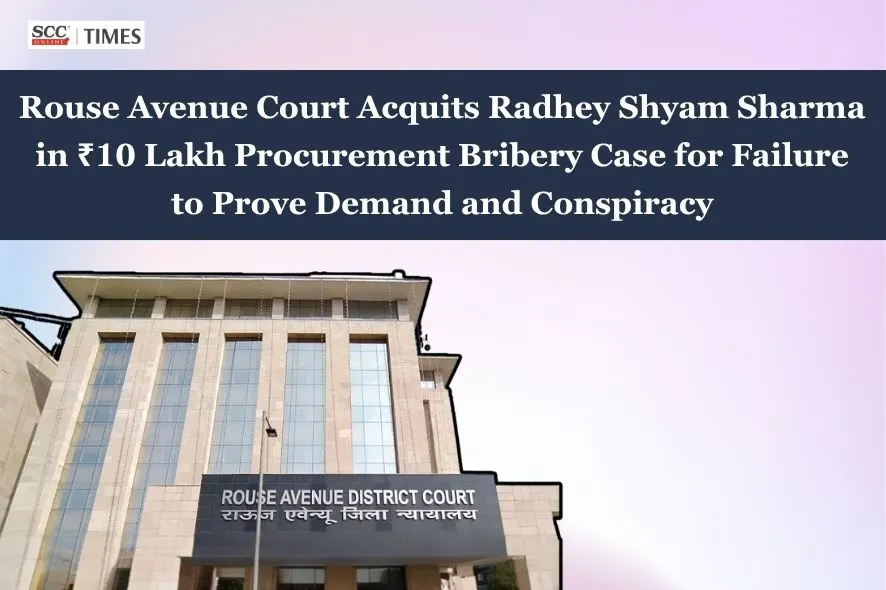
Rouse Avenue Court, New Delhi: In a case arising out of alleged corruption in the Ministry of Home Affairs (MHA) procurement process, involving accusations of illegal gratification of ₹10 lakhs supported primarily by intercepted telephonic conversations, a Single Judge Bench of Sushant Changotra, J., examined the admissibility and evidentiary value of such electronic evidence on the touchstone of statutory safeguards under Section 5(2), Telegraph Act, 1885 read with Rule 419-A of the Telegraph Rules, 1951 and the requirements of proof under the Evidence Act and held that,
“Mere production or exhibition of interception orders does not amount to proof, and in the absence of examination of the competent authority and compliance with mandatory procedural safeguards particularly placement before the Review Committee the interception orders stood unproved and invalid, rendering the resultant recordings inadmissible in evidence.”
Holding that the prosecution’s case, resting substantially on such inadmissible and unreliable material, failed to establish the essential ingredients of demand, acceptance, and criminal conspiracy beyond reasonable doubt, the Court acquitted all the accused of charges under Section 120-B, Penal Code, 1860 (IPC) read with Sections 11 and 12, Prevention of Corruption Act, 1988.
Background
An FIR had been registered by the CBI against Radhey Shyam Sharma, Director (Provisioning), MHA along with Directors of Anjani Technoplast Ltd. (ATL) and others, alleging that they were indulging in corrupt practices to secure contracts for ballistic protection products. On 3 July 2009, MHA had floated a tender for procurement of 59,000 light-weight bulletproof jackets, and following allegations of manipulation in trials, the earlier evaluation had been cancelled and a retrial had been ordered on ATL’s complaint. During this period, ATL had remained in regular contact with the accused public servant, who had allegedly provided updates and extended undue favours in lieu of illegal gratification.
On 22 January 2010, a CD had been received by the Anti-Corruption Branch, and on 11 March 2010 an FIR had been registered, later transferred to the CBI and merged with the present case. On 24 January 2010, a demand of ₹10 lakhs had allegedly been made, which had been arranged through a fictitious transaction by issuing a cheque of ₹11,91,240 on 27 January 2010 in favour of Varun Associates; the amount had thereafter been converted into cash and about ₹10.44 lakhs had been delivered to the accused. During investigation, phones had been intercepted, searches had been conducted and the accused had been arrested on 29 April 2010; jewellery worth ₹9.75 lakhs and cash had been recovered, which remained unexplained. Further, voice samples had been collected and CFSL report dated 1 September 2011 had been obtained.
It had further been found that though the accused had official dealings with the company in earlier procurements, no specific favour had been shown in the tender in question, and deviations noticed were general in nature. After investigation, sanction had been obtained, charge-sheet filed cognizance taken and charges had been framed under Section 120-B IPC read with Sections 11 and 12, Prevention of Corruption Act, 1988, to which the accused had pleaded not guilty and claimed trial.
Analysis
The Court examined allegations under Sections 11 and 12, Prevention of Corruption Act, 1988, and Section 120-B IPC against Radhey Shyam Sharma, then Director (Provisioning), MHA, and co-accused. The prosecution alleged that the accused demanded and received a bribe of ₹10 lakhs, misused company vehicles, and engaged in a criminal conspiracy to favour Anjani Technoplast Ltd. in procurement processes.
The Court first acknowledged that the accused was a public servant and had dealt with relevant files, including notings and representations concerning the Company, establishing his involvement in the procurement process. Valid sanction for prosecution under Section 19, Prevention of Corruption Act, 1988 had also been granted and duly reflected due application of mind.
Regarding criminal conspiracy under Section 120-B IPC, the Court reiterated that conspiracy is often hatched in secrecy and may be proved by circumstantial evidence, but there must be a physical manifestation of agreement. The prosecution relied on allegations that Radhey Shyam Sharma provided regular updates in return for favours. However, the charge-sheet itself recorded that investigation disclosed no role of the accused in favouring the company, and no witness, including the IO, could substantiate the allegation. Consequently, the Court held that the case of criminal conspiracy lacked evidentiary support.
The alleged demand and receipt of ₹10 lakhs rested primarily on intercepted telephone conversations. The Court emphasised that interception orders under the Telegraph Act and Rule 419-A of the Telegraph Rules must be placed before the Review Committee within seven days, and failure to do so renders them invalid. In the present case, the orders were neither verified for compliance nor proven to be genuine, with the author of the orders unexamined. The Court held the interception evidence inadmissible, relying on PUCL v. Union of India, (1997) 1 SCC 301; Jatinder Pal Singh v. CBI, 2022 SCC OnLine Del 135; Vinit Kumar v. CBI, 2019 SCC OnLine Bom 3155 and P. Kishore v. Union of India, 2025 SCC OnLine Mad 3053. Voice recordings were also held unreliable due to incomplete chain of custody, inability of witnesses to identify voices, and selective seizure of calls. The prosecution also failed to connect mobile numbers to the accused through CAFs or certified CDRs, further weakening the evidence.
Regarding generation and delivery of cash, key witnesses denied participation, and documents such as cheques and account statements were uncertified and unverified. The alleged recovery of jewellery on 30 April 2010 was rendered irrelevant because the prosecution failed to prove demand or receipt of the bribe. Search and seizure lacked proper documentation, search memos, site plans, and witness testimony, and the ₹25,000 recovered could not be linked to the alleged ₹10 lakhs. Allegations of use of vehicles belonging to ATL (P) Ltd. were unsupported, as all driver witnesses turned hostile and logbooks were unverified.
The Court also highlighted investigative lapses, including merging prior FIRs without authority, raising doubts regarding bias. Considering contradictions, hostile witnesses, inadmissible evidence, and broken chains of proof, the Court concluded that the prosecution failed to discharge its burden beyond reasonable doubt.
Decision
Accordingly, Radhey Shyam Sharma and other co-accused were acquitted of all charges under Sections 11 and 12, Prevention of Corruption Act, 1988, and Section 120-B IPC. Their bail and surety bonds under Section 437-A, Criminal Procedure Code, 1973 (CrPC) were directed to remain in force for six months.
[CBI v. Radhey Shyam Sharma, 2026 SCC OnLine Dis Crt (Del) 19, decided on 19-3-2026]
Advocates who appeared in this case :
Defendant: Harsh K. Sharma, Vaibhavi Sharma, Lakshya Prashar, Kashish Jain, Ujjwal Krishna Ranjeet Singh, Advocates
Buy Prevention of Corruption Act, 1988 HERE
Buy Penal Code, 1860 HERE