
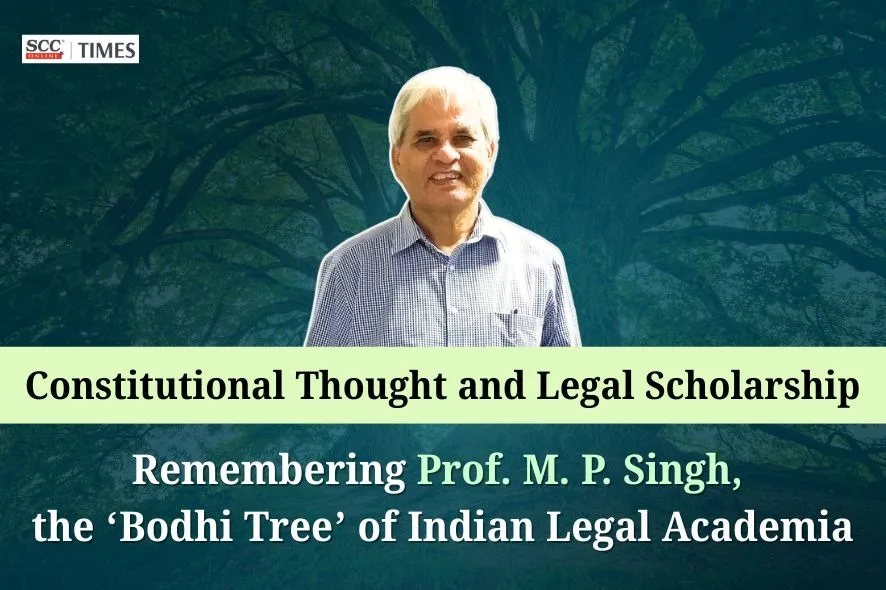
The legal fraternity mourns the passing of Professor Mahendra Pal Singh, one of India’s most respected jurists who passed away on 7 March 2026. He was a scholar of constitutional law, administrative law and comparative law, and Professor Emeritus at University of Delhi. His death marks the end of a distinguished academic career that profoundly shaped the study and teaching of constitutional law in India.
Early background and education
Born in 1940 in the village of Jitholi in the Meerut district of Uttar Pradesh, Prof Singh rose from modest beginnings to become one of the most distinguished legal academics of his generation.
He pursued his higher education at the University of Agra, where he completed his B.A. and LL.B., and later obtained his LL.M. from the University of Lucknow. It was during his time at Lucknow that he came under the influence of Professor V. N. Shukla, the eminent constitutional law scholar whose seminal treatise V. N. Shukla’s Constitution of India published by EBC, Prof. Singh would later revise and update in subsequent editions, thereby carrying forward and enriching its intellectual legacy.
Seeking to broaden his academic horizons, he later pursued another LL.M. at Columbia University in the United States. During his time there, he was deeply influenced by Professor Walter Gellhorn, a leading authority on American administrative law and civil liberties. This exposure to comparative constitutional and administrative law significantly shaped Prof. Singh’s scholarly approach and broadened his engagement with global legal thought1.
After returning to India, he completed his LL.D. from the University of Lucknow, further strengthening his academic foundations.
Later, Prof. Singh undertook advanced research in Germany at the South Asia Institute, Heidelberg University and the Max Planck Institute for Comparative Public Law and International Law. This period deepened his engagement with comparative public law but also led to enduring academic collaborations with several distinguished German scholars.
Career Progression
Prof. Singh devoted much of his academic life to teaching and research. He began his academic career in 1964 as a Lecturer in Law at the University of Meerut. In 1970, he joined the Faculty of Law at the University of Delhi, where he went on to play a significant role in teaching and shaping legal scholarship for several decades. During his distinguished career, he also served as the Director of the Indian Law Institute, contributing to research and policy-oriented legal studies.
From 2006 to 2011, he served as the Vice-Chancellor of The West Bengal National University of Juridical Sciences (NUJS) in Kolkata. During his tenure, he conceptualised the NUJS Law Review, published by EBC, the university’s flagship quarterly journal devoted to rigorous legal research, and served as its founding Editor-in-Chief. Under his guidance, the journal developed into an important platform for scholarly legal writing.
Prof. Singh also held several other important institutional roles. He served as the Chairperson of the Delhi Judicial Academy and later as the Chancellor of the Central University of Haryana. In addition, he was associated with National Law University Delhi (NLUD) as a Visiting Professor, where he held the Chair of Comparative Law.
In recognition of his immense contribution to legal education and scholarship, a festschrift titled Law and (In) Equalities was published in his honour on his 70th birthday in the year 2010. The volume explores questions of social inequality in India—an issue that remained central to Prof. Singh’s study of the Indian Constitution and legal system.
His dedication to teaching was also widely acknowledged. In 2009, the All India Law Teachers’ Congress conferred upon him the Lifetime Best Teacher Award in recognition of his outstanding role as an educator. Later in 2017, the University of Delhi honoured him with the title of Professor Emeritus, acknowledging his remarkable achievements and enduring contribution to the study and teaching of law.2
Positions held
Prof Singh was associated with several leading academic institutions across the world as a fellow and visiting professor. In 1985, he was appointed Professor of Law at the Faculty of Law, University of Delhi, and later served as its Dean and Head of the Department of Law. He was an Alexander von Humboldt Fellowship scholar at the Heidelberg University, a period that produced important work on German administrative law and fostered enduring academic ties between Indian and German legal scholarship. He briefly served as Director of the Indian Law Institute (ILI) in 1997.
From 2006 to 2011, he served as Vice-Chancellor of The West Bengal National University of Juridical Sciences (NUJS). He later chaired the Delhi Judicial Academy (2011—2013) and co-chaired a task force of the Commission on Centre—State Relations between 2007 and 2010. Prof. Singh also held visiting positions at several prominent institutions worldwide, including University of Heidelberg, University of Hong Kong, City University of Hong Kong, National University of Singapore, Kansai University, Jawaharlal Nehru University and Renmin University of China.3
Notable Works
Prof. Singh’s scholarship spanned constitutional law, administrative law, comparative law, and human rights. Generations of law students and practitioners know him best for his stewardship of the classic constitutional law treatise V. N. Shukla’s Constitution of India published by Eastern Book Company, which he revised and updated across multiple editions. The work remains one of the most authoritative and widely used textbooks on the Indian Constitution and has been cited by courts and relied upon by scholars for decades.
Among his other notable contributions was Outlines of Indian Legal and Constitutional History further enriching the literature on India’s legal development. A prolific scholar, he authored over a hundred research papers and several influential books, including German Administrative Law in Common Law Perspective, Freedom of Trade and Commerce in India, Comparative Constitutional Law, Legal Dimensions of Market Economy and Human Rights and Basic Needs.
His contribution to the legal fraternity
Beyond his writings, Prof. Singh was deeply committed to reforming and democratizing legal education. He actively supported initiatives aimed at widening access to top law schools for students from disadvantaged backgrounds and believed that legal education must remain responsive to the needs of Indian society. His mentorship inspired generations of students, many of whom went on to become distinguished lawyers, judges, and academics.
During his tenure at NUJS and thereafter, he actively supported and helped shape the initiative Increasing Diversity by Increasing Access to Legal Education (IDIA), which works with school students from rural and semi-urban areas to encourage and assist them in gaining admission to India’s leading law schools.
He also led a group of academicians under the Legal Education and Research Society (LEARS), dedicated to strengthening legal education and research in the country. Reflecting his commitment to grassroots education, he established a school in his native village of Jitholi, where students and volunteers associated with IDIA and NUJS frequently interacted with and mentored local children.
Conclusion
Prof. M. P. Singh will be remembered not only as a prolific scholar but also as a teacher whose intellectual rigor, humility, and dedication left an enduring mark on Indian legal academia. His legacy will continue to guide students and scholars who seek to understand the Constitution and the evolving contours of Indian public law.
His passing is a profound loss to the legal community, but his scholarship and ideas will endure in classrooms, courtrooms, and legal discourse for years to come.
1. https://en.wikipedia.org/wiki/Mahendra_Pal_Singh_(legal_scholar)
2. https://en.wikipedia.org/wiki/Mahendra_Pal_Singh_(legal_scholar)
3. https://en.wikipedia.org/wiki/Mahendra_Pal_Singh_(legal_scholar)