
Disclaimer: This has been reported after the availability of the order of the Court and not on media reports so as to give an accurate report to our readers.
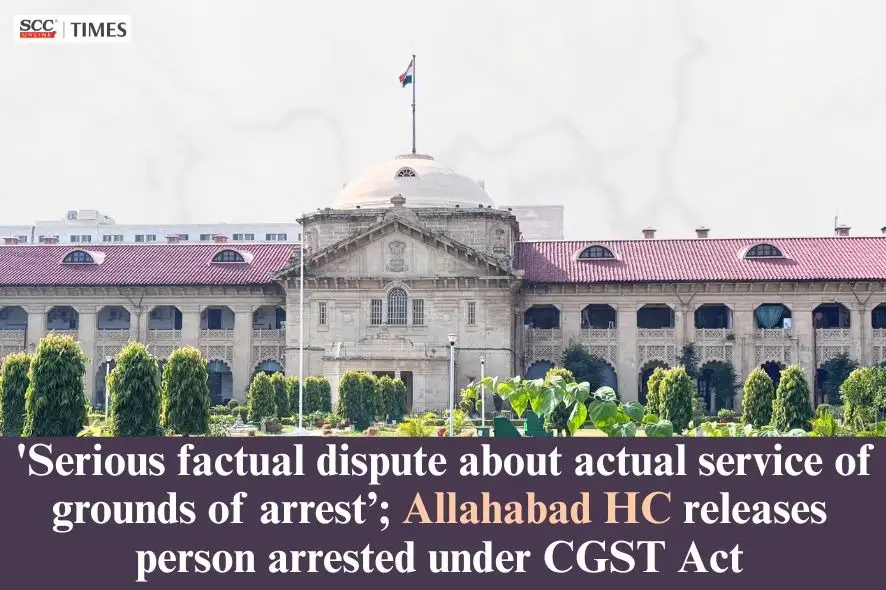
Allahabad High Court: In a writ petition of habeas corpus challenging the detention of the petitioner and an order passed under Section 132(1)(c), CGST Act, 2017, along with all the consequential proceedings thereof, the Division Bench of Siddharth and Jai Krishna Upadhyay, JJ., set aside the remand order and held that the said order was illegal for not being in accordance with the law. The Court noted that there was serious factual dispute about actual service of grounds of arrest to the petitioner. Hence, the petition was allowed and the petitioner was directed to be released.
Background
The present petition emanated from the detention of the petitioner by the officers of the Directorate General of Goods and Services Tax Intelligence (DGGI). The said officials conducted a search proceeding under Section 67, Central Goods and Services Tax Act, 2017 (the CGST Act), at his house, which led to his arrest under Section 69, CGST Act.
The petitioner’s counsel contended that the petitioner was not supplied with any documents, including the “grounds of arrest” and “reasons to believe” with the arrest memo.
Aggrieved, the petitioner filed the present petition.
Analysis and Decision
At the outset, the Court examined the respondents’ challenge to the maintainability of the petition. The Court held that the respondents’ contention that arrest was in accordance with Sections 67 and 69, CGST Act is not apparent from the record. The Court stated that the law in this regard is settled, if a remand order passed by the magistrate is not accordance with law, the arrest is illegal. The Court referred to the Supreme Court judgment in V. Senthil Balaji v. State, (2024) 3 SCC 51, to state that the Court has jurisdiction to entertain a habeas corpus writ.
The Court dealt with the next issue raised by the petitioner, i.e., it is mandatory to supply the “grounds of arrest” and “reasons to believe” to the arrestee. The Court noted that the said issue was raised based on the Supreme Court’s observations in Radhika Agarwal v. Union of India, (2025) 6 SCC 545. The Court distinguished the present case from the Radhika Agarwal case (supra), by stating that the Supreme Court made abovesaid observations while dealing with the provisions of the Prevention of Money Laundering Act, 2002, and not the CGST Act.
The Court on perusal of the Radhika Agarwal case (supra) noted that the Commissioner must ascertain that “reasons to believe” has been explicitly recorded along with the evidence that led to such belief. However, there is no provision to supply the “reasons to believe” to the accused.
It was pointed out that the Supreme Court in Satender Kumar Antil v. CBI, (2022) 10 SCC 51, had held that arrest cannot be effected for offences which are punishable up to 7 years or below. It was further noted that Satender Kumar Antil case (supra), did not exclude the application of the judgment’s ratio to the offences covered under the Special Act and noted that this judgment’s ratio will apply to the present case. This assessment was made in regard to the petitioner’s contention that he should not have been arrested since he was implicated for committing an offence, which is punishable below 7 years.
The Court thereafter examined the contention of the respondents that all documents including the “grounds of arrest” were served upon the petitioner, prior to producing him before the Remand Magistrate. The Court stated that as per the Radhika Agarwal case (supra), the “grounds of arrest must be explained to the arrested person and also be furnished to him in writing as an annexure to the arrest memo”. The Court observed that in the present case, no annexure was mentioned in the arrest memo, which indicated non-compliance by the respondents. Taking note of the serious factual dispute regarding actual service of the grounds of the arrest to the petitioner before affecting his arrest, the Court stated that there was no recital that a copy of “grounds of arrest” was provided to the petitioner at the time of his arrest and before producing him before the Remand Magistrate.
Therefore, in view of Supreme Court’s judgment in Satender Kumar Antil case (supra), the Court thus held the remand order to be illegal for not being in accordance with the law.
Hence, the Court allowed the petition by setting aside the remand order and directing petitioner’s release from custody.
[Jai Kumar Aggarwal v. Directorate General of GST Intelligence, 2026 SCC OnLine All 376, decided on 13-2-2026]
Advocates who appeared in this case :
For the petitioner: Senior Advocate Imran Ullah and Mohit Singh, Nadeem Murtaza, Vedant Gupta, Snigdha Singh, Harsh Vardhan Kediya and Vineet Vikram, Advocates
For the respondents no. 1 & 2: Harmanpreet Singh, Senior Standing Counsel DGGI, Delhi (Online), Dhnanjay Awasthi and Gopi Krishan Soodh
For the respondents no. 3 & 4: Manju Thakur, A.G.A. Ist