


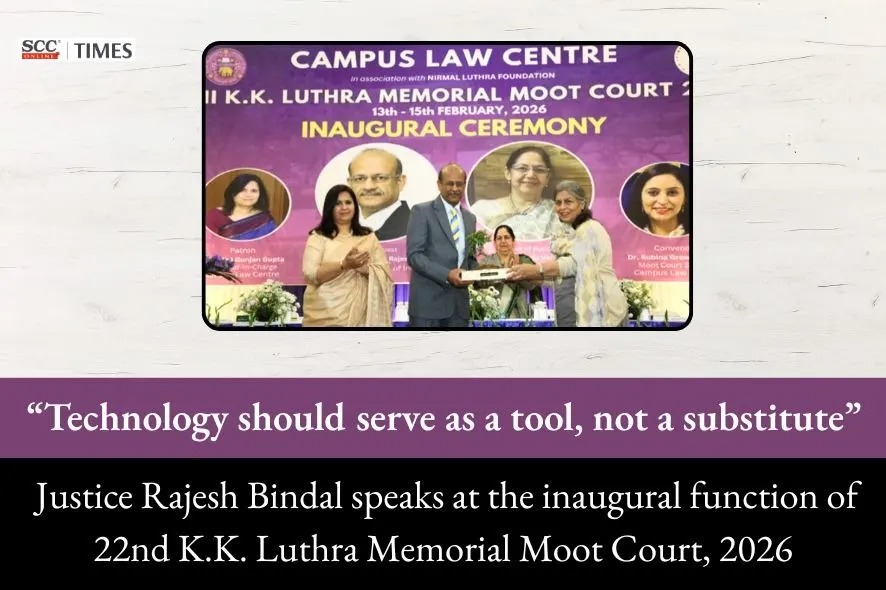
The inaugural function of the 22nd K.K. Luthra Memorial Moot Court was held at Campus Law Centre, Faculty of Law, University of Delhi, marking the commencement of the prestigious international criminal law moot court competition. The event witnessed participation from 72 shortlisted teams out of 138 registrations from institutions across more than thirteen countries, affirming the competition’s stature as one of India’s most distinguished student platforms for criminal law advocacy.
Overview of the Competition
The Campus Law Centre (‘CLC’), Faculty of Law, University of Delhi, in association with the Nirmal Luthra Foundation, hosted the 22nd edition of the K.K. Luthra Memorial Moot Court from 13-02-2026 to 15-02-2026 at CLC and the India Habitat Centre, New Delhi. Established in 2005 in honour of the Senior Advocate late Shri K.K. Luthra (1949—1997), this distinguished event continues to inspire legal excellence and remains India’s premier international criminal law moot court competition.
The competition has evolved remarkably since its inception. Beginning with participation from Indian institutions in 2005, the moot became international in 2009 and now attracts universities from multiple jurisdictions across the globe. This year’s competition received an overwhelming response with 138 registrations from institutions across 13 countries. Following a rigorous memorial selection process, 72 teams qualified for the oral rounds, representing the finest legal minds from premier institutions worldwide.
The K.K. Luthra Memorial Moot Court has distinguished itself through its unwavering focus on contemporary issues in criminal law and criminal jurisprudence. Over the years, the competition has addressed cutting-edge topics including medical negligence, cybercrime, terrorism law, financial fraud, international criminal law, judicial accountability, and narcotics regulations and hence preparing the students for tackling the complex legal challenges of the 21st century.
The Legacy of Campus Law Centre, Faculty of Law, University of Delhi
Established in 1922 under the aegis of the University of Delhi, CLC stands as one of India’s most prestigious centres for legal education. In 1975, the day classes of LL.B. at the Faculty of Law were rechristened as CLC, marking a new era of excellence in legal education. With a century-long legacy, CLC has nurtured some of the most eminent legal minds in the country, including Chief Justices, Judges, Union Cabinet Ministers, renowned lawyers and distinguished academicians who have contributed significantly to the legal landscape of India. Committed to fostering scholarly research and informed discussions on contemporary legal and policy issues, CLC remains a beacon of legal education, preparing students not merely to practice law but also to serve as guardians of constitutional values and agents of social transformation.
Welcome Address by the Faculty
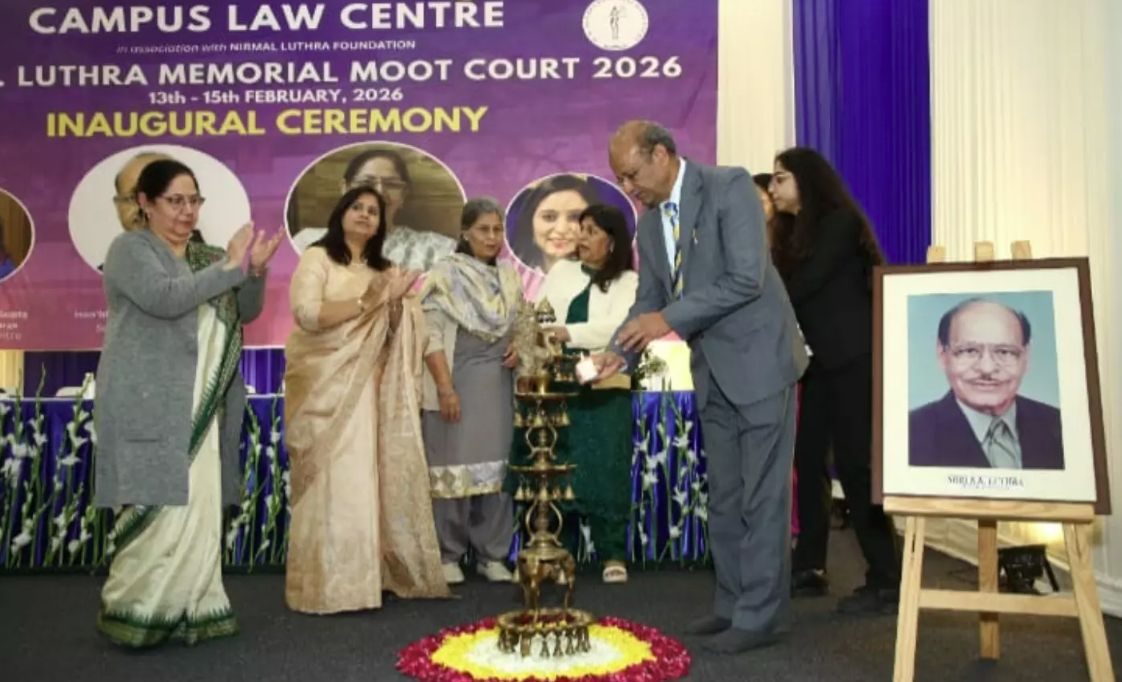
The inaugural function, compered by Dr. Sneh Yadav, commenced with traditional reverence. The ceremonial lighting of the lamp was followed by the University Kulgeet, setting a dignified tone for the proceedings that would follow.
Prof. (Dr.) Gunjan Gupta, Professor-in-Charge, CLC, delivered the welcome address, highlighting the academic significance of the K.K. Luthra Memorial Moot Court, as well as the institution’s proud tradition of hosting this competition for over two decades, underscoring how it has grown from a national event into an internationally recognised forum for criminal law advocacy.
Dr. Rubina Grewal, Convenor of the Moot Court Society, presented the annual report, acknowledging the invaluable contribution of the Nirmal Luthra Foundation and showcasing CLC’s strong performance across national and international moot court competitions during the year.
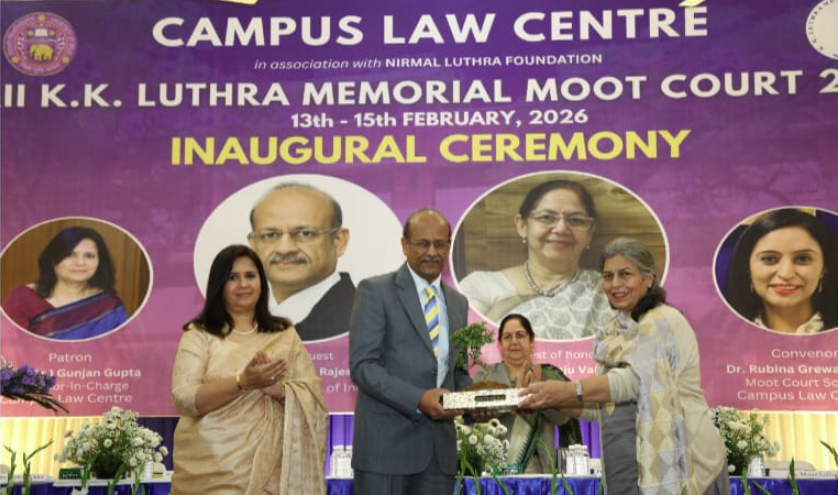
Prof. (Dr.) Anju Vali Tikoo, Head and Dean, Faculty of Law, University of Delhi, formally welcomed the Chief Guest, Justice Rajesh Bindal, expressed gratitude for his presence, and recognised the significant contributions of the Luthra family and the Nirmal Luthra Foundation towards student welfare, institutional development, and the continued excellence of this prestigious competition.
Chief Guest Address: Justice Rajesh Bindal, Supreme Court
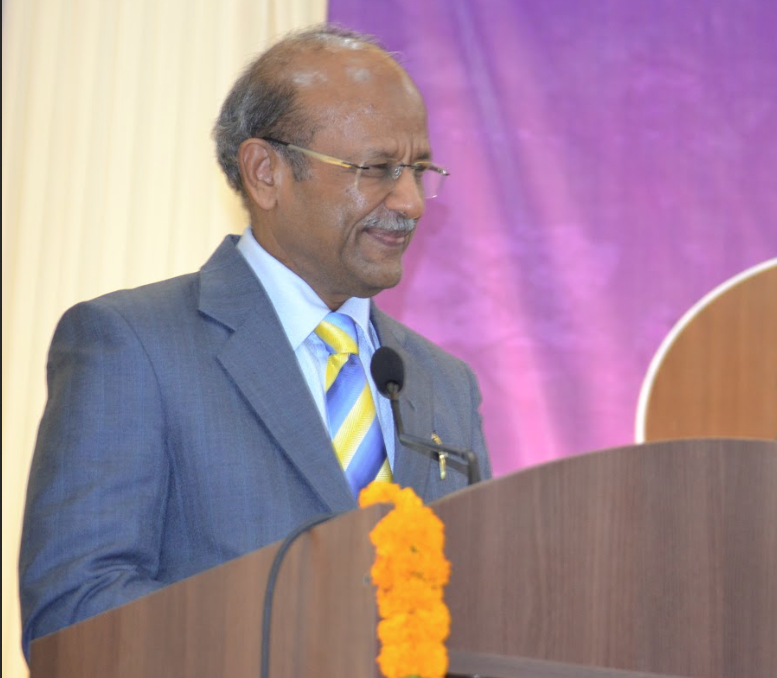
Justice Rajesh Bindal, began his address with a tribute to CLC that was as statistical as it was sincere, noting that the institution had produced four Chief Justices of India, currently had four Sitting Judges in the Supreme Court, and sixteen others who had served in that Court over the years; with the numbers from the High Courts and District Courts being, in his words, “simply countless”.
The Importance of Practical Exposure in Legal Education
Reflecting on his own journey, Justice Bindal recalled that when he graduated in 1985, law used to be widely regarded as the last resort, with no admission test and a 45 per cent marks as the only criterion and yet somehow,, “we also reached this place, because of the blessings of teachers, parents, family members, and the moot court.” He recounted how simply asking for a pass-over or an adjournment in the High Court used to be an ordeal, because the confidence that today’s students carry naturally into a courtroom simply did not exist and credited it to the current trend of students participating in the moot court competitions.
“This is the change brought in by moot courts. Being judged by High Court judges and sometimes even Supreme Court judges in the finals gives you that kind of exposure and confidence that no classroom alone can provide.”
He recalled a past competition judged by five Supreme Court Judges, where the confidence of student participants struck him deeply, stating many moot court participants argued better than some practicing lawyers in actual courts. He drew a pointed comparison with disciplines such as chartered accountancy and medicine, which havealways required practical, hands-on training alongside formal studyand observed that this gap had long existed in legal education but moot courts have begun to meaningfully bridge it. He also called for a system of continuous legal education for practicing lawyers, noting that the law was changing very fast, and that lawyers who were unaware should be periodically re-educated and required to earn mandatory credits, otherwise the profession would fall short of the demands of a rapidly evolving legal landscape.
The Digital Transformation of the Indian Judiciary
Justice Bindal then turned to what he described as a matter of genuine national pride, the Indian judiciary’s embrace of technology. He recounted attending international conferences where Judges from Commonwealth countries, Canada, the United Kingdom, Australia, and New Zealand had been visibly taken aback by the scale and sophistication of India’s judicial technology infrastructure.
“None of those countries have this kind of innovative technology that we are providing in the Indian judicial system. They were all surprised to see it.”
He walked the audience through the key advances: the live streaming of Constitution Bench hearings, which had transformed constitutional arguments from exclusive Delhi-centric events into accessible national proceedings; the system of e-filing that allowed lawyers to file cases, argue online, and upload documents without leaving their offices; virtual courts; and the e-Courts mobile application, which he described as placing a lawyer’s entire practice management within a single device, with live case listings updated directly from the court system. He also highlighted the network of e-Seva Kendras, which had brought one-stop judicial services to lawyers and litigants even at the sub-divisional level across the country.
“With this the courts have really reached the doorstep of the litigant, because he need not go anywhere.”
Cautioning Against Excessive Dependence on Digital Tools
Yet Justice Bindal was equally forthright in identifying the shadows that technology had cast, particularly for the younger generation. He cautioned that the internet had created not knowledge but information overload, and that too on every subject. He emphasised that one could find 20 to 30 different opinions, making it very hard to figure out which was correct. It was precisely here, he emphasised, that the teacher remained irreplaceable, for it was the teacher who would tell the student what was right and what was wrong.
He also flagged the growing menace of AI-generated fake citations being filed in courts across the world, including India. He urged students to always verify citations.
Privacy Concerns and the “Right to be Forgotten”
In a particularly forward-looking segment, Justice Bindal touched upon the right to be forgotten, a concept gaining increasing relevance as court judgments became permanently accessible online. He remarked that while earlier, access to judgments was limited to the litigant, the court, the lawyer, or an academic institution, now all judgments were being uploaded, and a character verification exercise could throw up a hundred judgments against a person’s name with no verification of accuracy. While instructions already existed for masking names in matrimonial, Protection of Children from Sexual Offences (‘POCSO’), and crimes-against-women matters, the broader question remained contested across different courts and was presently pending adjudication.
“All the judgments are being uploaded now. Suppose your character is to be verified, with that name there may be a hundred judgments coming in. Nobody will verify the details. This is the problem of the ‘right to be forgotten’ and this challenge is coming to us regularly.”
Encouraging Students Toward Litigation as a Career
In conclusion, Justice Bindal offered the competing teams a word of encouragement that was as personal as it was practical. He reminded them that winning and losing in a courtroom was not the ultimate measure of a lawyer, clients returned not on account of outcomes but on account of the quality of performance. He acknowledged that even a losing team would find something to be proud of, and a winning team would recognise that the other side had excelled in its own right.
“Nobody in moot court competitions is seeing your expert or best performance, they are seeing your zeal, how you want to perform. Winning and losing cases is not important; a lawyer is judged by the performance, not the result.”
He concluded with an exhortation that drew warm applause from the gathering, addressing those weighing their career paths:
“If you go into litigation, you will be known, like Late Mr. K.K. Luthra, Mr. Siddharth Luthra, Ms. Geeta Luthra. Otherwise, if you go into corporate, you will remain in books only or in the corporate files, that is all. So that is the advantage of going into litigation.”
The Competition: Excellence in Criminal Law Advocacy
The 22nd K.K. Luthra Memorial Moot Court focused on contemporary issues at the intersection of technology and criminal law, challenging participants to engage with cutting-edge legal questions relevant to the modern era. The competition’s commitment to addressing contemporary issues in criminal law and criminal jurisprudence has been a defining feature since its inception.
Over the years, the competition has tackled diverse and complex topics, including medical negligence, cybercrime, terrorism law, financial fraud, international criminal law, judicial accountability, and narcotics regulation. This year’s problem continued that tradition, requiring teams to demonstrate not only mastery of criminal law principles but also the ability to apply them to novel factual and technological contexts.
Global Participation and International Recognition
The 22nd edition of the K.K. Luthra Memorial Moot Court truly lived up to its international stature with participation from premier institutions across multiple jurisdictions. The competition received 138 registrations from institutions across 13 countries, a testament to its growing reputation as a platform for excellence in criminal law advocacy.
Following a rigorous memorial selection process, 72 teams qualified for the oral rounds. The teams shortlisted for the Competition represented some of the finest law schools from India and abroad, including, but not limited to:
Indian Institutions:
-
National Law School of India University (NLSIU), Bangalore
-
Symbiosis Law School, Noida and Hyderabad
-
ILS Law College, Pune
-
National Law Institute University, Bhopal
International Institutions:
-
Northumbria University (United Kingdom)
-
University of Mauritius (Mauritius)
-
North-West University (South Africa)
-
University of Zimbabwe (Zimbabwe)
-
Haramaya University College of Law (Ethiopia)
-
Tashkent State University of Law (Uzbekistan)
-
Prithvi Narayan Campus (Tribhuvan University), Nepal
-
Tulsipur Metro College, Nepal
-
National Law College, Nepal
-
Nepal Law Campus, Nepal
-
Far Western University, Nepal
-
Bangladesh University of Business and Technology (BUBT)
-
Comilla University (Bangladesh)
-
Independent University (Bangladesh)
-
Sri Lanka Law College (Sri Lanka)
-
General Sir John Kotelawala Defence University (Sri Lanka)
-
University of Lagos (Nigeria)
The diversity of participating institutions spanning multiple continents reflected the competition’s broad appeal and its recognition as a forum where the best legal minds converge to engage with complex questions of criminal law and jurisprudence. The K.K. Luthra Memorial Moot Court has steadily grown in prestige and participation since becoming international in 2009, mirroring CLC’s commitment to fostering global legal education and creating platforms for cross-jurisdictional dialogue on criminal law issues.
The Competition Schedule
Following the inaugural function on 13 February 2026, the competition proceeded across three days:
Day 1 — 13 February 2026 at Campus Law Centre
-
Inaugural Function
-
Preliminary Rounds
Day 2 — 14 February 2026 at Campus Law Centre
-
Continuing Rounds
-
Advancement to Elimination Rounds
Day 3 — 15 February 2026 at India Habitat Centre
-
Advanced Rounds
-
Final Round
-
Prize Distribution and Valedictory Function
Vote of Thanks
The inaugural function concluded with a heartfelt vote of thanks delivered by Samarth Krishna Luthra, Advocate, on behalf of the Nirmal Luthra Foundation, expressing deep gratitude to Justice Rajesh Bindal for his presence and enriching address, to Professor (Dr.) Anju Vali Tikoo, Professor Gunjan Gupta, Dr. Rubina Grewal, and the entire faculty and staff of CLC for their tireless efforts, and to all 72 participating teams for their hard work and commitment, reaffirming that the K.K. Luthra Memorial Moot Court endures as a living tribute to the memory of Shri K.K. Luthra and his legacy of excellence in criminal law advocacy.
The inaugural ceremony concluded by marking the formal commencement of three days of intense legal competition, intellectual exchange, and professional growth.
*Hemang Vyas, SCC Online Student Ambassador, Campus Law Centre, Faculty of Law, University of Delhi
“Several Government of India portals are not accessible from the United States due to geo‑technical restrictions. As an overseas citizen, I am unable to open or use the following portals from the USA despite repeated attempts: Central Vigilance Commission (CVC), Central Information Commission (CIC), and CPENGRAMS. These platforms either do not load, block access, or fail at OTP verification because they do not support international mobile numbers or overseas IP addresses. This creates a practical barrier for citizens residing abroad who are required to use these portals for statutory grievance redressal, appeals, and vigilance complaints.”