
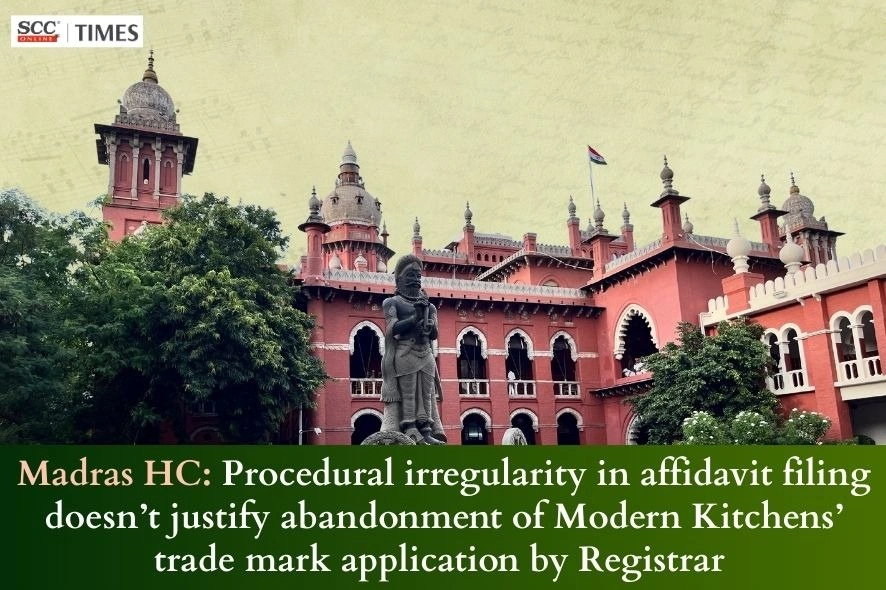
Madras High Court: While hearing an appeal filed under Section 91 of the Trade Marks Act, 1999 (‘Trade Marks Act’), against the order of the Registrar of Trade Marks deeming abandoned the application for registration of MODERN KITCHENS’ trade mark, a Single Judge Bench of N. Anand Venkatesh, J., set aside the impugned order and held that the affidavit of evidence filed on 01-06-2020 was within time and the later signed and attested affidavit was only a formal rectification. The Court further observed that Rule 46(2) of the Trade Mark Rules, 2017 (‘Trade Mark Rules’), to the extent it provides for deemed abandonment, is ultra vires the Act. Accordingly, the Registrar of Trade Marks was directed to consider the application on merits.
Background:
The appellant, engaged in the manufacturing and production of packaged snacks and ready-to-eat food products under the brand “MODERN KITCHENS’ Delite in Every Bite”  , filed an application for registration of its mark in Class 35 on 03-12-2018, claiming use since 1984. The application was published in the Trade Marks Journal dated 02-09-2019 for third-party opposition. On 12-12-2019, the application was opposed, and the appellant filed its counter statement on 07-02-2020. The affidavit of evidence in support of opposition was filed on 06-04-2020, and due to the Covid pandemic, the appellant filed its affidavit of evidence on 01-06-2020 without signature or attestation, undertaking to file a signed version later.
The proceedings thereafter went into hibernation until the appellant revived them by filing an interlocutory application on 08-10-2024, accompanied by a signed and attested affidavit, since the earlier authorised signatory had passed away. The Registrar, however, dismissed the interlocutory application and declared the application abandoned. The appellant contended that the affidavit filed in 2020 was within time and that Rule 46(2) of the Trade Mark Rules, which provides for deemed abandonment, is ultra vires the Trade Marks Act. The respondents argued that strict timelines must be adhered to, and failure to comply results in deemed abandonment. They maintained that the Registrar acted strictly in accordance with the Trade Marks Act and Trade Mark Rules.
Analysis and Decision:
The Court emphasised that the affidavit filed on 01-06-2020, though unsigned and unattested, was during the peak of the Covid pandemic, and the appellant had clearly intended to prosecute the application. It was observed that the respondent had filed a reply affidavit in 2020, which showed that the affidavit of evidence was acted upon.
The Court opined that procedural provisions should not be interpreted with rigidity to the extent of defeating the substantive rights vested in the parties. The Court noted that considering the fact that such filing of affidavit of evidence falls within the realm of procedure, pedantic interpretation should not be deployed, thereby defeating the substantive rights of the appellant.
The Court highlighted that Section 21(4) of the Trade Marks Act does not provide for deemed abandonment for failure to file evidence, unlike Section 21(2) of the Trade Marks Act. It was further observed that Rule 46(2) of the Trade Mark Rules, to the extent it provides for deemed abandonment, goes beyond the scope of the Act and is ultra vires.
The Court observed that a careful reading of Sub Rule (1) of Rule 46 of the Trade Mark Rules requires the applicant to file the affidavit of evidence within two months or inform the Registrar if no evidence is intended, and under Sub Rule (2) the consequence provided is deemed abandonment of the application. It was noted that on a plain reading, Sub Rule (2) goes beyond the scope of Section 21 of the Trade Marks Act, since Section 21(2) alone prescribes when an application will be deemed abandoned, and Sub Section (4) consciously does not provide for such consequence, making Sub Rule (2) to that extent ultra vires.
The Court further emphasised that by reading down Sub Rule (2), the only consequence of non-compliance would be deemed abandonment of letting in evidence, while the substantive right to prosecute the application would remain intact, thereby balancing the rights of the parties and addressing the consequence of non-compliance.
The Court remarked that the affidavit filed in 2024 was only a formal rectification of the earlier affidavit, with the same contents, duly signed and attested. It was emphasised that the affidavit of evidence must be taken as filed on 01-06-2020, and therefore, there was no question of deemed abandonment.
Ultimately, the Court held that the order dated 04-07-2025 was unsustainable. Accordingly, the order was set aside, and a direction was issued to the Registrar to proceed further with the application strictly in accordance with law, after affording opportunities to both parties, and to pass final orders within six months.
The Court thus allowed the appeal, with no order as to costs.
[ACE Foods (P) Ltd. v. Registrar of Trade Marks Office, 2026 SCC OnLine Mad 1210, decided on 10-02-2026]
Advocates who appeared in this case:
For the Appellant: Rajesh Ramanathan
For the Respondent: M. Karthikeyan, Standing counsel, Gladys Daniel and Somnath De