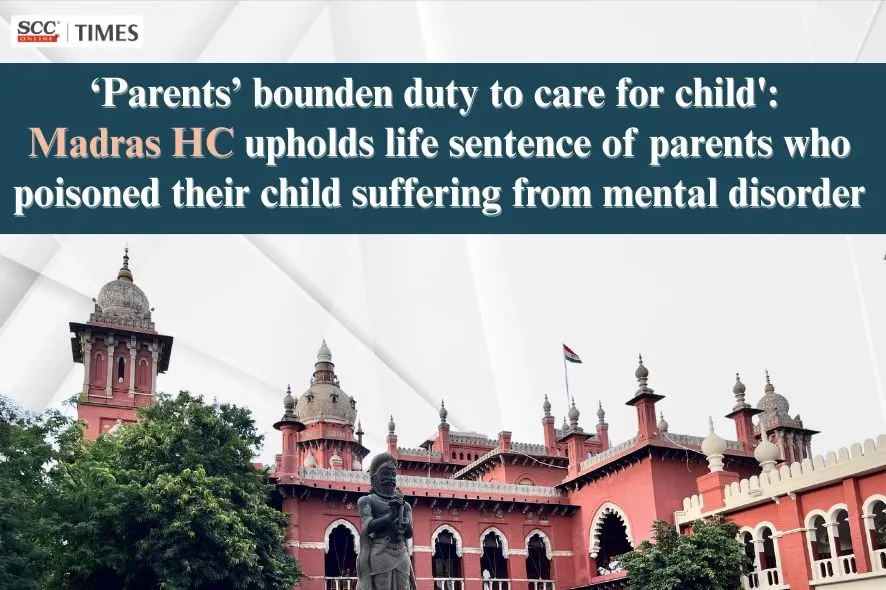
Madras High Court: In a criminal appeal under Section 374(2) of the Criminal Procedure Code, 1973 (‘CrPC’), the Division Bench of G. Kilanthiraiyan and R. Poornima*, JJ., upheld the conviction of the accused parents for administering poison to their daughter, despite the viscera report not detecting any poison. The Court underscored that medical evidence, documentary records, and the admissions made by the accused parents themselves conclusively established that the child died due to organophosphorus poisoning. Accordingly, the Court confirmed the conviction and the sentence of life imprisonment imposed by the Trial Court.
Background:
The case arose from an incident on 01-10-2018, when the accused parents administered Tafgor poison mixed in a cool drink to their mentally disabled daughter at Kathappasamy Temple. The daughter was admitted to hospital but succumbed on 06-10-2018. The Trial Court convicted the accused parents under Sections 342 and 302 of the Penal Code, 1860 (‘IPC’) and sentenced them to life imprisonment.
In appeal, the accused parents contended that several eyewitnesses had turned hostile, the Trial Court relied only on circumstantial evidence, and the post-mortem report did not conclusively establish poisoning. They further argued that the receipt evidencing purchase of poison was inadmissible as secondary evidence, and that the delay in lodging the complaint weakened the prosecution case.
The prosecution, however, emphasised that the accused parents themselves admitted before doctors that they had administered poison, which was duly recorded in the hospital register. The fertilizer shop owner categorically confirmed the purchase of Tafgor poison, and medical testimony consistently pointed to poisoning as the cause of death.
Analysis and Decision:
The Court emphasised that the deceased daughter was in the exclusive custody of her accused parents, and they themselves admitted her to hospital stating that poison had been administered. The Court noted that the Accident Register clearly recorded the admission by the appellants that they mixed Tafgor poison in a cool drink and gave it to the child. The Court further observed that the fertilizer shop owner categorically deposed that poison was purchased by one of the appellants and the doctors consistently testified that the clinical symptoms and treatment records were consistent with organophosphorus poisoning.
The Court emphasised that the daughter was in the exclusive custody of her accused parents, who themselves admitted the child to the hospital stating that they administered poison to her. The Court noted that the accused parents neither lodged any complaint nor claimed that the poisoning was accidental or caused by a third party. The Court highlighted that when a person is in the exclusive custody of the accused, it is their legal duty to explain the circumstances leading to the death and in the present case at hand the accused parents failed to offer any plausible explanation.
Though it is a settled principle of law that a negative viscera report is not automatically fatal to the prosecution case, particularly when the victim had undergone prolonged medical treatment. In cases where the victim survives for several days after consuming poison and receives treatment, the poison may be metabolized or eliminated from the body before death. Further, certain poisons are difficult to detect through routine forensic screening. However, the Court referred to Buddhadeb Saha v. State of W.B., (2024) 14 SCC 376, wherein it was held that lack of positive evidence would not result in throwing out the entire prosecution case, if the other circumstances clearly point out the guilt of the accused.
The Court observed that the absence of poison in the viscera report does not weaken the prosecution case since the evidence on record conclusively establishes that the father purchased the poison from the fertilizer shop owner, and the mother admitted before the doctor that both the accused parents had administered the poison to their daughter. The Court further noted that the prosecution examined several eyewitnesses to prove the offence, many of them turned hostile. It was however observed that the medical evidence clearly proves that the child died due to poisoning administered by the accused.
Finally, the Court underscored that while it sympathised with the accused parents for the difficulties they faced in bringing up the daughter, it must be borne in mind that the daughter did not come into this world on her own but was born to the accused parents themselves. The Court remarked that if the law permits the accused parents to eliminate the children born with mental retardation, no such child would survive in this world. The Court emphasised that it is the bounden duty of the accused parents to take care of their child, whether the child is born with mental illness, physical disability, or without any disability at all.
The Court concluded that the Trial Court rightly convicted the accused parents for murder, and the appeal lacked merit. The criminal appeal was accordingly dismissed, and the conviction and sentence of life imprisonment were confirmed.
[S. Muneeswaran v. State of Madras, 2026 SCC OnLine Mad 1491, decided on 13-02-2026]
*Judgment authored by: Justice R. Poornima
Advocates who appeared in this case :
For the Appellants: M. Jegadeesh Pandian
For the Respondent: R.M. Anbunithi, Additional Public Prosecutor