
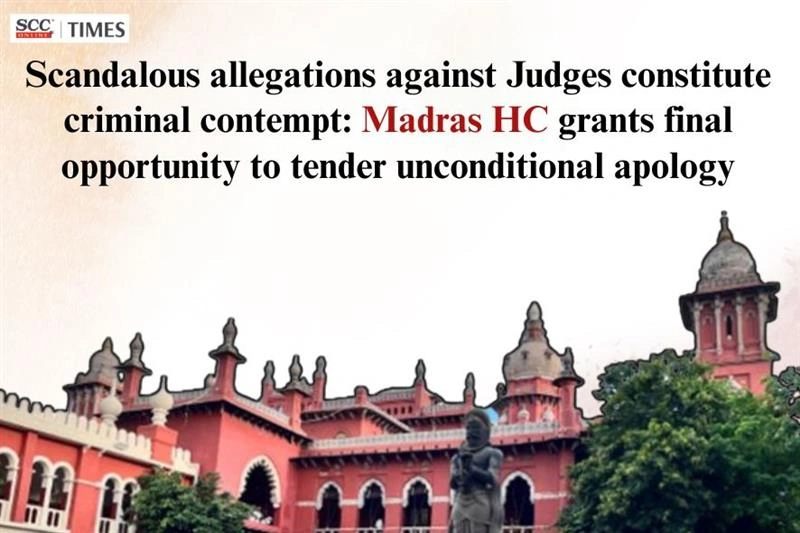
Madras High Court: In contempt proceedings under the Contempt of Courts Act, 1971 (‘Contempt of Courts Act’), the Division Bench of P. Velmurugan* and M. Jothiraman, JJ., held that repeated imputations of genocide and crime against humanity against Judges scandalised the institution and interfered with the due course of judicial proceedings. The Court emphasised that the persistent use of such allegations, despite repeated cautions, amounted to criminal contempt. It found the contemnor guilty but granted one final opportunity to purge the contempt by filing an affidavit of unconditional apology.
Background:
The case originated from a writ petition filed in 2017, which was dismissed in 2019. During those proceedings, the contemnor, appearing in person, alleged that a Judge had committed genocide and crime against humanity on a scale unknown to mankind. It was noted that similar allegations had been made against more than twenty Judges, resulting in their recusal.
Taking serious note of these statements, the Court directed initiation of contempt proceedings, and charges were framed under Section 2(c)(i) and 2(c)(ii) of the Contempt of Courts Act. Despite repeated cautions, the contemnor continued to reiterate the same allegations before different Benches.
In the present proceedings, a reply statement was filed demanding that the Judges tender an unabashed apology, make payment of compensation, and recuse from hearing any case in which the contemnor is a party in future. It was observed that the reply contained no apology.
Analysis and Decision:
The Court emphasised that the repeated making of scandalous allegations against the Court and its Judges, coupled with the use of intemperate and unwarranted expressions in the course of judicial proceedings, amounts to scandalising the Court and interferes with the due course of judicial proceedings and the administration of justice.
The Court observed that even after sufficient opportunity was afforded to the contemnor to respond to the charges, he, in his reply statement, reiterated his earlier stand and attempted to justify the allegations made. The Court noted that instead of expressing regret or tendering an apology, he persisted with such allegations and even called upon the Court to tender an apology. Such a stand, the Court held, reflects continued defiance and the absence of any sincere attempt to purge the contempt.
Accordingly, the Court held that the charges framed against the contemnor stood proved and that he had committed contempt of Court. However, the Court granted one final opportunity to the contemnor to file an affidavit tendering an unconditional apology. The Court emphasised that the affidavit must clearly express genuine regret and contain an undertaking that no such allegations or statements would be made in the future, and this affidavit of apology must be filed on or before the next date of hearing.
The Court further warned that, in the event the contemnor failed to file such an affidavit within the time granted, it would proceed to impose appropriate punishment under Section 12 of the Contempt of Courts Act, including a sentence of simple imprisonment for a period of one month.
[High Court of Madras v. T. Ashok Surana, 2026 SCC OnLine Mad 1188, decided on 10-02-2026]
*Judgment authored by: Justice P. Velmurugan
Advocates who appeared in this case:
For the Petitioner: V. Vijaya Shankar
For the Respondents: T. Ashok Surana, Party-in-Person