


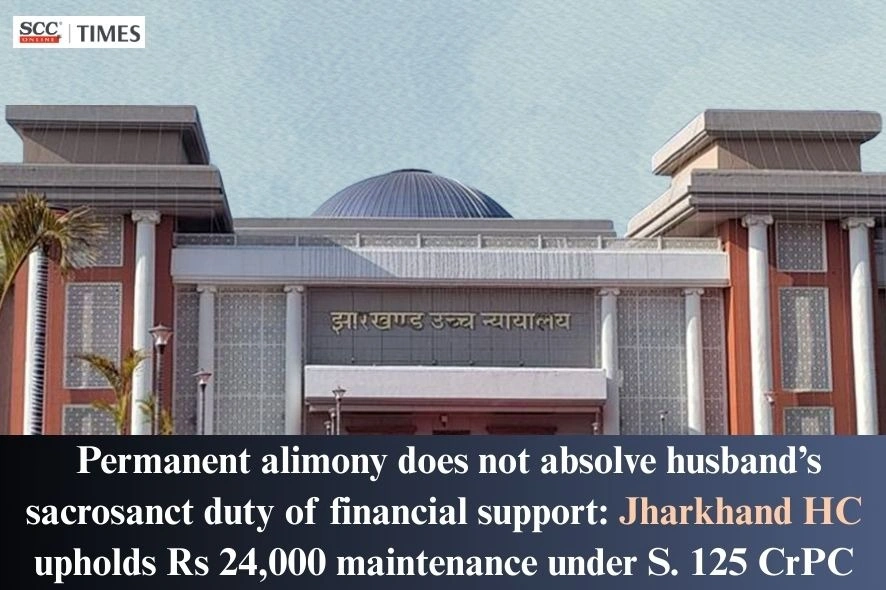
Jharkhand High Court: While considering criminal revision petitions under Section 125 of the Criminal Procedure Code, 1973, (‘CrPC’), a Single Judge Bench of Sanjay Kumar Dwivedi, J., observed that the wife, who sought enhancement of maintenance, and the husband, who sought quashing of the order, were not entitled to relief. The Court emphasised that proceedings under Section 125 CrPC are of a summary nature intended to prevent vagrancy and destitution, and held that the Family Court had rightly awarded Rs 24,000 per month in favour of the wife. The Court further underscored that permanent alimony does not absolve the husband’s sacrosanct duty of financial support, and accordingly dismissed both petitions.
Background:
The marriage was solemnised in 1985 according to Hindu rites. Initially cordial, the relationship soured during their stay abroad, leading to separation in 2006. The wife alleged degrading remarks, altercations, and even physical assault, after which she left the matrimonial home. She later approached the Mahila Aayog in 2014, which advised her to file a petition under Section 125 CrPC.
In her petition, she sought Rs 60,000 per month, citing her husband’s substantial income as a renowned neuro physician with a clinic in Patna. The Family Court awarded Rs 24,000 per month. The wife contended that the amount was meagre given his income and assets.
On the other hand, the husband argued that he had already paid interim maintenance, permanent alimony of Rs 20 lakhs pursuant to a divorce decree, and had borne the expenses of their daughters’ education and marriage. He claimed reduced income and sought setting aside of the order.
Analysis and Decision:
The Court highlighted that proceedings under Section 125 CrPC are of a summary nature, intended to prevent vagrancy and destitution. It was observed that Section 125 CrPC was conceived to ameliorate the agony, anguish, and financial suffering of a woman who left her matrimonial home for the reasons provided in the provisions, so that some suitable arrangements could be made by the court and she could sustain herself and also her children if they were with her. The Court observed that the concept of sustenance does not necessarily mean to lead the life of an animal, feel like an unperson to be thrown away from grace, and roam for her basic maintenance somewhere else.
The Court emphasised that she is entitled in law to lead a life in the similar manner as she would have lived in the house of her husband, as that is where the status and strata come into place, and that is where the obligations of the husband, in case of a wife, become prominent. In a proceeding of this nature, the husband cannot take subterfuges to deprive her of the benefit of living with dignity.
The Court remarked that, regard being had to the solemn pledge at the time of marriage and also in consonance with the statutory law that governs the field, it is the obligation of the husband to see that the wife does not become a destitute or a beggar. The Court emphasised that, regard being had to the solemn pledge at the time of marriage and also in consonance with the statutory law that governs the field, it is the obligation of the husband to see that the wife does not become a destitute or a beggar.
The Court highlighted that it is the sacrosanct duty to render financial support even if the husband is required to earn money through physical labour, if he is able-bodied as there is no escape route unless there is an order from the court that the wife is not entitled to get maintenance from the husband on any legally permissible grounds.
The Court noted that the Family Court had considered the liabilities of both sides, including the husband’s responsibility towards his daughters. It was further observed that the divorce decree had directed payment of Rs 20 lakhs as permanent alimony, which had already been deposited.
In view of the above, the Court concluded that the Family Court had rightly allowed Rs 24,000 per month in favour of the wife. Accordingly, the criminal revision filed by the wife and the criminal revision filed by the husband stood dismissed, and the pending petitions also stood disposed of.
[X v. Y, 2026 SCC OnLine Jhar 206, decided on 02-02-2026]
Advocates who appeared in this case:
For the Petitioner: Nikhil Ranjan, Advocate
For the Opposite Party: Vani Kumari, Advocate
For the State: Achinto Sen, Advocate
Buy Code of Criminal Procedure, 1973 HERE


So marriage is punishment for husband?
How does this empowers woman? By punishing man? If she has already taken 20lak monthly amount is also needed? Then why giving 20lak… So woman just have to marry there life is settled? They don’t have to work?