
Disclaimer: This has been reported after the availability of the order of the Court and not on media reports so as to give an accurate report to our readers.
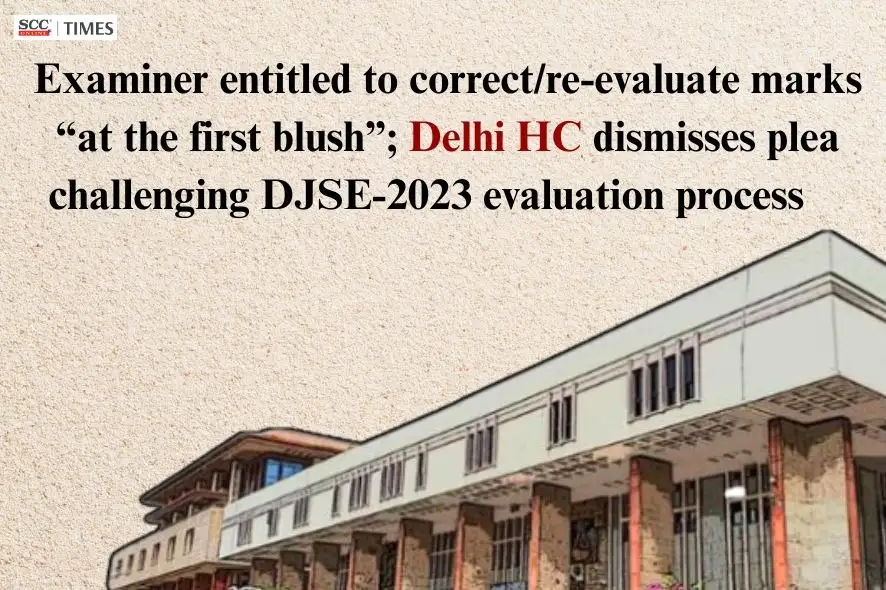
Delhi High Court: In a writ petition challenging the evaluation process of the Delhi Judicial Services Examination, 2023 (DJSE-2023), where the petitioner alleged unlawful alteration and reduction of marks after the initial assessment of her answer script, a Division Bench of C. Hari Shankar and Om Prakash Shukla, JJ., found no justification to restore the alleged original marks or to direct re-evaluation of the impugned answers.
The Court held that in the absence of mala fide, bias, or demonstrable material error, alteration of marks in subjective answers by an examiner prior to final submission of answer scripts does not warrant judicial interference, particularly where re-evaluation is expressly prohibited by statutory rules and interference would unsettle concluded appointments.
Factual Matrix
In the instant matter, the petitioner participated in the selection process conducted under the Delhi Judicial Services Rules, 1970 (DJS Rules). Pursuant to the notification dated 06-11-2023, applications were invited for 53 vacancies in the Delhi Judicial Service. The Mains Examination was conducted on 13 and 14-04-2024. The results were declared on 07-01-2025, following which 153 candidates, including the petitioner, were shortlisted for viva-voce.
The final result was declared on 04-03-2025. The petitioner was placed at Rank No. 45 overall and Serial No. 12 on the waiting list, having secured 605 marks. The last selected candidate in the General category had secured 615 marks, while the first wait-listed candidate had secured 612 marks.
Upon being declared unsuccessful, the petitioner sought copies of her answer scripts under the Right to Information Act, 2005, which were furnished in May 2025. On scrutiny of her Paper-I (Legal Knowledge and Language) answer booklet, the petitioner noticed that the marks awarded for Question Nos. 5 and 8 had been overwritten and reduced. According to the petitioner, Question No. 5 was reduced from 25 to 15 marks, and Question No. 8 from 30 to 20 marks. Correspondingly, the aggregate marks on the front page were altered from 191 to 171, and thereafter corrected to 169.
The petitioner contended that while the correction from 171 to 169 could be attributed to an arithmetical adjustment, the reduction of twenty marks was arbitrary, unexplained, and unsupported by any permissible procedure. She asserted that the alteration had materially affected her position in the merit list and sought restoration of the originally awarded marks and consequential revision of the final result.
Moot Points
-
Whether the reduction of marks in the petitioner’s Paper-I answer script amounted to arbitrary or impermissible interpolation warranting interference under Article 226 of the Constitution of India?
-
Whether a Writ Court could direct restoration of marks or re-evaluation in view of the express prohibition contained in the DJS Rules?
-
Whether interference at this stage would unjustly unsettle concluded appointments?
Parties’ Contentions
The petitioner contended that once the marks were totalled and recorded on the front page of the answer booklet in figures and words, the examiner became functus officio and lacked authority to alter the same. It was urged that the successive overwriting of marks, first in individual questions and thereafter in the aggregate, could not be characterised as a bona fide correction “at the first blush”.
The petitioner placed reliance on K.K. Wadhwani v. Sunita Singh, 2005 (23) LCD 548, and submitted that interpolation of marks vitiates the evaluation process. It was further argued that the unexplained alteration of marks violated principles of fairness and non-arbitrariness, and that the Writ Court retained the power to intervene where the decision-making process was tainted.
On the other hand, the respondents contended that evaluation of subjective answers lies within the exclusive domain of the examiner and that, in the absence of any allegation of mala fide, bias, or fraud, judicial review was impermissible. It was submitted that there was no prohibition against an examiner revising marks before submission of answer scripts to the examining authority. Reliance was placed on Nirmala Singh v. High Court of Delhi, 2023 SCC OnLine Del 4143, to submit that the examiner is entitled to change marks awarded “at the first blush”.
It was further argued that Rule 15 of the DJS Rules expressly prohibits re-evaluation, and that any interference would disturb settled appointments, particularly when selected candidates had already joined service after altering their positions irreversibly.
Court’s Analysis
The Court held that the petitioner’s allegation of “interpolation” carried an imputation of mala fide, which had neither been pleaded nor established. The Court held that in the absence of any allegation of bias, fraud, or extraneous consideration, the use of such terminology was unwarranted.
Reiterating settled principles, the Court emphasised that courts must exercise restraint in academic matters and refrain from substituting their own assessment for that of expert examiners. The Court noted that the answers in Question Nos. 5 and 8 were purely subjective, and there existed no objective or infallible standard by which the Court could determine whether the initial or revised marks were correct.
The Court rejected the contention that marks became immutable once tabulated on the front page. Relying on Nirmala Singh (Supra), the Court held that the expression “first blush” could not be construed narrowly so as to denude the examiner of authority to revisit marks while the evaluation process was still ongoing. To hold otherwise would impose an artificial and impractical constraint on academic evaluation.
The Court further noted that the Appendix to Rule 15 of the DJS Rules unequivocally prohibits re-evaluation. Applying the principles laid down in Ran Vijay Singh v. State of U.P., (2018) 2 SCC 357, i.e., “merits reiteration, sympathy cannot govern the examination process”, the Court held that judicial interference is permissible only in rare and exceptional cases involving demonstrable material error, which was absent in the present case.
On the aspect of equities, the Court observed that the petitioner had not challenged the appointment notification dated 13-08-2025 and that the selected candidates were innocent appointees against whom no allegation of fraud or illegality had been made. Disturbing their appointments at this stage would be inequitable and contrary to settled principles of service jurisprudence.
“While individual grievances may arise, redressal must be balanced against the larger imperative of preserving fairness, stability, and integrity of the selection system.”
The Court cautioned that permitting re-evaluation in such circumstances would open floodgates and lead to cascading consequences, thereby undermining stability and predictability in public appointments.
“Any direction for re-evaluation would necessarily require extending such exercise to all similarly placed candidates to maintain parity, thereby disturbing concluded selections and disrupting inter se seniority… Judicial interference in such circumstances would open floodgates, leading to cascading consequences and rendering the process unworkable.”
Court’s Decision
The Court held that the petitioner had failed to establish any material error, arbitrariness, or exceptional circumstance warranting judicial interference. The reduction of marks in subjective answers, made prior to finalisation of results and in the absence of mala fide, did not justify restoration of marks or re-evaluation.
Accordingly, the Court dismissed the writ petition with no order as to costs.
[Prerna Gupta v. Registrar General of Delhi High Court, 2026 SCC OnLine Del 459, Decided on 06-02-2026]
*Judgment by Justice Om Prakash Shukla
Advocates who appeared in this case:
Ms. Kanika Agnihotri, Mr. Vidit Pratap Singh and Ms. Khushi Anand, Advs. for DHC.
Mr. Sanjai Kumar Pathak, Ms. Shashi Pathak, Mr. Arvind Kumar Tripathi, Mr. Robin Kumar, Ms. Shweta Jayshankar Dwivedi and Ms. Smriti Singh, Counsel for the Respondent 2 and 3
Mr. Naveen Nagarjuna, Counsel for the Respondent 5
Mr. Abhin Narula, Counsel for the Respondent 6