
Disclaimer: This has been reported after the availability of the order of the Court and not on media reports so as to give an accurate report to our readers.
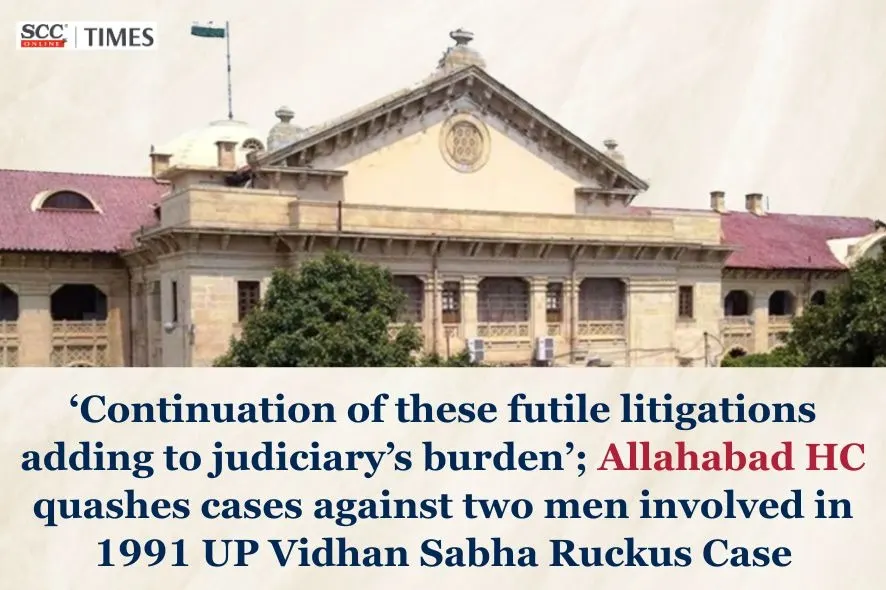
Allahabad High Court: In a set of two applications seeking quashing of proceedings filed by accused persons who had been implicated in the 1991 UP Vidhan Sabha Ruckus Case, the Single Judge Bench of Pankaj Bhatia, J., allowed the applications due to the absence of any material to prosecute the accused persons under the charged Sections, the inordinate delay in the trial, and the futility of the litigation.
Background
On 15-02-1991, the informant was on duty in front of the UP Vidhan Sabha, when the present accused persons arrived with 30-40 people and started creating a ruckus, wanting to open the door to enter the Vidhan Sabha Parishad. Some people climbed over the boundary wall and entered the premises, while others left after breaking items, including windshields and lights. While some of the people were apprehended, the rest fled away.
Thus, an FIR was lodged, and after investigation, a charge sheet was filed under Sections 147, 353, 452, 427 of the Penal Code, 1860 (“IPC”), read with Section 7 of the Criminal Law (Amendment) Act, 1932, and Section 2 of the Prevention of Damages to Public Property Act, 1984.
Thereafter, cognizance was taken by the Trial Court, but not even one witness was examined for three decades, and none of the accused had been served. Additionally, all the prosecution witnesses were officers on duty, most of whom have retired.
Aggrieved, the accused persons herein filed the present applications seeking the quashing of the proceedings.
Considering the allegations, the Court took notice of the huge amounts of litigation pending, which were futile due to the passage of time, unavailability of the witnesses, etc. The Court opined that such litigations were unnecessarily draining the State’s resources and passed detailed orders to that effect on various dates.
The Court also took note of the State’s submission that the State was trying and was contemplating the creation of a policy for withdrawing these kinds of stale cases, which have outlived their utility and have no chances of prosecution.
In terms of the said order passed by the Court, an affidavit was filed by the State stating that after considering the policies framed by various States, it had constituted a committee headed by Additional Advocate General (“AAG”) for issuing directives for efficient and effective management of stale/futile cases by the State Government, which was in furtherance of the directives given by the Government of India.
The AAG informed the Court that the Committee was contemplating various measures and is in seisin for formulating a case management policy; however, no such decision had been taken so far.
Analysis
The Court noted that the accused persons were not present and could not be served despite warrants being issued on several occasions, as reflected in the order sheet. The Court stated that the trial had continued to lag from 1994 to 2024 when the present applications were filed.
On perusal of the allegations and the material collected, the Court stated that prima facie, the material to suggest the use of violence by an unlawful assembly in prosecution of a common object of such assembly was missing in the FIR, the charge sheet, and the evidence. Thus, the prosecution of the accused persons under Section 147 of the IPC could not be made out.
Similarly, for prosecuting the accused persons under Section 353 of the IPC, the Court held that there was no material in the charge sheet or FIR to suggest assault or use of criminal force to deter the public servant from discharge of his duty.
Regarding Section 452 of the IPC, the Court stated that it is essential that the building which is said to be trespassed should be used as a human dwelling, or is a place for worship, or is in the custody of the property. However, in the present case, the accused persons tried to enter the Vidhan Sabha Parishad. Furthermore, the Court noted that there were no allegations that any preparations were made, which are sine qua non for punishing a person under Section 452 of the IPC.
The Court further noted that the charge for Section 427 of the IPC was not justified as there was no material regarding which property was damaged. Thus, the Court held that on plain reading of the FIR and the charge sheet, the material to punish the accused persons under the said sections was missing.
Additionally, the Court held that the delay in trial was adversely affecting the rights of a speedy trial vested by virtue of Article 21 of the Constitution, and on that ground, also, the proceedings were liable to be quashed. The continuation of trials, which are eventually going to be a futile exercise, was evident from the fact that the only witnesses proposed to be examined as per the charge sheet were police officers who were either retired or not present.
Thus, the Court quashed the proceedings due to the absence of any material to prosecute the accused persons under the charged Sections, the inordinate delay in the trial, and the futility of the litigation.
As regards the directions given by the Court for the formulation of a policy, the Court remarked that continuation of these kinds of proceedings was leading to a waste of the precious resources available to the judiciary.
“It is common knowledge that the judiciary is starved of the resources to meet the growing explosion of litigation. Continuation of these futile litigations is adding to the burden on the judiciary.”
The Court further remarked that it was expected that the Committee would come up with an effective solution to weed out the futile litigations and the State would act in furtherance of its suggestions so that the efficiency with which the judiciary should function is restored and the deadwood is chiselled off from the overgrowing dockets of the District Courts.
[Madhukar Sharma v. State of U.P., 2026 SCC OnLine All 115, decided on 28-01-2026]
Advocates who appeared in this case:
For the petitioner: Anshul Verma, Ali Bin Saif, Himanshu Suryavanshi
For the respondent: A.A.G. V.K. Shahi, G.A. Dr. V.K. Singh, A.G.A. – I Bhanu Pratap Singh, and A.G.A Arun Kumar Verma
Buy Penal Code, 1860 HERE

Buy Constitution of India HERE