
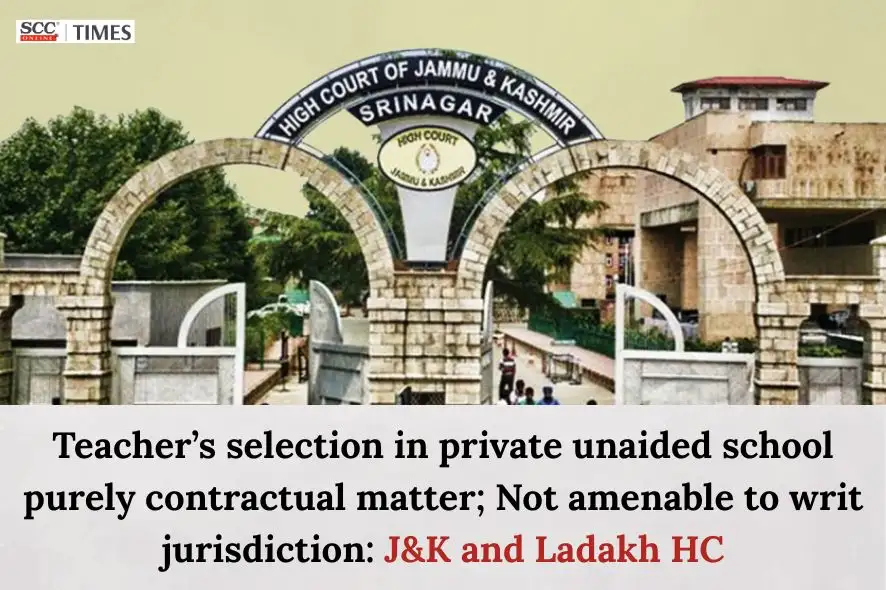
Jammu & Kashmir and Ladakh High Court: Clarifying the scope of writ maintainability against private unaided school authorities in matters arising from contractual service engagements, a Single Judge Bench of Sanjay Dhar, J., held that a teacher’s selection in a private unaided school is a purely contractual matter falling within the realm of private law and, therefore, not amenable to writ jurisdiction, as such institutions come under Article 226 of the Constitution only when their actions involve a public duty. Consequently, the Court dismissed the writ petition as not maintainable.
Background:
The petitioner had joined as a primary teacher in Maharaja Hari Singh DAV Centenary Public School (‘School’) on 4-4-2014. She had nine years of continuous service without any complaint against her. In March 2023, Respondent 4 had issued an advertisement for the post of Primary Teacher to which the petitioner responded. She joined her service in April 2023 but in July 2023, a fresh advertisement was issued by Respondent 4 for the session 2023-2024.
After appearing before the selection committee, the petitioner’s name did not figure in the select list and was kept in the waiting list. She submitted that most of the candidates in the select list did not possess the requisite qualification, had not undergone B.Ed. course, and were not CTET qualified. She made a representation to the School’s management about her arbitrary rejection but without any success. The petitioner filed the present petition and challenged the select list of primary teachers issued in July 2023 by the School’s administration, seeking a direction to her allow continuation as primary teacher and not to replace her with another contractual teacher.
The Union Territory and CBSE filed replies asserting that they were not concerned with the selection process and that a writ petition against the School was not maintainable. The Chairman and Principal of the School also raised a preliminary objection that the relationship between employees and the School’s administration was contractual and fell within private law, and therefore, the petition was not maintainable. They also submitted that the petitioner was working on contractual basis with the School and her contractual tenure was complete.
It was further argued that the selection committee could appoint or reject a candidate based on his or her performance or merit. The petitioner was not selected as she could not satisfy the selection committee. It was also submitted that the petitioner had worked for nine years but her contractual appointment was never extended from time to time. She had applied at the end of each session for fresh appointment on contractual period for each session.
Analysis and Decision:
Regarding the preliminary objection as to maintainability of the writ petition, the Court noted that under Article 226 of the Constitution, the writ jurisdiction which extends to ‘any person or authority’ includes not only the statutory authorities and instrumentalities of the State but also ‘any person or authority’ performing public duties. The Court observed that private body or institution is also amenable to writ jurisdiction of the High Court even when it is not State within the meaning of Article 12 of the Constitution, if its action falls within the domain of public duty.
The Court referred to Andi Mukta Sadguru Shree Muktajee Vandas Swami Suvarna Jayanti Mahotsav Smarak Trust v. V.R. Rudani, (1989) 2 SCC 691, where it was emphasised that writs may be issued to bodies performing public duties, except in cases where rights were purely private or the management was purely private with no public duty. The Court relied on Binny Ltd. v. V. Sadasivan, (2005) 6 SCC 657, wherein it was held that a writ of mandamus can lie against a private body “but there must be a public law element, and it cannot be exercised to enforce purely private contracts entered into between the parties”.
The Court also relied on St. Mary’s Education Society v. Rajendra Prasad Bhargava, (2023) 4 SCC 498, and observed that while a private body like the School would be amenable to writ jurisdiction of the High Court under Article 226 of the Constitution but the judicial review of its actions by the High Court would be confined to only those actions which have the element of public duty whereas, its actions which have the character of private law rights are not amenable to the writ jurisdiction.
The Court noted that the selection of teachers by a private unaided school results in creation of a contract of service between the school and the selected teacher, which falls within the realm of private law. The Court opined that the rights arising in favour of candidates participating in the selection process are private rights, which cannot be enforced against an institution which is neither a State nor an instrumentality of the State by way of a writ petition. The Court referred to Showkat Ahmad Rather v. State (UT of J&K), 2022 SCC OnLine J&K 837, wherein it was held that a writ petition for enforcement of private contract of service is not maintainable.
Accordingly, the Court, while dismissing the petition, held that it was not maintainable and left it open to the petitioner to work out appropriate remedy.
[Malika v. State (UT of J&K), 2026 SCC OnLine J&K 66, decided on 27-1-2026]
Advocates who appeared in this case:
For the Petitioner: Nitin Verma, Advocate.
For the Respondents: Monika Thakur, Assisting Counsel vice Ravinder Gupta, AAG, Karan Singh vice Vipan Gandotra, Rajat Gupta.
Buy Constitution of India HERE